Steel Framing Hammer Guide: LGS Mallets vs Structural Spud Wrenches
Discover the right steel framing hammer for your project. Compare LGS dead blow mallets and structural steel spud wrenches for ironworkers.
The Myth of the Universal Steel Framing Hammer
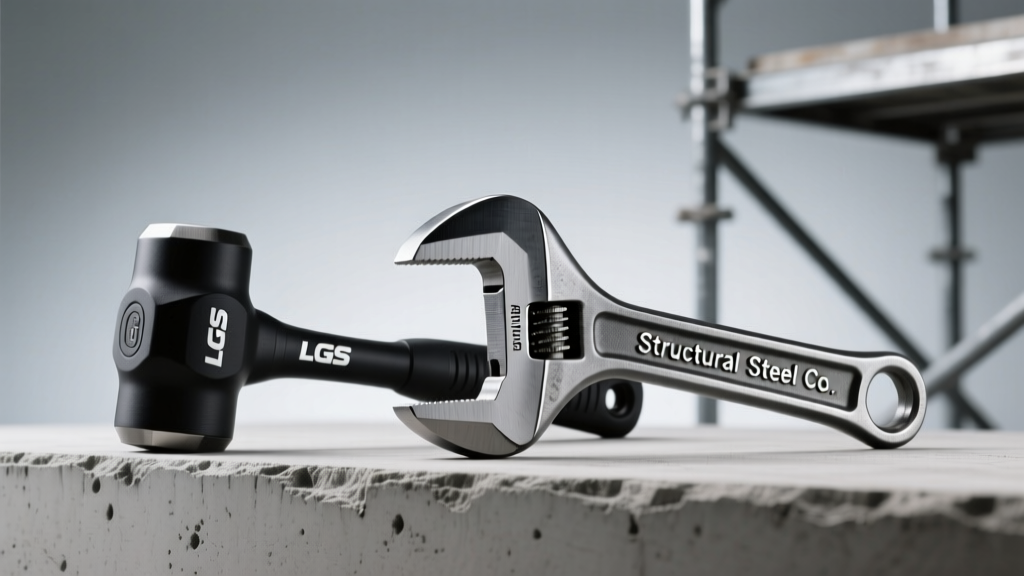
Walk onto a wood-framing job site, and the 22-ounce steel claw hammer is the undisputed king. But in steel construction, the term "steel framing hammer" is a misnomer that confuses many transitioning contractors. Steel framing splits into two entirely different disciplines: Light Gauge Steel (LGS) framing for interior and exterior walls, and heavy structural steel erection for commercial frameworks. Neither discipline uses a traditional claw hammer. In fact, using a standard steel-faced hammer on light gauge studs will destroy the galvanized coating, while using a lightweight mallet on structural I-beams will fail to move the mass. This guide breaks down the exact impact tools, mallets, and spud wrenches required for both ends of the steel framing spectrum, detailing specific models, striking physics, and field applications.

Light Gauge Steel (LGS) Framing: Why Claw Hammers Fail
Light gauge steel studs (typically 20-gauge to 25-gauge, ranging from 0.0329 to 0.0179 inches thick) are coated with a G60 or G90 zinc galvanization layer to prevent corrosion. The Steel Framing Industry Association (SFIA) strictly advises against using hardened steel striking faces on LGS components. A standard claw hammer spalls the zinc coating upon impact, exposing the bare cold-rolled steel underneath to moisture and guaranteeing premature rust failure inside the wall cavity.
The Dead Blow Hammer and Non-Marring Mallets
When an LGS framer needs to tap a 25-gauge track into alignment over a slightly uneven concrete slab, or seat a stubborn stud into a track channel, they reach for a dead blow hammer or a polyurethane mallet. Dead blow hammers are engineered with a hollow head partially filled with steel or lead shot. Upon impact, the shot shifts forward, transferring maximum kinetic energy while eliminating the rebound bounce that causes secondary surface damage.
Top LGS Striking Tools for 2026
- Malco FMT1 Non-Marring Mallet: Features a replaceable polyurethane head. Ideal for daily LGS track adjustment. (Avg. Cost: $28)
- Vaughan 16 oz. Soft Face Dead Blow Hammer: The industry standard for residential steel framing. The 16 oz weight provides enough force to seat 20-gauge studs without denting the web. (Avg. Cost: $18)
- Klein Tools 30724CR Rubber Mallet: A heavier 24 oz option for commercial metal stud partitions where 16-gauge tracks require more persuasive impact. (Avg. Cost: $32)
Structural Steel Framing: Spud Wrenches and Beating Hammers
Heavy structural steel framing relies on hot-rolled W-shapes, I-beams, and HSS (Hollow Structural Sections). Ironworkers connecting these massive members do not use mallets. They use specialized leverage and striking tools, primarily the spud wrench and the drilling hammer (often referred to in the trade as a beating hammer or structural framing hammer).
Anatomy of an Ironworker's Spud Wrench
The spud wrench is the quintessential structural steel framing hammer. It features a box or open-end wrench on one side for tightening structural bolts, and a long, tapered pin (the "spud") on the other. The spud is driven through misaligned bolt holes in shear connections using a separate striking tool, acting as a lever to pry the heavy steel plates into perfect alignment. The handle is often forged with a mallet-like striking surface or used in conjunction with a 4-pound drilling hammer.
| Tool Type | Specific Model | Weight / Length | Primary Application | Est. Price |
|---|---|---|---|---|
| Spud Wrench (Standard) | Klein Tools 3218 | 18-inch / 2.6 lbs | Aligning bolt holes, tightening 3/4" to 1-1/8" nuts | $45 |
| Offset Spud Wrench | Channellock 3214 | 14-inch / 1.8 lbs | Tight spaces, HSS tube steel connections | $38 |
| Drilling / Beating Hammer | Stanley 56-804 | 4 lbs / 11-inch handle | Striking spud pins, driving drift pins through gusset plates | $25 |
| Ironworker's Reamer | Klein Tools 3288 | 18-inch / 3.1 lbs | Enlarging misaligned holes, heavy prying | $55 |
Powder-Actuated "Hammers": Fastening Steel Tracks
In commercial construction, the phrase "hammering the track" often refers to using a powder-actuated fastening system to pin the bottom steel track directly into a concrete slab. While colloquially called "powder hammers," these are highly regulated ballistic tools. According to OSHA Standard 1926.302, only certified operators may use powder-actuated tools, and they must utilize specific low-velocity loads when fastening light gauge steel tracks to prevent the fastener from blowing completely through the thin steel and shattering the concrete substrate.
The American Institute of Steel Construction (AISC) notes that while mechanical anchoring (wedge anchors) is preferred for heavy structural base plates, powder-actuated pins remain the standard for non-load-bearing LGS partition tracks due to the massive time savings—reducing track installation time by up to 70% compared to rotary hammer drilling.
Maintenance and Galvanization Preservation
Tool maintenance in steel framing directly impacts the longevity of the building materials. When using dead blow hammers on LGS, the polyurethane faces eventually pick up microscopic zinc shards and concrete dust. If not cleaned, these embedded abrasives will act like sandpaper on the next stud you strike, stripping the G90 coating. Wipe mallet faces daily with a solvent like mineral spirits. For structural spud wrenches, the tapered pins must be kept free of rust and burrs. A burred spud pin will gouge the inside of the bolt hole, potentially compromising the friction-grip capacity of high-strength A325 or A490 structural bolts.
Frequently Asked Questions
Can I use a standard rubber mallet for structural steel erection?
No. Rubber mallets lack the necessary mass and density to move structural W-shapes or drive drift pins. Ironworkers rely on 4 lb to 8 lb steel drilling hammers (beating hammers) for structural impact tasks.
What is the best hammer for metal stud framing beginners?
Beginners should start with a 16 oz polyurethane dead blow hammer. It provides a forgiving strike that minimizes bounce-back, reducing the chance of accidentally denting the drywall-facing flange of the steel stud.
Do I need a hammer at all if I use a pneumatic pin tool?
Pneumatic and powder-actuated tools replace the hammer for track-to-concrete fastening, but a dead blow mallet is still required for plumbing walls, tapping studs into tight tracks, and adjusting top tracks during layout corrections.
Written by
Priya KapoorPriya Kapoor is a real estate market analyst and construction economics researcher with expertise in housing affordability, development feasibility, and infrastructure investment. She holds a Master of Regional Planning from Cornell University and previously worked as a senior analyst at CBRE's Investment Properties group, where she modeled returns for $4B in mixed-use development pipelines. Priya now runs an independent research practice advising developers, municipalities, and REITs on construction cost forecasting and market timing. She publishes the quarterly "BuildMat Market Pulse" report tracking material price indices across 12 commodity categories. Based in Austin, TX, Priya serves on the board of Habitat for Humanity Austin and is a marathon runner.
More from Priya Kapoor
View all
Construction Cost
Cost to Build a 1600 Sq Ft Home in 2026: Full Breakdown
Accurate 2026 cost to build a 1600 sq ft home—material, labor, and regional pricing breakdowns included. Plan your budget with real-time estimates.
Aug 11, 2026

Wood & Lumber
Name the Types of Wood for Pressure Treatment and Preservation
Learn how to name the types of wood best suited for pressure treatment. Compare species treatability, chemical retention levels, and 2026 preservation costs.
Aug 4, 2026

Stone & Masonry
Stone Veneer Suppliers Lindenhurst: 2026 Cost Analysis
Analyze 2026 stone veneer costs in Lindenhurst, NY. Compare local supplier pricing, delivery fees, and Suffolk County installation labor rates.
Aug 4, 2026