Galvanized Steel and Corrosion: Lifespan and Durability Analysis
Analyze galvanized steel and corrosion resistance. Explore ASTM coating classes, ISO 9223 lifespans, and time-to-first-maintenance data.
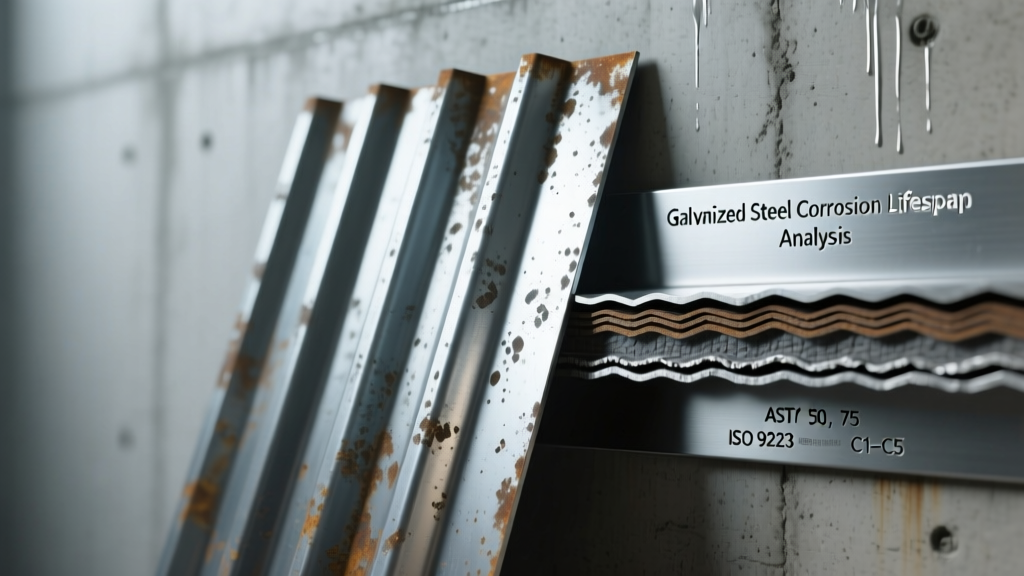
The Metallurgy of Zinc Coatings: How Galvanizing Actually Works
When evaluating galvanized steel and its long-term performance in aggressive environments, structural engineers must look beyond the surface-level crystalline spangle. Hot-dip galvanizing (HDG) is not merely a surface coating; it is a metallurgical bond. When structural steel is immersed in a molten zinc bath (typically at 830°F to 850°F), a series of iron-zinc alloy layers form perpendicular to the steel surface.
Understanding these layers is critical for predicting lifespan and failure modes:
- Gamma Layer (75% Zn, 25% Fe): The thinnest layer (1-2 microns) directly adjacent to the steel substrate. It provides the foundational metallurgical bond.
- Delta Layer (90% Zn, 10% Fe): A thick, ductile layer that absorbs mechanical shock and prevents coating flaking during transport and erection.
- Zeta Layer (94% Zn, 6% Fe): A hard, brittle layer that provides exceptional abrasion resistance.
- Eta Layer (100% Zn): The outermost layer formed as the steel exits the bath. It provides the initial physical barrier and the characteristic spangle appearance.
Because the zinc is anodic to steel, it provides dual protection: a physical barrier and galvanic (sacrificial) cathodic protection. Even if the coating is scratched down to the bare steel, the surrounding zinc will sacrificially corrode to protect the exposed iron, preventing localized red rust creep.
Decoding Coating Classes: ASTM Standards and Thickness Metrics
A common error in material specification is conflating continuous sheet galvanizing (ASTM A653) with structural batch galvanizing (ASTM A123). The lifespan of the steel is directly proportional to the zinc thickness. According to the American Galvanizers Association, the corrosion rate of zinc is linear; doubling the coating thickness effectively doubles the time-to-first-maintenance (TTFM).
| Standard / Designation | Application | Minimum Thickness (mils) | Minimum Thickness (µm) | Zinc Weight (oz/ft²) |
|---|---|---|---|---|
| ASTM A653 (G90) | Light-gauge sheet / metal studs | 0.76 mils (total both sides) | 19 µm | 0.90 |
| ASTM A653 (G185) | Heavy-gauge sheet / roofing | 1.57 mils (total both sides) | 40 µm | 1.85 |
| ASTM A123 (1/8 in. steel) | Structural shapes, plates | 2.8 mils (single side) | 71 µm | 2.00 |
| ASTM A123 (≥ 1/4 in. steel) | Heavy beams, columns | 3.9 mils (single side) | 99 µm | 2.80 |
| ASTM A153 (Hardware) | Fasteners, bolts, nuts | 1.8 mils (Class C) | 46 µm | 1.30 |
Note: For structural applications, always specify ASTM A123. Relying on G90 sheet goods for primary structural framing will result in premature corrosion in anything other than benign indoor environments.
Environmental Degradation: The ISO 9223 Framework
To accurately forecast the lifespan of galvanized steel, specifiers must categorize the project site using the ISO 9223 standard, which classifies atmospheric corrosivity from C1 (Very Low) to CX (Extreme). The Steel Construction Institute provides extensive data on how zinc consumption rates vary across these categories.
Zinc Consumption Rates by Environment
- C1 (Heated, clean indoor): < 0.1 µm/year. Lifespan exceeds 100+ years.
- C2 (Rural, unheated): 0.1 - 0.7 µm/year. Lifespan: 75 - 100 years.
- C3 (Urban, light pollution): 0.7 - 2.1 µm/year. Lifespan: 40 - 70 years.
- C4 (Industrial, moderate salinity): 2.1 - 4.2 µm/year. Lifespan: 20 - 40 years.
- C5 (Marine, heavy industrial): 4.2 - 8.4 µm/year. Lifespan: 10 - 20 years.
In a C5 marine environment, a standard 3.9-mil (99 µm) ASTM A123 coating will be consumed in approximately 12 to 23 years. If a 50-year lifespan is required in a C5 zone without maintenance, the steel must be duplex-coated (galvanized plus a specialized epoxy/polyurethane topcoat) or the zinc thickness must be augmented via thermal spraying.
Galvanized Steel and White Rust: The Hidden Lifespan Killer
While red rust (iron oxide) indicates structural degradation, white rust (zinc hydroxide and zinc oxide) is a storage and handling failure that can severely compromise the coating before the steel is even erected.
When newly galvanized steel is stacked tightly in wet, poorly ventilated conditions, the zinc cannot react with carbon dioxide in the air to form the stable, protective zinc carbonate patina. Instead, it forms a bulky, porous white powder (zinc hydroxide). This white rust can consume up to 20 times the volume of the original zinc, rapidly depleting the coating thickness.
Mitigation Protocol: Never stack freshly galvanized members flat on top of one another. Use timber dunnage to separate pieces, store at a 5-degree angle to promote water runoff, and specify chromate or non-chromate passivation treatments at the galvanizer if prolonged outdoor storage is anticipated prior to erection.
Time-to-First-Maintenance (TTFM) vs. Total Service Life
A critical distinction in lifecycle costing is the difference between TTFM and total service life. TTFM is defined as the point at which 5% of the surface exhibits red rust. For galvanized steel, reaching TTFM does not mean structural failure. Once the zinc is depleted, the steel begins to corrode at a predictable rate based on the environment. However, the cost of maintenance at the TTFM mark is where galvanized steel demonstrates its economic superiority.
Compared to a three-coat paint system (zinc-rich primer, epoxy intermediate, polyurethane topcoat), which typically requires its first major field maintenance at 15 to 20 years in a C3 environment, an equivalent HDG coating will easily achieve 50+ years to first maintenance in the same environment, effectively eliminating field maintenance costs for the lifecycle of the building.
Cost-Benefit Matrix: Initial Premium vs. Lifecycle Savings
In 2026 market conditions, the initial cost of hot-dip galvanizing structural steel ranges from $1.80 to $3.20 per square foot, depending on regional zinc commodity pricing and the complexity of the fabrication (e.g., internal venting requirements). While this represents a 15% to 25% initial premium over bare steel or basic shop primers, the lifecycle savings are substantial.
| Metric | Hot-Dip Galvanized (ASTM A123) | 3-Coat Paint System (SSPC) |
|---|---|---|
| Initial Applied Cost (per sq. ft.) | $2.40 - $3.20 | $1.80 - $2.50 |
| Time to First Maintenance (C3 Env.) | 50 - 70 Years | 15 - 22 Years |
| Field Touch-up Required During Erection? | No (ASTM A780 for damaged areas only) | Yes (Extensive touch-up of rigging damage) |
| 50-Year Lifecycle Cost (per sq. ft.) | $2.40 - $3.20 (Zero maintenance) | $6.50 - $9.00 (Includes 2 field repaints) |
Expert Specifications for Maximum Longevity
To ensure the theoretical lifespan of galvanized steel is achieved in practice, architects and structural engineers must incorporate specific fabrication and detailing requirements into their contract documents. Poor detailing leads to un-drained pockets, which cause acid entrapment during the pickling process and subsequent internal corrosion.
- Mandate ASTM A780 for Repairs: Specify that any field damage to the galvanized coating exceeding 1 inch in any dimension must be repaired using high-purity zinc-rich paint or zinc solder, applied to a thickness 50% greater than the original surrounding coating, per ASTM A780.
- Design for Drainage and Venting: Tubular sections (HSS) must have copes or holes at the lowest and highest points to allow zinc to flow freely and gases to escape. A minimum 1-inch diameter hole is required for most standard HSS sections to prevent explosive pressure buildup in the 840°F zinc bath.
- Avoid Silicone and Epoxies: Fabricators must not use silicone-based sealants or epoxy marking paints prior to galvanizing. These materials are impervious to the hydrochloric acid pickling bath and will result in bare, uncoated spots on the final product.
- Specify Silicon Content Limits: For structural steel, specify that the steel chemistry must fall within the recommended ranges for galvanizing (Silicon content between 0.15% and 0.25%, or less than 0.04%). High-silicon steels (like ASTM A572 Gr. 50 with high Si) react hyperactively with molten zinc, resulting in excessively thick, brittle, and dull-gray coatings that are prone to spalling during bolt tightening.