Steel Stud Framing Near Me: A Corrosion Protection Buying Guide
Sourcing steel stud framing near you? Learn how to evaluate local suppliers for galvanization grades, climate-specific coatings, and 2026 pricing.

The Hidden Risk in Local Sourcing
When contractors search for 'steel stud framing near me', the primary drivers are usually freight reduction, immediate lead times, and supporting local supply chains. However, prioritizing proximity over material specification is a leading cause of premature structural degradation in commercial and multi-family residential builds. Local building material yards often stock the lowest common denominator for inventory turnover: standard G60 galvanized studs. If your project is located in a coastal zone, an area with high industrial pollution, or a high-humidity interior environment, deploying standard G60 studs without verifying the galvanization grade will result in localized rust, fastener pop-outs, and compromised fire-rated assemblies within five to seven years.
This guide provides a technical framework for evaluating local steel stud suppliers, matching ASTM A653 galvanization coatings to specific environmental threats, and managing field-cut corrosion to protect your structural warranty.
Decoding ASTM A653 Galvanization Grades
The Steel Framing Industry Association (SFIA) mandates that structural and non-structural steel framing conform to ASTM A653 for zinc-coated (galvanized) steel sheet. The 'G' designation refers to the total weight of the zinc coating on both sides of the steel sheet, measured in ounces per square foot (oz/ft²). Understanding these designations is critical when reviewing the inventory sheets of local suppliers.
| Coating Grade | Zinc Weight (Total) | Approx. Thickness per Side | Primary Application | Corrosion Resistance |
|---|---|---|---|---|
| G60 | 0.60 oz/ft² | 0.0005 inches | Standard interior, climate-controlled | Baseline (Minimum Code) |
| G90 | 0.90 oz/ft² | 0.00075 inches | Exterior soffits, high-moisture interiors | Moderate to High |
| G185 | 1.85 oz/ft² | 0.0015 inches | Coastal zones, severe industrial | Severe / Maximum |
| EQ (Equivalent) | Varies (e.g., G40) | Thinner zinc + chemical passivation | Interior non-structural partitions | Equal to G60 (Lab tested) |
Expert Insight: Many local yards have transitioned to EQ (Equivalent) coatings for interior non-load-bearing walls to reduce material costs. EQ coatings use a thinner layer of zinc combined with an advanced chemical passivation layer (often chromium-free) to achieve the same corrosion resistance as G60 in controlled environments. However, EQ coatings perform poorly when exposed to continuous moisture or alkaline environments, such as direct contact with uncured concrete or masonry.
Matching Coating Weights to Regional Corrosion Threats
Before finalizing a purchase order with a local distributor, map your project's micro-climate against the required galvanization grade. The Association for Materials Protection and Performance (AMPP) categorizes atmospheric corrosivity into distinct zones that dictate steel protection requirements.
Category C3: Medium Corrosivity (Urban/Inland Humid)
Projects in the US Southeast or Midwest with high summer humidity and moderate urban pollution require a minimum of G60 for interior walls and G90 for exterior backup framing (e.g., behind EIFS or rain screens). Ensure the local yard stores G90 inventory indoors; outdoor storage of G90 in humid climates leads to rapid white rust formation.
Category C4: High Corrosivity (Coastal/Industrial)
Buildings within 1,500 feet of a saltwater coastline, or situated near chemical processing plants, mandate G185 galvanized steel or specialized coated studs (such as ClarkDietrich's ProSTUD with specialized barrier coatings). Standard G90 will experience zinc depletion and base-metal rust within 36 months in a direct salt-spray environment.
Evaluating Local Yards: Storage and White Rust
When you visit a local supplier to source steel stud framing, inspect their storage practices. The most common failure mode for locally sourced steel is not inadequate galvanization, but improper yard storage resulting in wet storage stain, commonly known as white rust.
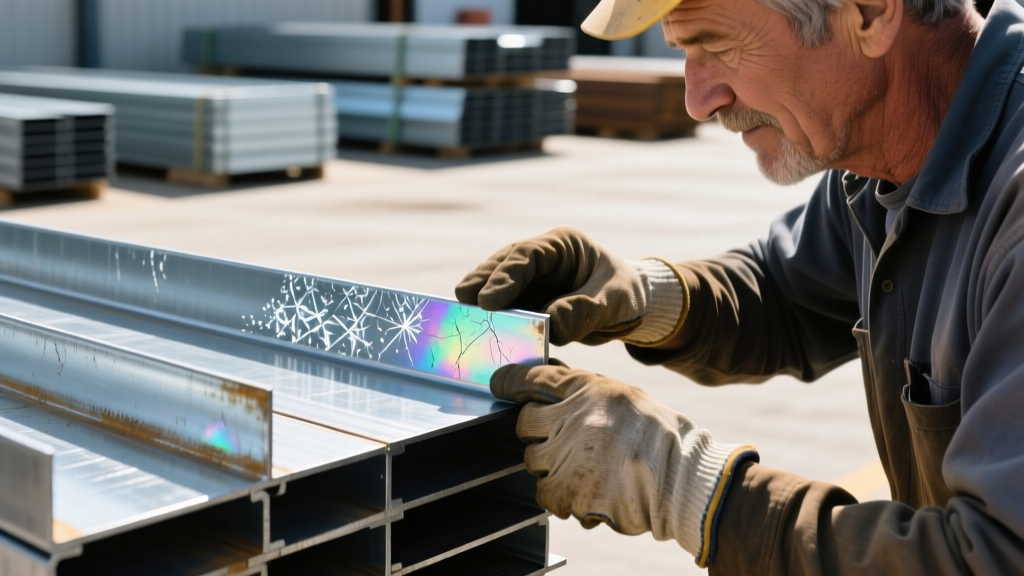
White rust is a bulky, white, chalky deposit of zinc oxide and zinc hydroxide that forms when newly galvanized steel is exposed to trapped moisture without adequate airflow. If you receive a bundle of steel studs with heavy white rust, the sacrificial zinc layer has been partially consumed before installation even begins. Reject bundles with severe white rust flaking, as the underlying steel will be vulnerable to red rust.
Supplier Vetting Checklist:
- Indoor Storage: Are G90 and G185 studs stored in a climate-controlled or fully enclosed warehouse?
- Bundle Wrapping: Are bundles wrapped in breathable paper or non-condensing plastic? Fully sealed plastic traps condensation during temperature swings.
- Elevation: Are bundles stored on dunnage (wood blocks) at least 4 inches off the concrete floor to prevent capillary moisture absorption?
- Inventory Turnover: Ask the yard manager how long the current G90 inventory has been sitting. Zinc coatings degrade if stored outdoors for more than 6 months, even in moderate climates.
Field Modifications and Warranty Voids
Sourcing high-grade G90 or G185 steel stud framing near your job site is only half the battle. The moment a framer takes a reciprocating saw or aviation snips to a galvanized stud, the continuous zinc coating is severed, exposing raw, unprotected carbon steel at the cut edge. In high-corrosion environments, red rust will initiate at these cut edges and creep beneath the adjacent zinc layer (undercutting).
To maintain the corrosion warranty provided by manufacturers like ClarkDietrich or MarinoWARE, contractors must implement a strict field-treatment protocol:
- Minimize Field Cuts: Order custom-cut lengths from the local yard whenever possible to keep factory-coated edges intact.
- Deburr Edges: Remove all metal burrs after cutting. Burrs create micro-crevices that trap moisture and accelerate galvanic corrosion.
- Apply Cold Galvanizing Compound: Brush or spray all cut ends and punched holes with a zinc-rich paint containing a minimum of 90% zinc dust in the dry film (e.g., ZRC Cold Galvanizing Compound or Rust-Oleum Cold Galv). Standard primer or touch-up paint does not provide sacrificial cathodic protection.
- Isolate Dissimilar Metals: Never allow galvanized steel studs to come into direct contact with copper piping or aluminum flashing. Use dielectric separators or neoprene gaskets to prevent galvanic corrosion.
2026 Cost Matrix: Upgrading Your Corrosion Protection
Upgrading your galvanization grade impacts the bottom line, but it prevents catastrophic rework costs in commercial renovations. Below is the current 2026 pricing matrix for standard 3-5/8' 25-mil (20-gauge) non-structural studs, reflecting regional averages from major local and regional distributors.
| Galvanization Grade | Avg. Cost per Linear Foot | Cost Premium (vs G60) | Lead Time at Local Yards |
|---|---|---|---|
| G60 (Standard) | $4.85 - $5.40 | Baseline | In Stock (Immediate) |
| EQ Coating | $4.70 - $5.15 | -3% to -5% | In Stock (Immediate) |
| G90 (Heavy) | $5.75 - $6.50 | +18% to +20% | 3 to 7 Days |
| G185 (Severe) | $7.10 - $8.25 | +45% to +55% | 2 to 4 Weeks (Special Order) |
Procurement Strategy: Most local 'pro yards' do not stock G185 on their shelves due to low turnover velocity. If your project requires G185 for coastal exterior framing, you must factor a 14-to-21-day lead time into your critical path schedule. Attempting to substitute G90 and applying a field-applied liquid zinc barrier is generally rejected by building inspectors in designated high-velocity hurricane zones (HVHZ) and severe coastal corrosion districts.
Summary: The Local Sourcing Protocol
Finding 'steel stud framing near me' is a logistical advantage, but it requires rigorous technical oversight. Always verify the ASTM A653 coating weight on the mill certificate provided by the local distributor, inspect the physical inventory for white rust before accepting delivery, and enforce strict cold-galvanizing protocols for all field cuts. By aligning your local procurement strategy with the specific corrosivity category of your build site, you ensure the longevity of the framing assembly and protect your firm from costly moisture-related callbacks.
Written by
Sarah WhitfieldSarah Whitfield is a chartered quantity surveyor (MRICS) and construction cost analyst with 15 years of experience in material pricing, procurement strategy, and project budgeting. She earned her degree in Construction Management from the University of Reading (UK) and has worked on projects ranging from $2M custom homes to $180M mixed-use developments across North America and Europe. Sarah currently leads cost estimating for BuildMat Insight, maintaining a proprietary database of 4,000+ material price points updated quarterly. She is a frequent contributor to RSMeans cost data panels and has presented at the International Cost Engineering Council (ICEC) congress. Based in Denver, CO, Sarah is an avid trail runner and volunteer mentor for Women in Construction.
More from Sarah Whitfield
View all
Wood & Lumber
What Are the Different Types of Wood? A Builder's Guide
Compare structural softwoods, finish hardwoods, and engineered lumber. Analyze Janka ratings, MOE values, and 2026 pricing for construction.
Aug 4, 2026

Walls & Panels
Steel Framing vs Wood Framing: Corrosion and Moisture Defense
Compare steel framing vs wood framing for moisture resistance. Learn about galvanized coatings, condensation risks, and corrosion protection strategies.
Jul 21, 2026

Stone & Masonry
How to Cut Stone Veneer: Wet Saw vs Grinder Comparison
Compare the best tools for cutting stone veneer. We review wet saws, angle grinders, and chop saws to help you achieve clean, chip-free cuts.
Jul 21, 2026