Galvanized Steel Fence Posts: Brand Specs & Buyer Guide
Deep-dive into galvanized steel fence posts, comparing PostMaster Plus and HDG round lines with exact specs, pricing, and wind-load data.
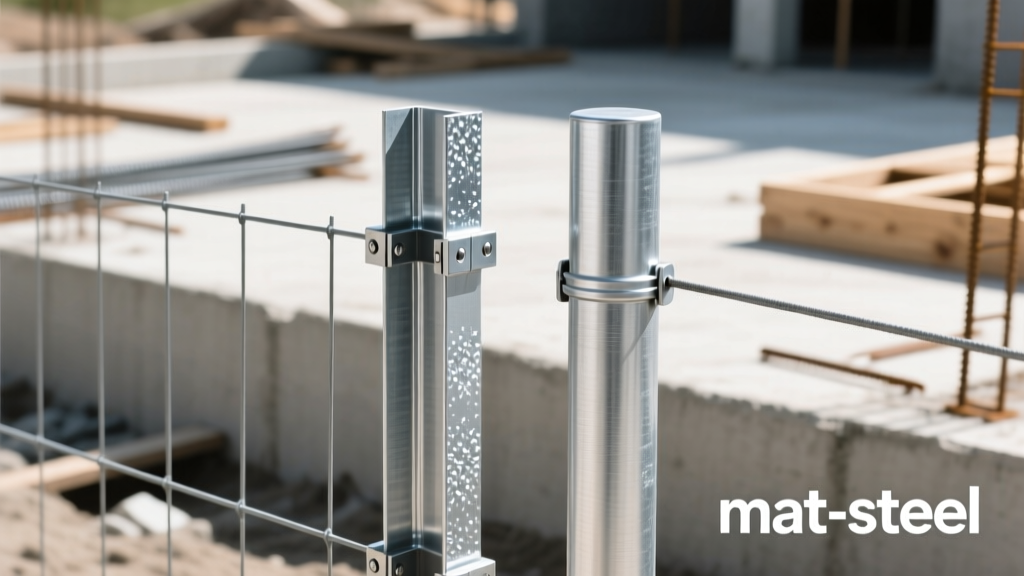
The Metallurgy of Fence Posts: HDG vs. G90 Pre-Galvanized
When sourcing galvanized steel fence posts, contractors and property managers frequently conflate hot-dip galvanized (HDG) and pre-galvanized (continuous) coatings. Understanding the metallurgical distinction is critical for predicting lifespan in corrosive environments. According to the American Galvanizers Association, HDG involves submerging fabricated steel into a bath of molten zinc (approx. 850°F), creating a metallurgical bond consisting of four distinct zinc-iron alloy layers topped by a layer of pure zinc. This yields a coating thickness of 3.0 to 4.0 mils (ASTM A153).
In contrast, pre-galvanized steel (often designated as G90 or Z275 under ASTM A653) is coated in a continuous mill process before being roll-formed into posts. The zinc layer is significantly thinner, typically averaging 0.9 mils total (0.45 mils per side). While G90 posts are more economical and offer a smoother aesthetic finish, HDG posts provide up to four times the sacrificial corrosion protection, making them mandatory for coastal installations, high-moisture agricultural zones, or areas where de-icing salts are prevalent.
Brand Deep-Dive: Master Halco PostMaster Plus
The PostMaster Plus line by Master Halco dominates the residential and light-commercial wood-fence market as a hidden steel post system. Designed to replace traditional 4x4 pressure-treated wood posts, it integrates seamlessly into standard wood picket frameworks while eliminating the rot and warping associated with timber ground-encasement.
Technical Specifications & Pricing
- Material: 14-gauge (0.075-inch) high-tensile steel.
- Coating: G90 pre-galvanized zinc with a powder-coated exterior option (typically matte black or brown).
- Dimensions: 2-inch x 3-inch profile, available in 8-foot and 9-foot lengths.
- Weight: Approximately 14.5 lbs per 8-foot post.
- Current Pricing (2026): $28.00 to $34.00 per 8-foot post, depending on regional distributor markups and powder-coat color.
Wind Load and Structural Performance
The primary engineering advantage of the PostMaster Plus is its asymmetric roll-formed channel, which provides high moment-of-inertia resistance against lateral wind loads. Independent testing verifies that an 8-foot post set 2 feet into concrete can support a 6-foot tall solid wood privacy fence at 8-foot on-center spacing in 100 mph wind zones. For 110 mph to 130 mph hurricane-prone zones, the manufacturer mandates reducing post spacing to 6 feet on-center and utilizing a 9-foot post buried 3 feet deep.
Commercial Round HDG Lines: Pro-Series and Schedule 40 Equivalents
For chain-link, ornamental iron, and heavy agricultural fencing, round HDG posts remain the industry standard. Master Halco’s Pro-Series and equivalent commercial lines are manufactured from high-strength low-alloy (HSLA) steel tubing, hot-dip galvanized after welding and swaging.
| Post Type | Outside Diameter (OD) | Wall Thickness | Avg. Cost (8ft) | Primary Application |
|---|---|---|---|---|
| Line Post (Light) | 1.900" | 0.083" | $16 - $19 | Residential Chain-Link |
| Line Post (Comm.) | 2-3/8" | 0.120" | $24 - $29 | Commercial / Security |
| Terminal Post | 2-7/8" | 0.145" | $38 - $45 | Gates / Corners / Ends |
| Schedule 40 HDG | 2-3/8" | 0.154" | $42 - $50 | High-Security / Anti-Climb |
Decision Matrix: Hidden vs. Exposed Steel Systems
Selecting between hidden roll-formed posts and exposed round HDG posts requires balancing aesthetic mandates with structural loading requirements.
- Choose PostMaster Plus (Hidden): When building solid privacy wood fences (board-on-board, shadowbox) in residential zones where HOA covenants prohibit visible steel. The flat nailing flange speeds up picket attachment, reducing labor costs by approximately 15% compared to routing wood posts.
- Choose 2-3/8" Round HDG (Exposed): When constructing chain-link, welded wire mesh, or tubular ornamental fences. The cylindrical profile allows for the use of standard tension bands, brace bands, and post caps, which are incompatible with the rectangular profile of hidden posts.
Installation Framework: Setting Steel in Concrete
Improper encasement is the leading cause of premature steel post failure, specifically through spalling and base-level corrosion. Follow this precise setting protocol for 8-foot posts:
- Excavation: Dig a 10-inch diameter hole to a depth of 30 inches (adhering to the 1/3 depth rule for a 6-foot above-grade fence).
- Drainage Base: Drop 3 inches of 3/4-inch crushed angular gravel into the hole. Never set a steel post directly on soil or flat concrete, as this traps moisture against the base, accelerating galvanic corrosion.
- Placement & Bracing: Insert the post and use a magnetic torpedo level to plumb it on two adjacent axes. Secure with temporary wooden braces.
- Concrete Pour: Use a 4,000 to 5,000 PSI high-strength concrete mix. Pour to 2 inches below grade level.
- The Sloped Crown: Trowel the top of the concrete into a 15-degree slope away from the post. Apply a bead of polyurethane sealant (like Sikaflex) at the concrete-to-steel joint to prevent water infiltration during freeze-thaw cycles.
Common Failure Modes & Edge Cases
The Abrasive Saw Mistake
Cutting HDG or G90 posts with an abrasive chop saw generates extreme friction heat (exceeding 1,000°F), which vaporizes the zinc coating and leaves a wide, unprotected burn zone. This exposed carbon steel will begin rusting within weeks. Correction: Always cut galvanized posts using a cold-cutting bandsaw or reciprocating saw with a bi-metal blade. If an abrasive saw must be used, immediately coat the cut edge and the adjacent 2-inch zone with a ZRC Cold Galvanizing Compound, which contains over 90% zinc dust by weight in the dried film to restore cathodic protection.
Galvanic Corrosion with Dissimilar Metals
Attaching aluminum fence brackets or copper-based hardware directly to galvanized steel posts creates a galvanic cell. Because zinc and steel are anodic to aluminum and copper, the post's galvanized coating will rapidly sacrifice itself to protect the attached hardware. Always use hot-dip galvanized steel fasteners, or isolate dissimilar metals using heavy-duty neoprene or EPDM rubber gaskets between the bracket and the post surface.