Galvanized Steel Raised Garden Bed Selection: Coatings & Gauges
Master galvanized steel raised garden bed selection. Compare G90 vs G185 zinc coatings, gauge thicknesses, and Galvalume for optimal soil retention.
The Metallurgy of Garden Beds: Decoding Zinc Coatings
When evaluating a galvanized steel raised garden bed, the primary point of failure is rarely the steel itself; it is the zinc coating. Continuous galvanizing, the process used for 95% of commercial garden bed kits, involves passing cold-rolled steel sheets through a molten zinc bath. The resulting coating weight dictates the material's lifespan in the highly corrosive, moisture-dense environment of a soil bed.
Industry standards classify these coatings by weight, measured in ounces per square foot (oz/ft²). A standard G90 coating contains 0.90 oz/ft² of zinc. While adequate for roofing or siding exposed to intermittent rain, G90 degrades rapidly when subjected to the constant hydrostatic pressure and microbial acidity of damp loam. For agricultural and landscaping applications, specifying a G185 coating (1.85 oz/ft²) is non-negotiable. According to the American Galvanizers Association, doubling the zinc mass more than doubles the time to first rust, providing a critical buffer against the microscopic abrasion caused by settling soil and root expansion.
Material Taxonomy: Pure Galvanized vs. Galvalume
Beyond pure zinc, the market offers Galvalume (often branded as Aluzinc or Zincalume). Understanding the metallurgical distinction between these two is vital for material selection.
| Material Type | Coating Composition | Cut-Edge Protection | Expected Lifespan (Damp Soil) |
|---|---|---|---|
| G90 Galvanized | 100% Zinc (0.90 oz/ft²) | Excellent (Sacrificial) | 3 - 5 Years |
| G185 Galvanized | 100% Zinc (1.85 oz/ft²) | Excellent (Sacrificial) | 8 - 12 Years |
| AZ55 Galvalume | 55% Aluminum, 43.4% Zinc, 1.6% Silicon | Poor (Requires edge sealing) | 15 - 20+ Years |
Galvalume's aluminum matrix provides superior barrier protection and heat reflectivity, making it highly resistant to uniform surface corrosion. However, aluminum does not offer the same galvanic (sacrificial) cut-edge protection as pure zinc. If a Galvalume sheet is sheared or drilled during assembly, the exposed steel edge will rust unless treated with a cold-galvanizing compound or zinc-rich paint. For garden beds requiring extensive field modifications, G185 pure galvanized steel remains the superior choice.
Gauge Thickness and the Bowing Threshold
The steel gauge system is inverse: a lower number indicates a thicker sheet. Selecting the correct gauge is a function of the bed's width and the hydrostatic pressure exerted by wet soil. Wet topsoil weighs approximately 120 pounds per cubic foot. A standard 4-foot wide, 2-foot deep bed exerts immense outward lateral pressure against the sidewalls.
Gauge Specifications and Bracing Requirements
- 22-Gauge (0.0299 inches / 0.76 mm): The entry-level standard for budget kits. Suitable only for beds 24 inches wide or less. Any wider, and the walls will bow outward within the first season of heavy watering. Requires wooden top-rails and bottom-ties every 3 feet.
- 20-Gauge (0.0359 inches / 0.91 mm): The professional landscaping standard. Offers sufficient rigidity for beds up to 4 feet wide without intermediate cross-bracing, provided the top edge is rolled or capped with an aluminum or timber trim to increase the moment of inertia.
- 18-Gauge (0.0478 inches / 1.21 mm): Heavy-duty commercial grade. Required for beds exceeding 4 feet in width or depths greater than 30 inches. Resists denting from wheelbarrow impacts and eliminates the need for internal tie-rods, maximizing root space.
According to horticultural infrastructure guidelines from the Royal Horticultural Society, structural integrity in raised beds is paramount not just for aesthetics, but to prevent soil compaction caused by inward-bowing walls, which restricts root aeration.
Form Factor Taxonomy: Corrugated vs. Flat Panel
The physical profile of the steel drastically alters its load-bearing capacity and thermal dynamics.
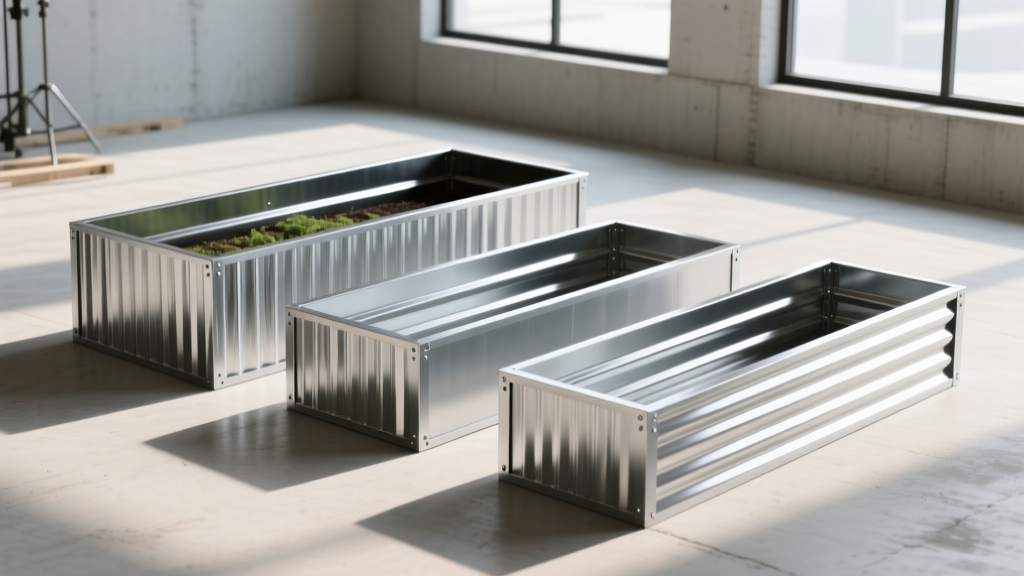
Corrugated Panels: The alternating ridges and valleys act as structural flutes, increasing the section modulus of the steel. A 22-gauge corrugated panel often matches the lateral stiffness of a 20-gauge flat sheet. Furthermore, the corrugations create micro-air gaps between the soil and the outer environment, slightly buffering soil temperature fluctuations. However, the ridges can trap debris and make interior lining with weed fabric more difficult.
Flat Sheet with Pressed Ribs: Premium kits utilize flat sheets with horizontal, stamped structural ribs. This offers a clean, modern aesthetic and a smooth interior wall that prevents soil from hanging up during seasonal turning. The stamped ribs provide localized reinforcement, but flat panels are more susceptible to oil-canning (visible rippling) when exposed to direct midday sun.
2026 Market Pricing & Sourcing Strategy
Pricing for galvanized steel raised garden beds has stabilized following the supply chain fluctuations of the early 2020s. When budgeting, evaluate the cost per square foot of growing footprint rather than the total kit price.
• Budget (22-Gauge, G90, 4x4x1.5 ft): $60 - $85 ($3.75 - $5.30 per sq ft)
• Mid-Tier (20-Gauge, G185, 4x8x2 ft): $180 - $260 ($5.60 - $8.10 per sq ft)
• Premium (18-Gauge, Galvalume, Modular): $350 - $500+ ($10.90 - $15.60 per sq ft)
For large-scale installations, bypass pre-packaged consumer kits. Sourcing 20-gauge G185 corrugated roofing panels directly from commercial metal suppliers (such as MSC Metals or local roofing wholesalers) and fabricating custom dimensions using aluminum corner extrusions can reduce material costs by up to 40% compared to branded garden kits.
Expert FAQ
Is zinc leaching a concern for edible crops?
Zinc is an essential micronutrient for plant growth. While excess zinc can be phytotoxic, the amount leached from a G185 coating in neutral pH soil (6.0-7.0) is negligible and well within safe limits for human consumption. The primary risk occurs only in highly acidic soils (pH < 5.0), where zinc mobility increases. If you are growing acid-loving plants like blueberries in a steel bed, line the interior walls with a 6-mil polyethylene barrier to separate the soil from the metal.
Can I use untreated steel and paint it?
Using untreated cold-rolled steel and applying exterior paint is a false economy. Paint films are semi-permeable to moisture vapor. Once trapped moisture initiates oxidation beneath the paint layer, the steel will flake and fail from the inside out within two seasons. Hot-dip galvanizing or continuous G185 coatings provide a metallurgical bond that paint cannot replicate. If aesthetic color is required, specify a powder-coated galvanized substrate, ensuring the powder coat is applied over the zinc, not bare steel.
How do I prevent the top edge from cutting skin?
Raw sheared steel edges are exceptionally sharp. Never leave a cut edge exposed on a garden bed. Always specify kits that include a rolled top lip (hemmed edge) or install a U-channel rubber trim or a capped timber rail (such as a 2x2 cedar strip) secured with self-drilling Tek screws. This not only ensures safety but significantly increases the torsional rigidity of the bed's upper perimeter.