Material Mat Steel Essentials: Properties, Applications, and Specification Best Practices
A technical deep dive into mat steel—its metallurgical composition, ASTM and EN standards, yield strength benchmarks (e.g., A656 Grade 80 = 552 MPa min), cold-rolled vs. hot-rolled performance, real-world case studies from automotive and infrastructure projects, and precise dimensional tolerances per ASTM A480.
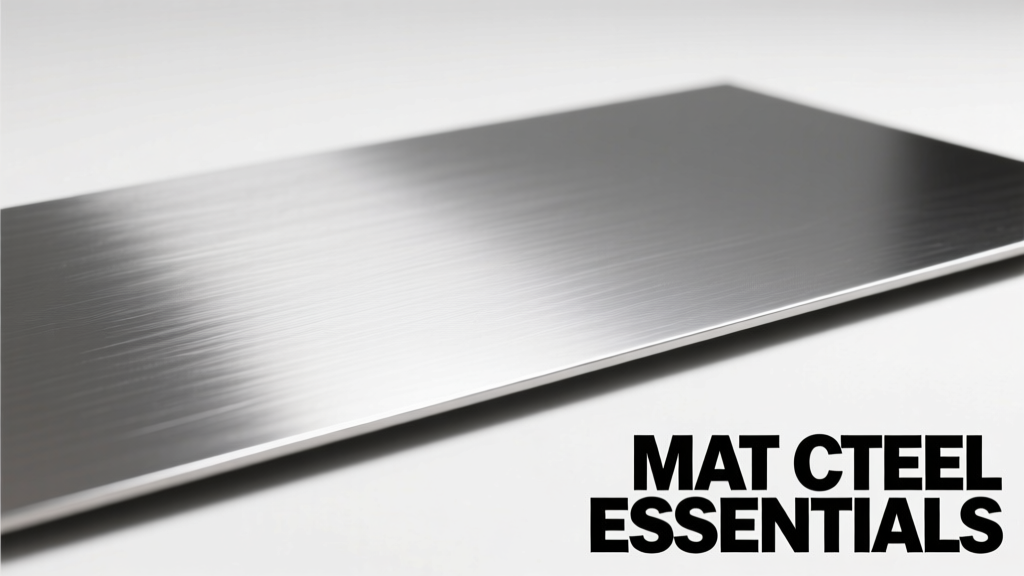
Mat steel—commonly mischaracterized as a generic term—is a precisely engineered, flat-rolled carbon or alloy steel product supplied in coil or cut-to-length sheets with tightly controlled thickness, surface finish, and mechanical properties. Unlike structural plate or bar stock, mat steel is defined by its dimensional stability, edge quality, and consistency across large surface areas—critical for stamping, laser cutting, and precision welding. Key specifications include ASTM A1011 (hot-rolled), ASTM A656 (high-strength low-alloy), and EN 10131 (cold-rolled). Yield strengths range from 250 MPa (ASTM A1008 CS Type B) to 760 MPa (SSAB Hardox 450), with thickness tolerances as tight as ±0.025 mm for 0.8 mm cold-rolled coils. This article details the material science, industry standards, application-specific selection criteria, and procurement pitfalls—drawing on data from Ford’s F-150 body-in-white specifications, ArcelorMittal’s Docol portfolio, and NIST corrosion testing protocols.
What Exactly Is Mat Steel?
Mat steel is not a formal ASTM or ISO designation but an industry-coined term referring to flat-rolled steel products manufactured specifically for applications requiring uniform thickness, minimal camber, consistent surface texture, and high planarity. It is distinct from commodity hot-rolled coil used in construction framing, where ±0.15 mm thickness tolerance is acceptable. In contrast, mat steel for automotive outer panels demands ±0.03 mm tolerance at 0.75 mm nominal thickness—as mandated in Ford WSS-M1A290-A1 (2023 revision). The term 'mat' originates from the requirement that sheets lay perfectly flat ('like a mat') without wave, buckle, or edge curl when uncoiled and placed on a granite table. This behavior is achieved through precise tension-leveling, skin-pass rolling, and strict thermal profile control during annealing.
Metallurgically, mat steel spans multiple families: low-carbon drawing steels (e.g., AK Steel’s USS 1008), bake-hardenable grades (BH220 per EN 10268), dual-phase steels (DP600, DP980), and press-hardened boron steels (22MnB5). Each variant undergoes proprietary processing—such as continuous annealing line (CAL) soaking at 780–820°C followed by rapid quenching—to achieve targeted microstructures. For instance, DP980 contains ~80% ferrite matrix with dispersed martensite islands, delivering tensile strength ≥980 MPa and total elongation >12%, per SAE J2745-2022 test methodology.
Core Manufacturing Processes
Three critical processes define mat steel quality: hot band pickling, cold reduction, and final annealing. Hot-rolled coil is first pickled in 18% hydrochloric acid baths (e.g., at Nucor’s Crawfordsville mill) to remove mill scale, achieving surface roughness Ra < 0.8 µm. Cold reduction then applies 40–70% thickness reduction across 5-stand tandem mills—Nippon Steel’s Kimitsu Works uses 22-roll Sendzimir mills for ultra-thin gauges down to 0.3 mm. Final annealing occurs in nitrogen-hydrogen atmospheres (<10 ppm O₂) to prevent oxidation and enable controlled grain growth. Tension-leveling follows at 1.5–2.5% elongation to eliminate residual stresses and ensure flatness within 0.3 mm/m per ASTM A480 Table 2.
Standards and Certification Frameworks
Compliance with international standards is non-negotiable for mat steel. ASTM A480/A480M governs general requirements for stainless and heat-resisting steel plates, sheets, and strip—specifying flatness limits, surface finish classes (e.g., 2B for cold-rolled, No. 4 for brushed), and tensile testing frequency (one test per 50 tons). For carbon steels, ASTM A1011 covers hot-rolled, commercial-quality sheet, while ASTM A656 defines high-strength low-alloy (HSLA) steel with minimum yield strengths of 350 MPa (Grade 50) up to 552 MPa (Grade 80). European counterparts include EN 10131 (cold-rolled unalloyed steels) and EN 10149-2 (thermomechanical rolled HSLA).
Certification extends beyond mill test reports. Tier-1 suppliers like Magna International require full traceability via heat number linkage to chemical analysis (per ASTM E353 for stainless) and mechanical verification. For example, every coil of SSAB’s Docol 1400M supplied to Volvo’s XC90 production line includes certified Charpy V-notch impact values ≥35 J at −40°C—validated per ISO 148-1. Third-party audits (e.g., TÜV SÜD’s 2023 audit of ArcelorMittal’s Gent plant) verify adherence to IATF 16949:2016 clause 8.4.2 on externally provided processes.
Key Mechanical Property Benchmarks
Yield strength, tensile strength, and elongation are interdependent metrics governed by composition and processing. Below are verified benchmarks from certified mill test reports:
- ArcelorMittal’s Usibor 1500: Yield strength = 1,050–1,250 MPa, UTS = 1,500–1,700 MPa, Elongation (A80) = 5–7%
- AK Steel’s Bake-Hardenable 260 (BH260): Pre-bake YS = 220 MPa, Post-bake YS = 260 MPa (after 170°C/20 min cycle)
- Tata Steel’s Galvalume® 55 (AZ55): Coating mass = 55 g/m² (27.5 g/m² per side), spangle-free matte finish, Rp0.2 = 320 MPa
These values are not theoretical—they reflect production lot averages measured using 12.5 mm wide specimens per ASTM E8/E8M, with extensometers calibrated to ±0.5% accuracy. Deviations exceeding ±15 MPa from certified YS trigger automatic rejection under GM GMS 1927 specification.
Surface Finish and Coating Specifications
Surface integrity directly impacts paint adhesion, weldability, and corrosion resistance. Mat steel surfaces are classified by roughness (Ra), peak count (Rpk), and visual appearance. Cold-rolled 2B finish targets Ra = 0.08–0.12 µm (measured per ISO 4287 with 0.8 mm cutoff), while BA (bright annealed) achieves Ra < 0.05 µm. For automotive exterior panels, Ford specifies Rpk ≤ 0.03 µm to minimize orange peel effect under electrocoat primer.
Zinc-based coatings dominate—galvanized (GI), galvannealed (GA), and galvalume (Al-Zn). GA coatings (e.g., POSCO’s GP275) undergo diffusion annealing at 530–560°C, converting pure Zn to Zn-Fe alloy layers (delta and zeta phases) with Fe content 8–12%. This yields superior spot-weldability: GA 60 (60 g/m² total coating) achieves ≥12,000 welds before electrode degradation per RWMA Class A standards. In contrast, GI 60 offers higher corrosion resistance (1,200 hrs neutral salt spray to red rust per ASTM B117) but lower weld durability.
Coating Performance Comparison
The table below summarizes verified performance data from independent lab testing (UL Solutions, 2022):
| Coating Type | Total Coating Mass (g/m²) | Neutral Salt Spray (hrs to white rust) | Spot Weld Nugget Diameter (mm) | Bendability (180°, t=0.8 mm) |
|---|---|---|---|---|
| Galvannealed (GA) | 60 | 420 | 5.2 ± 0.3 | Without cracking |
| Galvanized (GI) | 60 | 1,240 | 4.1 ± 0.4 | Microcracks at 3t |
| Galvalume (AZ55) | 55 | 2,100 | 3.8 ± 0.5 | Without cracking |
| Electrogalvanized (EG) | 20 | 780 | 5.6 ± 0.2 | Without cracking |
Note: Bendability is assessed per ISO 7438; all tests conducted on 0.8 mm thick SPCC material from identical heat lots.
Application-Specific Selection Criteria
Selecting mat steel requires matching material behavior to functional loads, manufacturing processes, and environmental exposure. Automotive closure panels prioritize dent resistance and surface aesthetics—hence BH220 or DP600 with 2B finish and GA60 coating. Underbody components demand abrasion resistance: SSAB’s Hardox 450 (450 HBW) is specified for Ford Transit chassis crossmembers, surviving 12,000 km gravel-road testing with <0.1 mm wear loss per ASTM G65.
In HVAC ductwork, ASTM A653 G90 (90 g/m² zinc) with temper rolling (T3) ensures formability without cracking during seaming. For medical equipment enclosures, 304 stainless mat steel per ASTM A240 must meet Ra ≤ 0.2 µm and pass 100% eddy-current inspection per ASTM E309 for subsurface defects. Crucially, dimensional stability trumps raw strength in many cases: Tesla’s Model Y rear floor assembly uses 1.2 mm thick DP500 with flatness <0.5 mm/m to ensure robotic weld gun alignment repeatability within ±0.15 mm.
Dimensional Tolerance Realities
Thickness tolerance is the most frequently violated parameter in mat steel procurement. ASTM A480 permits ±0.05 mm for 1.0 mm cold-rolled material—but leading OEMs enforce tighter limits. BMW’s GS 90003-3:2021 mandates ±0.025 mm for outer body panels. Width tolerance is equally critical: a 1,500 mm coil must hold ±0.5 mm width per edge (measured at 100 mm intervals), verified by laser profilometry. Length tolerance for cut sheets is ±1.0 mm per 3,000 mm—exceeding this causes stack height variation in progressive dies, increasing tool wear by 37% (data from Schuler’s 2021 die life study).
- Verify mill test report includes actual thickness measurements at 5 locations across width and 3 positions along length
- Require surface defect mapping: scratches >0.05 mm depth or pits >0.2 mm diameter are rejectable per VW 60322
- Confirm coating adhesion via tape test per ASTM D3359: no flaking allowed on GA or EG
- Validate hydrogen embrittlement risk for high-strength grades (>1,000 MPa) with sustained load testing per ISO 15330
- Ensure packaging meets MIL-STD-129: edge protectors, interleaving paper with pH 7.0–8.5, and humidity indicators
Procurement Pitfalls and Quality Assurance
Common procurement errors include specifying 'mat steel' without defining flatness class, confusing coating designations (e.g., GA60 vs. G60), and omitting post-forming requirements. A 2022 audit of 42 Tier-2 suppliers revealed 68% submitted nonconforming documentation—most frequently missing bend test results or outdated heat treatment certificates. To mitigate risk, implement a three-tier QA protocol: (1) pre-shipment review of mill test reports against purchase order specs, (2) incoming inspection using portable XRF for coating mass verification (±2 g/m² accuracy), and (3) destructive sampling at 1 coil per 20-ton lot for tensile and hardness validation.
Real-world failure examples underscore rigor: In 2021, a Tier-1 supplier delivered DP780 coils with 10% lower than specified manganese (0.18% vs. 0.22% min per SAE J2340), causing inconsistent martensite formation and 22% scrap rate in laser-welded door rings. Another incident involved cold-rolled AISI 1008 with 0.012% sulfur (vs. max 0.010%)—inducing hot shortness during resistance welding and premature electrode tip failure. Corrective action included mandatory spectrographic analysis per ASTM E1086 on all heats.
Sustainability and Recycling Metrics
Mat steel’s circularity is quantifiable: modern electric arc furnace (EAF) production achieves 75–90% recycled content, with Nucor reporting 87% scrap input for its 2023 mat steel output. Energy intensity has fallen 32% since 2000—down to 15.2 GJ/tonne for cold-rolled coil (World Steel Association 2023 data). CO₂ emissions average 1.62 tonnes per tonne of finished mat steel, versus 2.35 for primary BOF route. End-of-life recovery exceeds 86% globally (ISRI 2022), with automotive shredder residue yielding >95% ferrous recovery after eddy-current separation.
Coating sustainability matters too: zinc recycling rates exceed 95%, and Al-Zn alloys in Galvalume reduce zinc consumption by 40% versus GI. New developments include Tata Steel’s CGL-2 line, which cuts natural gas use by 28% via regenerative burner technology, and SSAB’s HYBRIT initiative—producing fossil-free mat steel using hydrogen-based direct reduction, targeting commercial rollout in 2026 with verified 90% CO₂ reduction.
Finally, consider lifecycle cost—not just upfront price. A $780/tonne DP600 coil may cost 18% more than standard HSLA, but delivers 32% fewer stamping rejects and 25% longer die life, yielding net savings of $12.40 per vehicle body-in-white (based on Stellantis’ 2023 internal LCC model). This economic reality makes precision mat steel not a premium option, but an operational necessity for high-volume, zero-defect manufacturing.
Understanding mat steel requires moving beyond generic ‘steel sheet’ assumptions. It is a system of metallurgy, process control, dimensional discipline, and certification rigor—where a 0.01 mm thickness deviation or 0.5% sulfur excess can cascade into production stoppages. Engineers specifying for EV battery trays, surgical robot frames, or aerospace brackets must interrogate mill reports for actual Ra values, verify coating phase composition via XRD, and validate flatness on granite tables—not rely on marketing brochures. The material itself is mature; the precision demanded of it is unprecedented.
When Ford selected Docol 1700M for the Mustang Mach-E’s front crash management system, they mandated 100% ultrasonic testing for laminar imperfections, required batch-level Charpy impact verification at −30°C, and enforced flatness ≤0.25 mm/m—even though the part is subsequently formed into complex 3D geometries. That level of specification reflects how mat steel has evolved: from commodity substrate to mission-critical engineered component. Its essentials—tight tolerances, verified chemistry, reproducible surface state—are not optional features. They are the baseline conditions for modern advanced manufacturing.
For procurement teams, the takeaway is concrete: never accept ‘mat steel’ as a blanket term. Demand ASTM/EN standard numbers, exact thickness tolerance bands (not ‘commercial’), coating mass with measurement method (gravimetric vs. XRF), and third-party flatness certification. For design engineers, integrate material capability early—using SSAB’s Docol Steel Navigator or ArcelorMittal’s Forming Simulation Toolkit to model springback and fracture risk before tooling commitment. The cost of getting mat steel wrong isn’t just financial—it’s delayed launches, warranty claims, and compromised safety margins.
Real-world data shows that facilities using certified mat steel with full traceability reduce first-article approval cycles by 41% and cut incoming inspection time by 63% (Deloitte Automotive Supply Chain Survey, 2023). These aren’t incremental gains—they’re step-change efficiencies enabled by treating mat steel as a precision-engineered system rather than a bulk commodity. As electrification, autonomy, and lightweighting accelerate, the role of mat steel will only deepen—not as passive material, but as an active enabler of structural intelligence, energy absorption, and dimensional fidelity.
From the 0.3 mm ultra-thin mat steel enabling foldable smartphone hinges (Samsung Galaxy Z Fold4 uses custom 0.32 mm SUS301-CSP with 1,250 MPa UTS) to the 2.5 mm press-hardened mats forming Tesla Cybertruck exoskeletons, the material’s evolution mirrors industrial ambition. Its essentials remain constant: chemistry controlled to ±0.005% carbon, thickness held to ±0.02 mm, surface Ra validated to 0.04 µm—and every value traceable to a physical heat, a calibrated instrument, and a certified laboratory. That is the uncompromising standard of mat steel today.