Matching Metal Roof Screws to Climate, Substrate, and Panel Type
Match metal roof screws to your climate, panel type, and substrate. Compare sizing, EPDM washers, and corrosion-resistant coatings for leak-proof steel roofs.
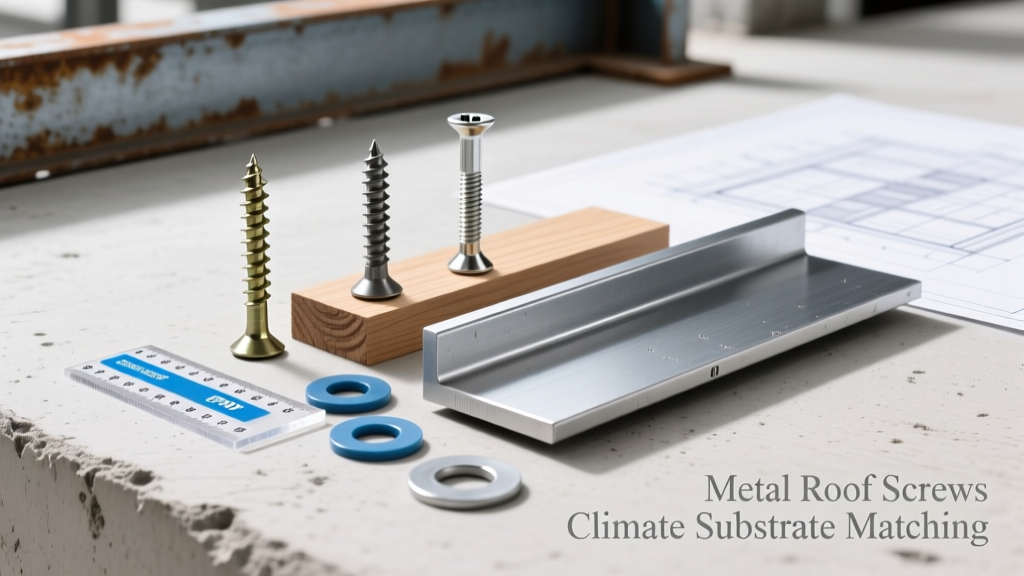
The Anatomy of a High-Performance Fastener
A $20,000 metal roofing system is ultimately only as reliable as the $200 worth of fasteners holding it down. Selecting the correct metal roof screws requires moving beyond generic hardware store bins and understanding the precise engineering of the fastener's anatomy. The primary differentiator in self-drilling fasteners is the drill point geometry, which dictates the maximum steel thickness the screw can penetrate without pre-drilling.
- #2 Point: Designed for light-gauge metal, penetrating up to 0.070 inches (16-gauge).
- #3 Point: The industry standard for most roofing applications, penetrating up to 0.105 inches (12-gauge) steel.
- #4 Point: Engineered for heavy structural steel, penetrating up to 0.250 inches (1/4-inch).
- #5 Point: Used for thick structural members up to 0.500 inches (1/2-inch).
Beyond the drill point, the shank design matters. Type 17 shanks feature a fluted tip that acts like an auger, efficiently clearing wood chips when fastening into timber purlins, preventing the shank from binding and snapping under high torque.
Washer Chemistry: Why EPDM is Non-Negotiable
The washer is the only component standing between your building's interior and water intrusion. Historically, neoprene and standard rubber washers were used, but these materials degrade rapidly under ultraviolet (UV) radiation and thermal cycling. Neoprene typically becomes brittle and cracks at temperatures exceeding 180°F (82°C)—a threshold easily surpassed on a dark metal roof in direct summer sunlight.
For any professional installation, Ethylene Propylene Diene Monomer (EPDM) washers are mandatory. EPDM maintains its elasticity and sealing properties across a massive temperature range, from -40°F to 300°F. When sourcing metal roof screws, verify that the EPDM is bonded to a carbon steel or stainless steel backing washer. This metal backing prevents the screw head from cutting into the rubber during installation and distributes the clamping force evenly across the panel rib.
Scenario Matching Matrix: Environment and Material Selection
Galvanic corrosion and environmental degradation dictate the base material and coating requirements for your fasteners. The Metal Construction Association (MCA) provides strict guidelines on matching fastener metallurgy to the surrounding environment to prevent catastrophic red-rust streaking and structural failure.
| Environment | Substrate / Panel | Recommended Screw Material | Head Coating | Washer Type |
|---|---|---|---|---|
| Standard Inland Residential | Galvanized Steel / Galvalume | Carbon Steel (Zinc/Aluminum plated) | Powder-coated (Color-matched) | Bonded EPDM |
| Coastal (Within 1 Mile of Saltwater) | Galvalume / Aluminum | 304 or 316 Stainless Steel | Uncoated or PVDF coated | Bonded EPDM |
| Agricultural (Livestock Confinement) | Galvanized Steel | 304 Stainless Steel or Heavy Polymer-Coated Carbon | Thick Polymer (Ammonia resistant) | Bonded EPDM |
| Industrial (Chemical/Smog Exposure) | Galvalume | Carbon Steel with Hylar 5000 or Stalgard coating | PVDF / Kynar 500 | Bonded EPDM |
Expert Insight on Galvanic Corrosion: A common mistake is using 304 stainless steel screws on standard galvanized steel panels in non-coastal areas. Because stainless steel is highly cathodic and zinc is anodic, the zinc coating on the panel will sacrifice itself rapidly around the fastener hole, leading to premature white rust and panel degradation. For standard inland galvanized roofs, a high-grade carbon steel screw with a premium ceramic or polymer coating (like Stalgard) actually outperforms stainless steel by matching the galvanic potential of the roof panel.
Dimensional Sizing: Panel, Lap, and Substrate Penetration
Correct sizing ensures structural pull-out resistance without compromising the panel's weather-tightness. The Metal Roofing Alliance emphasizes the 'three-thread rule': a minimum of three full threads must extend past the back of the structural substrate to achieve rated withdrawal strength.
Panel-to-Purlin Fasteners (Exposed Fastener Roofs)
- Steel Purlins (14 to 12 gauge): Use #10 or #12 diameter screws, 1 inch to 1-1/4 inches in length. A #3 drill point is required.
- Wood Purlins or Decking: Use #9 or #10 diameter screws, 1-1/2 inches to 2 inches in length. Ensure a Type 17 wood-cutting shank to prevent splitting.
Lap Fasteners (Stitch Screws)
Lap screws secure overlapping panel edges and do not penetrate the structural substrate. Therefore, they require a much shorter length—typically 3/4 inch to 7/8 inch. Crucially, lap screws should feature a pancake head or a low-profile hex head. Standard hex washer heads protrude too far and will interfere with overlapping panels or cause localized dimpling that compromises the capillary seal.
Installation Dynamics: RPM and Depth Sensing
Achieving the perfect 'donut' seal requires specialized tooling. Standard impact drivers are entirely unsuitable for metal roof screws; their rotational hammering action shatters EPDM washers and strips the hex heads. Installers must use dedicated screw guns equipped with adjustable depth-sensitive nose cones (such as the Makita XSF03 or DeWalt DCF622).
The depth collar disengages the drive mechanism the exact millisecond the washer reaches the predetermined compression point, regardless of how hard the operator pushes. Furthermore, driving RPMs must be strictly controlled between 1,800 and 2,000 RPM. Driving at higher speeds generates excessive friction heat at the drill point, which can melt the EPDM washer from the bottom up before the head even seats.
Procurement and Cost Benchmarks
Budgeting for fasteners requires looking at the cost-per-screw in bulk contractor quantities (typically boxes of 1,000 or 2,500). Based on current 2026 wholesale material pricing:
- Standard Carbon Steel (Zinc/Aluminum plated with painted head and EPDM): $0.08 to $0.12 per screw.
- Premium Coated Carbon Steel (Ceramic/Polymer coated for agricultural/industrial use): $0.15 to $0.22 per screw.
- 304 Stainless Steel (with bonded EPDM): $0.28 to $0.38 per screw.
- 316 Stainless Steel (Marine grade): $0.45 to $0.65 per screw.
While stainless steel fasteners cost three to five times more than standard carbon steel, they represent less than 2% of the total installed cost of a commercial metal roof. According to data from Birmingham Fastener and other leading manufacturers, value-engineering a roof by downgrading fastener metallurgy to save $150 on a 10,000-square-foot project inevitably results in thousands of dollars in leak remediation and panel replacement within the first decade. Always match the fastener's corrosion resistance and lifespan to the warranty period of the roofing panel itself.