Metal Roof Snow Guards Cost Calculator & 2026 Pricing Guide
Calculate exact quantities and costs for metal roof snow guards. Includes 2026 pricing matrices, spacing formulas, and adhesive vs mechanical labor rates.
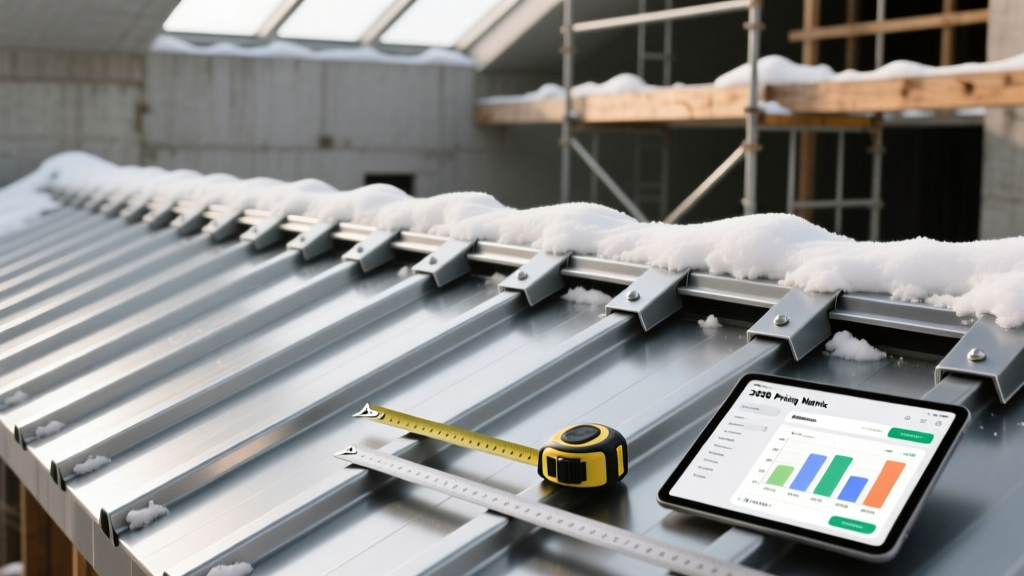
2026 Pricing Matrix for Metal Roof Snow Guards
Estimating the cost of snow retention systems for steel roofs requires moving beyond simple per-piece pricing. In 2026, material costs have stabilized, but specialized labor for standing seam clamp installations and structural penetrations has increased by roughly 8% compared to previous years. The total project cost depends heavily on the retention profile you select: pad-style, pipe-style, or fence-style.
| System Type | Material Cost (2026) | Installation Labor | Best Application |
|---|---|---|---|
| Pad-Style (Polycarbonate/Aluminum) | $3.50 – $8.50 per unit | $2.00 – $4.50 per unit | Residential corrugated/R-panel steel roofs |
| Pipe-Style (1" to 3" Aluminum) | $14.00 – $28.00 per linear ft. | $6.00 – $12.00 per linear ft. | Commercial standing seam, steep residential |
| Fence-Style (Multi-pipe) | $24.00 – $45.00 per linear ft. | $10.00 – $18.00 per linear ft. | Heavy snow load zones, slate/steel hybrids |
For a standard 2,500 sq. ft. residential steel roof requiring a staggered pad-style layout, expect to purchase between 80 and 120 units, bringing material costs to roughly $600–$900, with labor adding another $300–$500. Conversely, a commercial standing seam roof utilizing a continuous 2-pipe ColorGuard system across 200 linear feet of eave will cost between $4,000 and $6,500 fully installed.
The Quantity Calculation Framework
The most common estimation error is placing snow guards only along the eave. According to engineering guidelines published by the Metal Construction Association, snow retention must be distributed across the entire roof slope to prevent localized overloading and structural tear-out. You are not just holding snow at the bottom; you are breaking up the snowpack's shear force across the panel ribs.
Step-by-Step Quantity Calculation
To calculate the exact number of pad-style guards (like the industry-standard SnoBlox Deuce) required for your steel roof, follow this framework:
- Calculate Total Roof Area: Multiply the footprint square footage by your roof pitch multiplier (e.g., a 6/12 pitch uses a 1.118 multiplier). A 2,000 sq. ft. footprint at 6/12 pitch equals 2,236 sq. ft. of actual roof area.
- Determine Ground Snow Load (Pg): Check your local municipal building code. For example, Denver, CO is roughly 25 PSF, while Buffalo, NY is 50+ PSF.
- Apply the Coverage Ratio: In moderate snow zones (20-30 PSF), one pad-style guard typically covers 100 to 120 sq. ft. of roof area. In heavy zones (40+ PSF), reduce coverage to 60-80 sq. ft. per guard.
- Calculate Total Units: Divide the total roof area by the coverage ratio. (2,236 sq. ft. / 100 = 23 guards minimum for a single eave row, but distributed layout requires more).
Mechanically Fastened vs. Adhesive-Mounted Cost Analysis
Your steel roof profile dictates your attachment method, which drastically alters the labor estimate. Corrugated and R-panel roofs can accommodate both, while standing seam roofs strictly require mechanical clamping to preserve the weathertight warranty.
Adhesive-Mounted (Polycarbonate Pads)
Using a chemical adhesive like SureBond SB-190 is highly cost-effective for labor but carries strict environmental limitations.
- Material Cost: ~$1.50 per tube (covers roughly 15-20 pads).
- Labor Rate: Fast application, roughly 1 minute per unit.
- The 28-Day Cure Gotcha: SB-190 requires 28 consecutive days at 50°F (10°C) or above to fully cross-link and cure. If you estimate an adhesive installation in late autumn in a northern climate, the system will fail during the first winter storm. Adhesive applications must be scheduled between May and August in most of North America.
Mechanically Fastened & Clamped
For standing seam steel roofs, you must use specialized clamps (such as S-5! clamps) that grip the seam without piercing the steel membrane.
- Hardware Cost: S-5! clamps and set screws add $4.00 – $7.00 per attachment point.
- Labor Rate: Slower. Requires torque-calibrated drills to tighten set screws to exact manufacturer specifications (usually 165-180 inch-pounds) to avoid crushing the seam or under-tightening, leading to slip-failures.
- Piercing Screws (Corrugated only): If screwing directly through corrugated steel into the purlin, you must use #12 or #14 wood-to-metal screws with EPDM neoprene sealing washers to prevent leaks. Budget $0.35 per screw.
Edge Cases That Destroy Snow Guard Budgets
When building your quantity calculator, standard formulas fail to account for architectural anomalies. Failing to estimate for these edge cases will result in change orders and material shortages.
"Snow does not fall evenly. It slides, drifts, and accumulates. Estimating for the 'average' roof plane guarantees failure at the valleys and dormers." — Structural Roofing Engineer
- Roof Valleys and Crickets: Snow sliding from two intersecting roof planes creates massive accumulation zones in valleys. You must increase snow guard density in valleys by 50% to 100% compared to the main roof field. Budget for continuous pipe systems or tightly clustered pads in these zones.
- Solar Panel Arrays: If the steel roof features solar panels, snow will slide off the glass panels at accelerated speeds, bypassing standard roof-mounted guards. You must install specialized solar panel snow guards (like the SnoBlox Solar Snow Max) clamped directly to the panel frames. Add $12–$18 per linear foot of solar array to your estimate.
- Galvanic Corrosion Risks: Never estimate bare aluminum snow guards for direct screw-down onto galvanized steel roofs without a plastic or rubber separator pad. The dissimilar metals will cause rapid galvanic corrosion, rusting the steel panel within 2 to 3 seasons. Always specify powder-coated aluminum or color-matched painted steel guards for galvanized substrates.
- Dormers and Lower Roofs: Snow sliding off a primary upper roof will obliterate a lower dormer or porch roof. You must estimate a heavy-duty pipe or fence system on the upper roof directly above any lower roof intersections to hold the pack in place.
Frequently Asked Estimation Questions
Can I mix pad-style and pipe-style guards on the same steel roof?
Structurally, yes, but it is highly discouraged. Different retention profiles release snow at different rates. Mixing them creates uneven shear loads on the steel panels, which can cause localized panel buckling or seam tearing during a spring thaw. Stick to one system type per continuous roof plane.
Do I need snow guards if my steel roof has a low pitch?
Generally, steel roofs with a pitch of 3/12 or lower do not generate enough gravitational shear force to cause sudden, dangerous snow avalanches. However, if the roof is adjacent to high-traffic pedestrian walkways or critical HVAC equipment, ColorGuard and other manufacturers still recommend perimeter retention to manage gradual melt-off and ice damming.
How do I factor in ice damming costs?
Snow guards hold snow on the roof; they do not prevent ice dams. If your steel roof lacks adequate attic insulation or ventilation, heat loss will melt the bottom layer of the retained snowpack, causing water to back up under the steel seams. If estimating for a cold-climate retrofit, always pair your snow guard quote with a line item for heat tape (self-regulating de-icing cables) in the gutters and eaves, costing $8 to $14 per linear foot installed.