Environmentally Friendly Building Materials: Steel vs Wood vs Concrete
Compare steel, wood, and concrete as environmentally friendly building materials. Analyze embodied carbon, LCA data, and end-of-life recyclability.

The Carbon Conundrum: Evaluating Structural Materials
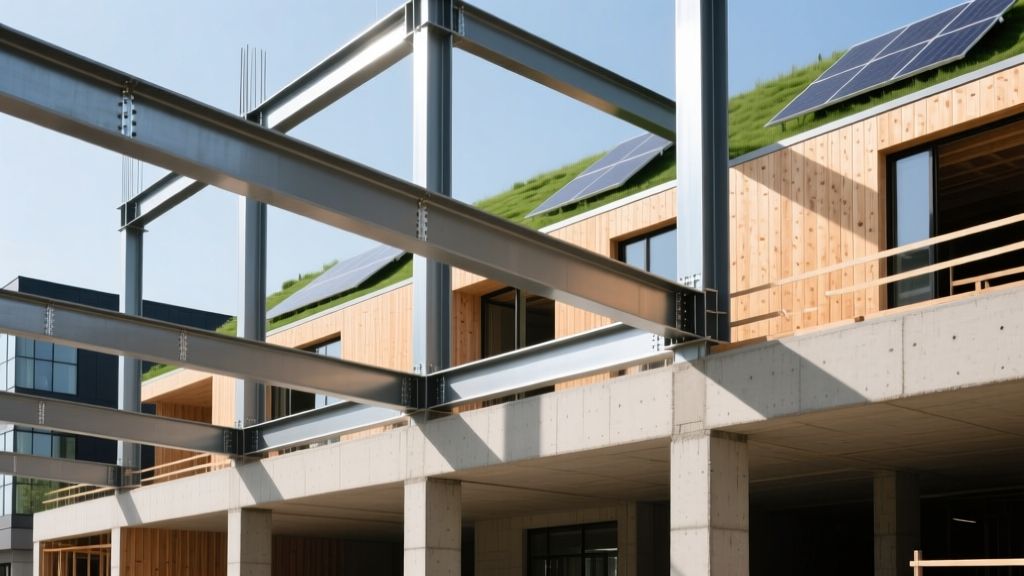
When architects and engineers specify structurally sound, environmentally friendly building materials, the debate inevitably narrows to three primary contenders: structural steel, mass timber, and concrete. Evaluating these materials requires moving beyond simplistic 'green' marketing and conducting a rigorous Life Cycle Assessment (LCA). An accurate LCA measures embodied carbon (emissions from extraction, manufacturing, and transport), operational carbon (energy used during the building's lifespan), and end-of-life impacts (recyclability versus landfill methane).
Steel: The Recyclability Champion
Structural steel is frequently misunderstood in carbon discussions due to the high heat requirements of its production. However, the modern steel industry has fundamentally shifted its manufacturing processes, making it one of the most sustainable choices available when sourced correctly.
Electric Arc Furnaces (EAF) vs. Blast Furnaces (BOF)
The environmental impact of steel depends entirely on how it is melted. Traditional Blast Oxygen Furnaces (BOF) rely on virgin iron ore and coal, emitting roughly 2.0 metric tons of CO2 per ton of steel. In contrast, Electric Arc Furnaces (EAF) melt scrap steel using electricity. EAF production emits approximately 0.4 metric tons of CO2 per ton of steel—an 80% reduction. In North America, over 70% of structural steel is produced via EAF. When specifying W-shapes (like a standard W14x90 beam), procurement teams should mandate EAF-produced steel from domestic mills like Nucor or Steel Dynamics to minimize embodied carbon.
The 93% Recycled Content Reality
According to data from the American Institute of Steel Construction (AISC), structural steel shapes produced in the United States contain an average of 93% recycled scrap content. Furthermore, steel is one of the only materials that does not degrade during the recycling process. At the end of a building's life, 98% of structural steel is recovered and recycled into new steel products, completely bypassing the landfill and creating a true closed-loop circular economy.
Wood: The Biogenic Carbon Sink (And Its Caveats)
Mass timber, specifically Cross-Laminated Timber (CLT) and Glulam, has surged in popularity as an environmentally friendly building material due to its ability to sequester carbon. Trees absorb CO2 as they grow, locking it into the wood fibers. A cubic meter of CLT can sequester roughly 0.9 metric tons of CO2.
The End-of-Life Methane Problem
While wood acts as a carbon sink during the operational phase of a building, its end-of-life profile presents a severe environmental risk. If timber is demolished and sent to a landfill, it decomposes anaerobically, releasing methane. Methane is a greenhouse gas approximately 25 times more potent than CO2 over a 100-year period. Unless a robust, large-scale timber recycling infrastructure exists at the time of demolition (which is currently lacking in most municipalities), the biogenic carbon advantage of wood can be entirely negated by end-of-life methane emissions.
Chemical Treatments and Fire Ratings
To meet commercial building codes, mass timber often requires chemical fire retardants or protective encapsulation. While CLT achieves fire resistance through predictable charring rates (typically 1.5 inches per hour for heavy timber), the adhesives used in engineered wood (such as polyurethane or melamine-urea-formaldehyde) introduce volatile organic compounds (VOCs) and complicate the recycling process at the end of the structure's life.
Concrete: The Heavyweight Emitter
Concrete is the most widely used construction material globally, but its environmental footprint is heavily tied to Portland cement production. The calcination of limestone to create clinker releases massive amounts of CO2, accounting for roughly 8% of global anthropogenic emissions.
Decarbonizing the Mix
Concrete can be optimized to become a more environmentally friendly building material through mix design substitutions. Replacing a portion of Portland cement with Supplementary Cementitious Materials (SCMs) like fly ash, slag, or silica fume drastically reduces embodied carbon. Additionally, the adoption of Type IL (Portland-Limestone Cement) reduces the carbon footprint by up to 10% without sacrificing compressive strength. Emerging technologies, such as CarbonCure, inject captured CO2 directly into the concrete mix during batching, where it mineralizes and permanently traps the carbon while actually increasing the concrete's compressive strength.
Lifecycle Assessment (LCA) Matrix: Steel vs. Wood vs. Concrete
The following matrix compares the three materials across critical environmental and structural metrics, providing a framework for specification.
| Metric | Structural Steel (EAF) | Mass Timber (CLT) | Concrete (Optimized Mix) |
|---|---|---|---|
| Embodied Carbon | Moderate (Offset by scrap content) | Low / Negative (Biogenic sequestration) | High (Clinker production) |
| Recycled Content | 93% (Structural shapes) | 0% (Virgin harvested timber) | Low (SCMs act as partial substitutes) |
| End-of-Life Recovery | 98% recycled into new steel | High landfill risk (Methane emission) | Downcycled as road base aggregate |
| Thermal Conductivity | High (Requires continuous insulation) | Low (Natural insulator) | Moderate (High thermal mass) |
| Design Lifespan | 100+ years (Non-combustible, rot-proof) | 50-75 years (Moisture/pest vulnerability) | 100+ years (Spalling/rebar corrosion risk) |
Operational Energy and Thermal Bridging
A material's environmental impact extends far beyond its installation. Steel is highly thermally conductive, meaning uninsulated steel studs or beams will create severe thermal bridges, transferring heat out of the building in winter and into the building in summer. This increases HVAC loads and operational carbon.
To make steel framing an environmentally friendly building material in the operational phase, designers must specify continuous exterior insulation (ci) systems. Using rigid mineral wool or polyiso boards over the steel sheathing, combined with advanced fluid-applied air barriers (like the ZIP System liquid flash), breaks the thermal bridge. When detailed correctly, a steel-framed building can easily achieve Passive House or LEED Platinum operational energy targets, matching or exceeding the thermal envelope performance of mass timber.
Decision Framework: When to Choose Steel for Green Building
Selecting the right material requires aligning the project's specific constraints with the material's strengths. Use this framework to determine if steel is the optimal eco-friendly choice:
- Choose Steel When: The project requires long clear-spans (e.g., aviation hangars, large auditoriums), high seismic resilience (steel's ductility absorbs earthquake energy without catastrophic failure), or a design lifespan exceeding 100 years with minimal maintenance.
- Choose Steel When: The site has strict weight limitations. Structural steel is significantly lighter than concrete, reducing the size and carbon footprint of the required foundation.
- Choose Mass Timber When: The project is a low-to-mid-rise residential or office building where the biophilic design aesthetic is a priority, and the local jurisdiction has established wood-waste diversion and recycling programs.
- Choose Concrete When: The project requires massive thermal mass to passively regulate interior temperatures in extreme desert climates, or when below-grade waterproofing and hydrostatic pressure resistance are non-negotiable.
Sourcing and Verifying Environmentally Friendly Building Materials
Claims of sustainability must be verified through data. When procuring steel for a green building project, architects and general contractors should require Environmental Product Declarations (EPDs). An EPD is a standardized, third-party-verified document that transparently reports the environmental impact of a specific product, much like a nutrition label for food.
Furthermore, the World Steel Association provides extensive lifecycle inventory data that can be imported directly into LCA software like Tally or One Click LCA. By inputting these exact datasets, design teams can mathematically prove that high-recycled, EAF-produced steel framing and decking yield a lower 60-year lifecycle carbon footprint than alternative materials that suffer from premature degradation, landfill methane, or high operational energy leaks.
Ultimately, labeling any single material as the definitive 'green' choice is a disservice to building science. Steel stands out as an exceptionally environmentally friendly building material not because its initial extraction is carbon-free, but because its unparalleled durability, 93% recycled content, and infinite closed-loop recyclability make it the most responsible choice for permanent, multi-generational infrastructure.
Written by
James ThorntonJames Thornton is a construction industry veteran with 25 years of hands-on experience in wood framing, lumber grading, and residential building codes. He started as a framing carpenter in rural Oregon, earned his ICC Residential Building Inspector certification, and eventually became a senior plan reviewer for the City of Portland Bureau of Development Services. James holds a B.S. in Wood Science & Technology from Oregon State University and is a certified lumber grader through the West Coast Lumber Inspection Bureau (WCLIB). He has inspected over 3,000 residential construction sites and authored the city's internal guide on advanced framing techniques (2x6 at 24" O.C.). James lives in Bend, OR, where he builds custom timber-frame cabins and competes in lumberjack sports.
More from James Thornton
View all
Insulation
Best Home Insulation Materials: Complete 2026 Guide
Compare top home insulation materials for 2026. Find R-values, installed costs per square foot, and best uses for fiberglass, spray foam, and mineral wool.
Aug 4, 2026

Sustainable Building
Certify Your Green Building Material for LEED and WELL
Step-by-step guide to certifying a green building material for LEED v5 and WELL v2. Master EPDs, HPDs, and VOC limits for 2026 project specifications.
Aug 4, 2026

Stone & Masonry
Veneer Stacked Stone Panels: Interior Design & Style Showcase
Discover how veneer stacked stone panels transform interiors. Explore modern design profiles, material pairings, and technical installation specs.
Aug 4, 2026