Technical Specs for Working with Cold-Formed Steel Framing
Master technical specs for working with cold-formed steel framing, including ASTM standards, gauge thicknesses, fastener matrices, and tolerances.

Core Material Standards and Metallurgical Requirements
When working with cold-formed steel framing (CFS), structural integrity relies on strict adherence to material specifications governed by the AISI S100 North American Specification. Unlike structural hot-rolled steel, CFS is manufactured by press-braking or cold-roll forming sheet steel at ambient temperatures, which increases its yield strength through strain hardening.
The base material must comply with ASTM A1003, which dictates the chemical composition, mechanical properties, and metallic coating weights. The most critical specification for framing members is the designation of thickness. The industry has largely transitioned away from the ambiguous "gauge" nomenclature to "mils" (minimum uncoated thickness in thousandths of an inch) to prevent structural under-design.
Thickness and Yield Strength Matrix
| Designation (Mils) | Approximate Gauge | Minimum Uncoated Thickness (in) | Standard Yield Strength (Fy) | Primary Application |
|---|---|---|---|---|
| 33 mils | 20 ga | 0.0329" | 33 ksi | Non-loadbearing interior partitions |
| 43 mils | 18 ga | 0.0428" | 33 ksi / 50 ksi | Loadbearing exterior walls, shear walls |
| 54 mils | 16 ga | 0.0538" | 50 ksi | Multi-story loadbearing, floor joists |
| 68 mils | 14 ga | 0.0677" | 50 ksi | Heavy structural headers, truss chords |
Fastener Engineering and Connection Protocols
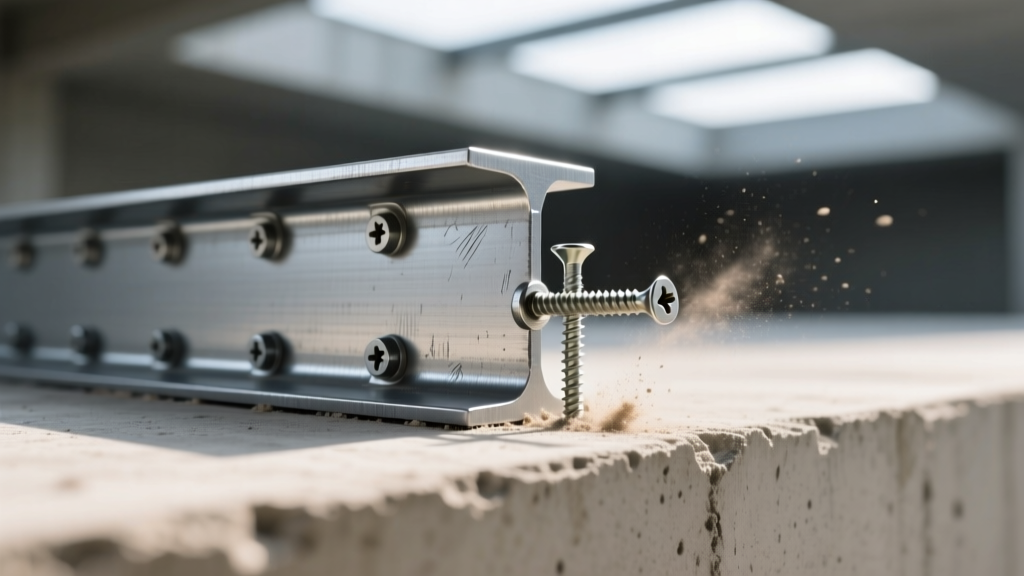
Connections in CFS framing are predominantly executed using self-drilling, self-tapping screws conforming to ASTM C1512. The selection of fastener diameter, point type, and head style is dictated by the thickness of the steel being joined and the shear/tension loads applied to the joint.
Screw Selection and Point Types
- #8 Screws (0.164" diameter): Used for connecting drywall to steel, or joining thin sheet steel (33 mils to 43 mils) where high shear capacity is not required.
- #10 Screws (0.190" diameter): The standard for most framing-to-framing connections (e.g., stud-to-track) in 43-mil to 54-mil steel.
- #12 Screws (0.216" diameter): Reserved for heavy connections, clip angles, and joining 68-mil structural members.
Screw points are categorized by their drilling capacity. Type S (sharp point) is used for steel-to-steel connections under 54 mils. Type D (drill point) features a built-in drill bit and is mandatory for punching through thicker structural steel or when attaching CFS to hot-rolled structural steel.
Protective Coatings and Corrosion Resistance
Cold-formed steel framing is protected by a continuous hot-dip zinc or zinc-iron alloy coating. The coating weight is designated by the ASTM A653 standard, measured in ounces per square foot of total surface area (both sides combined).
| Coating Designation | Total Zinc Weight (oz/ft²) | Thickness per Side (inches) | Recommended Environment |
|---|---|---|---|
| G40 | 0.40 | 0.00034" | Interior, climate-controlled, non-loadbearing |
| G60 | 0.60 | 0.00050" | Standard interior loadbearing, exterior behind weather barrier |
| G90 | 0.90 | 0.00075" | High-moisture interiors, exterior framing, coastal zones |
For exterior loadbearing walls or high-humidity environments (e.g., commercial restrooms, pool enclosures), specifying G90 is non-negotiable. Furthermore, when working with cold-formed steel framing in corrosive environments, all field cuts must be treated with a zinc-rich cold galvanizing compound (minimum 93% zinc dust in the dry film) to restore the sacrificial anode protection.
Thermal Bridging and Continuous Insulation (ci)
Steel is a highly conductive material, with a thermal conductivity of approximately 314 Btu·in/h·ft²·°F—roughly 300 times greater than dimensional lumber. Without mitigation, CFS studs create severe thermal bridges that can degrade the effective R-value of a wall assembly by up to 50%.
To meet modern energy codes (such as ASHRAE 90.1 and IECC), structural CFS exterior walls require continuous insulation (ci) or advanced thermal break strategies:
- Exterior Rigid Foam ci: Installing polyisocyanurate or mineral wool boards over the exterior sheathing interrupts the thermal bridge. A minimum of R-5 to R-10 ci is typically required depending on the climate zone.
- Thermal Break Pads: High-density fiberglass or specialized elastomeric pads placed between the CFS stud flanges and the interior/exterior sheathing reduce direct conductive heat transfer.
- Slotted Stud Webs: Some manufacturers produce studs with slotted webs designed to increase the heat flow path length through the steel itself, improving the framing cavity's thermal performance by 10-15%.
"The effective R-value of a CFS framed wall is dictated not by the cavity insulation alone, but by the ratio of steel-to-cavity area and the presence of continuous exterior insulation. Ignoring thermal bridging in CFS design leads to condensation risks and code violations." — Steel Stud Manufacturers Association (SSMA) Design Guidelines.
Installation Tolerances and Defect Prevention
Precision in CFS installation is paramount. Unlike wood, which can be easily planed or shimmed on-site, cold-formed steel requires strict adherence to plumbness and alignment tolerances to ensure proper load transfer and prevent drywall finishing defects. The Steel Framing Industry Association (SFIA) outlines strict acceptance criteria for framing contractors.
SFIA Allowable Tolerance Matrix
| Measurement Category | Allowable Tolerance | Failure Mode if Exceeded |
|---|---|---|
| Stud Plumbness | 1/8" in 10 feet | Drywall bowing, compromised axial load capacity |
| Wall Alignment (Straightness) | 1/4" in 10 feet | Visible seams, uneven shadow lines under lighting |
| Stud Spacing (On-Center) | +/- 1/4" from design dimension | Panel edge miss, insufficient fastener engagement |
| Track to Substrate Gap | Maximum 1/8" (shimmed if larger) | Track deformation, point-load crushing of substrate |
Acoustic Isolation in CFS Assemblies
Achieving high Sound Transmission Class (STC) ratings in CFS partitions requires decoupling the gypsum board from the steel framing. Standard rigid connections transmit low-frequency sound vibrations directly through the metal web.
Technical solutions for acoustic mitigation include:
- Resilient Channels (RC-1): 25-gauge hat-shaped channels installed horizontally across studs at 24" o.c. The drywall is screwed only to the channel, not the stud, creating a mechanical break.
- Staggered Stud Configurations: Using a wider track (e.g., 6" track with 2-1/2" studs) and alternating studs to opposite flanges so no single stud connects both faces of the wall.
- Isolation Clips and Furring: Heavy-duty rubberized acoustic clips paired with 7/8" furring channels, capable of achieving STC ratings exceeding 60 in commercial multi-family demising walls.
Frequently Asked Technical Questions
Can CFS studs be field-cut and welded?
Field welding of light-gauge CFS (under 68 mils) is strongly discouraged and generally prohibited by AISI S100. The heat from welding destroys the localized galvanization (sacrificial corrosion protection) and anneals the cold-worked steel, eliminating the strain-hardened yield strength in the heat-affected zone. Mechanical connections (screws, bolts, or specialized crimping tools) must be used.
What is the maximum allowable hole size in a CFS stud web?
For non-loadbearing partitions, web holes punched in the factory are standard. For field-cut holes in loadbearing studs, the maximum hole depth cannot exceed 40% of the web depth, and the hole must be centered on the web with a minimum 1/2" clearance from the flange radius. Any hole exceeding these limits requires a structural reinforcing sleeve or a engineered clip repair.
Written by
Elena RodriguezElena Rodriguez is a civil engineer and technical writer specializing in concrete technology, masonry systems, and ASTM/ACI compliance. She earned her B.S. in Civil Engineering from Texas A&M University and spent a decade at a materials testing laboratory, performing over 2,000 concrete compressive strength tests and masonry prism evaluations. Elena is an ACI-certified Field Testing Technician (Grade I) and a member of ASTM Committee C12 on Natural Building Stone. She currently consults on forensic engineering cases involving concrete failures and moisture intrusion. Based in San Antonio, TX, Elena is a proud member of the Society of Women Engineers (SWE) and coaches her daughter's FIRST Robotics team.
More from Elena Rodriguez
View all
Walls & Panels
Cost Analysis: Light Gauge Steel Framing Advantages and Disadvantages
Evaluate light gauge steel framing advantages and disadvantages through a strict cost analysis lens, comparing material, labor, and lifecycle expenses.
Aug 4, 2026

Walls & Panels
Gypsum Board Types: Exact Specifications, Thickness & Dimensions
Compare standard, Type X, and moisture-resistant gypsum board types. Get exact specifications, thicknesses, dimensions, and ASTM standards for your project.
Aug 4, 2026

Fire Resistance
Best Fire-Resistant Outdoor Decking Materials: 2026 Buyer Guide
Discover the best fire-resistant outdoor decking materials for 2026. Compare Class A PVC, aluminum, and hardwood options for WUI compliance and safety.
Aug 4, 2026