#4 Rebar Durability: Lifespan Analysis and Corrosion Prevention
Analyze the durability and expected lifespan of #4 rebar in concrete. Learn how concrete cover, coatings, and environmental exposure affect corrosion.
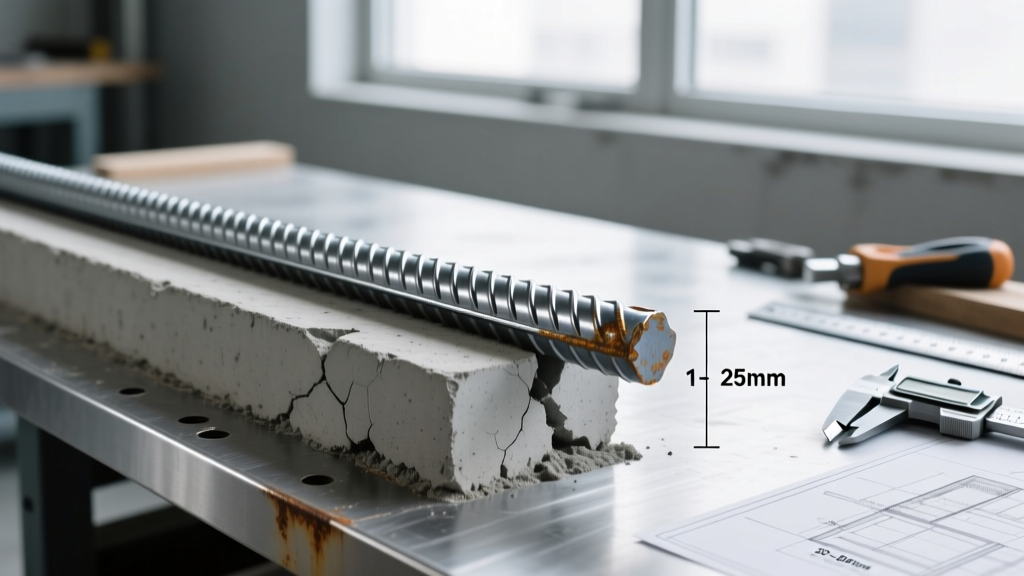
Baseline Durability: Uncoated Grade 60 #4 Rebar
Number 4 rebar, universally recognized by its 1/2-inch nominal diameter, remains the primary tensile reinforcement for residential foundations, light commercial slabs, and retaining walls. When specifying uncoated, black Grade 60 #4 rebar (ASTM A615), structural engineers are relying on the alkaline environment of Portland cement concrete to passivate the steel surface. This passive oxide layer is what prevents rust and dictates the material's baseline lifespan.
- Nominal Diameter: 0.500 inches (12.7 mm)
- Cross-Sectional Area: 0.20 sq inches
- Weight: 0.668 lbs per linear foot
- Yield Strength (Grade 60): 60,000 psi minimum
In a controlled, interior, dry environment where the concrete remains uncarbonated and free of chlorides, black #4 rebar can easily exceed a 100-year structural lifespan. However, the moment the passive layer is compromised by carbonation (the natural lowering of concrete pH over time) or chloride ingress (from de-icing salts or marine environments), the corrosion clock accelerates exponentially. Rust occupies up to six times the volume of the original steel, generating internal tensile stresses that crack and spall the concrete cover, ultimately exposing the rebar to direct atmospheric attack.
Environmental Degradation Timelines
The lifespan of #4 rebar is not an inherent property of the steel itself, but rather a function of its surrounding matrix and environmental exposure. The following matrix outlines expected timeframes to initial corrosion and subsequent structural compromise based on exposure conditions, assuming standard 2-inch concrete cover.
| Exposure Environment | Time to Depassivation | Time to Spalling/Failure | Primary Corrosion Catalyst |
|---|---|---|---|
| Interior, Climate-Controlled | 75 - 100+ years | 100+ years | Deep carbonation |
| Exterior, Inland (No De-icing) | 40 - 60 years | 60 - 80 years | Atmospheric carbonation, moisture |
| Exterior, Freeze-Thaw (De-icing Salts) | 10 - 20 years | 20 - 35 years | Chloride ion penetration |
| Marine Splash Zone | 5 - 12 years | 15 - 25 years | High-concentration chlorides, oxygen |
The Criticality of Concrete Cover Depth
According to the American Concrete Institute (ACI) 318 building code, the minimum concrete cover for #4 rebar is strictly dictated by placement and exposure. For #4 rebar cast against and permanently exposed to earth, the minimum cover is 1.5 inches. For #4 rebar exposed to earth or weather, the requirement jumps to 2 inches. Field studies consistently show that every additional 0.5 inches of high-quality, low-permeability concrete cover can double the time it takes for chlorides to reach the steel reinforcement. Specifying #4 rebar without enforcing strict cover tolerances via plastic or steel chairs is a primary cause of premature structural failure.
Extending Lifespan: Coated and Alloyed #4 Rebar
When designing for harsh environments in 2026, relying solely on concrete cover is often insufficient. Engineers must specify modified #4 rebar to halt electrochemical corrosion. Below is a comparative analysis of the three primary alternatives to black steel.
Epoxy-Coated #4 Rebar (ASTM A775/A934)
Lifespan Extension: Adds 15-25 years in chloride environments.
Mechanism: A fusion-bonded epoxy powder creates a physical dielectric barrier, preventing moisture and chlorides from contacting the steel.
The Catch: The macrocell corrosion risk. If the epoxy coating is chipped during transit or tying (which is common), the small exposed anode corrodes rapidly when coupled with the massive surrounding area of coated cathode. Inspectors must mandate field touch-up of all holidays (flaws) using approved epoxy patching compounds.
Hot-Dip Galvanized #4 Rebar (ASTM A153)
Lifespan Extension: Adds 30-40 years.
Mechanism: A zinc coating acts as both a physical barrier and a sacrificial anode. Even if the coating is scratched, the zinc corrodes preferentially to protect the underlying steel.
The Catch: Zinc reacts with the high alkalinity of fresh Portland cement, generating hydrogen gas. This can cause micro-voids at the steel-concrete interface, slightly reducing bond strength. Using chromate passivation or specific cement blends mitigates this issue.
Stainless Steel #4 Rebar (ASTM A955)
Lifespan Extension: 75 to 100+ years in marine/salt environments.
Mechanism: Alloyed with chromium, nickel, and molybdenum (typically Grade 316L or 2205 duplex), the steel forms an impenetrable, self-healing passive layer that is entirely immune to standard chloride ingress.
The Catch: Cost. As of 2026, stainless #4 rebar carries a 300% to 500% price premium over black steel. However, life-cycle cost analyses by the Federal Highway Administration frequently justify this upfront capital for marine bridges and critical infrastructure where future repair access is prohibitively expensive.
Non-Destructive Testing for In-Situ #4 Rebar
For existing structures where #4 rebar was utilized, predicting remaining lifespan requires empirical data rather than theoretical models. Structural forensic engineers rely on Half-Cell Potential Testing (ASTM C876) to map the corrosion probability of the embedded rebar grid.
Diagnostic Threshold: When utilizing a copper/copper sulfate reference electrode, a half-cell potential reading more negative than -350 mV indicates a greater than 90% probability that active corrosion is currently occurring on the #4 rebar network. Readings between -200 mV and -350 mV represent an uncertain, transitional state requiring further chloride profiling.
Combining half-cell mapping with ground-penetrating radar (GPR) allows engineers to locate the exact depth of the #4 rebar mat, verifying whether the original contractors adhered to the minimum cover requirements or if the steel was inadvertently stepped on and pushed closer to the surface during the concrete pour.
Procurement and Specification Checklist
To ensure maximum durability for your next project utilizing #4 rebar, implement the following actionable specifications during the procurement and pre-pour phases:
- Verify Mill Certifications: Require the supplier to provide Mill Test Reports (MTRs) confirming the heat number, chemical composition, and yield strength meet ASTM A615 (for black) or the relevant coating standard.
- Mandate Continuous Chairing: Specify continuous high-chair supports spaced at a maximum of 36 inches on center to prevent #4 rebar deflection under the weight of workers and wet concrete.
- Specify Low-Permeability Mixes: For exterior #4 rebar applications, require a concrete mix design with a maximum water-to-cement (w/c) ratio of 0.40 and incorporate supplementary cementitious materials (SCMs) like fly ash or slag to densify the matrix and block chloride pathways.
- Enforce Epoxy Touch-Up Protocols: If using epoxy-coated #4 rebar, explicitly state in the contract that all wire tie marks, cuts, and abrasions must be patched with a two-part epoxy resin approved by the coating manufacturer prior to the concrete pour.
- Implement Vibrator Limits: Instruct crews to keep internal concrete vibrators at least 6 inches away from the #4 rebar grid to prevent segregation of the cement paste directly adjacent to the steel, which creates porous, vulnerable zones.
By treating #4 rebar not just as a commodity tensile material, but as a component of a complex electrochemical system, builders and engineers can accurately predict lifespans and eliminate the costly structural remediations associated with premature rebar corrosion.