Installing Metal Roofing: A Post-Install Maintenance Playbook
Discover the essential post-install cleaning and maintenance playbook for installing metal roofing, preventing swarf rust, and preserving warranties.
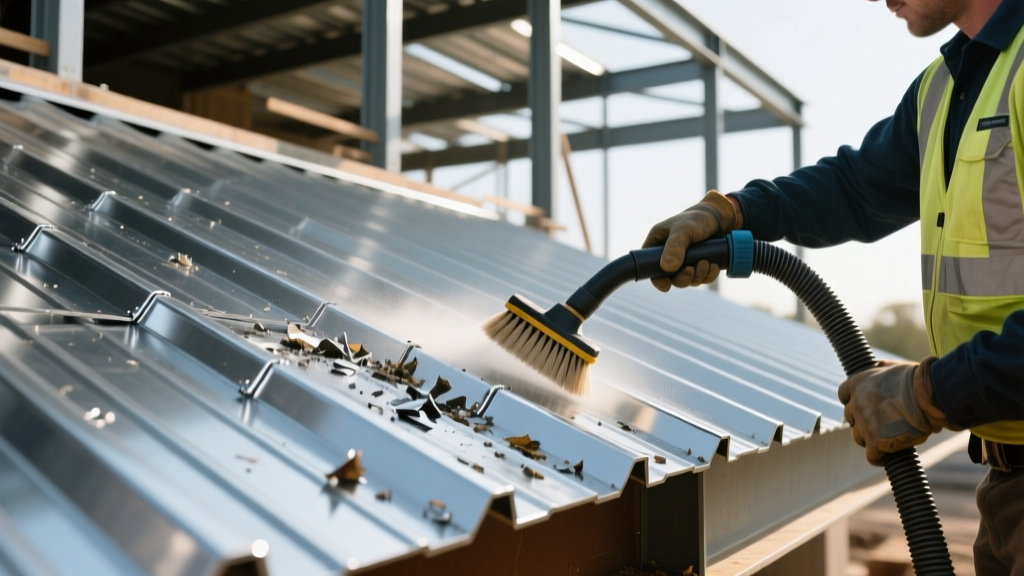
The Hidden Threat of Swarf: Day-Zero Eradication
The final phase of installing metal roofing is not driving the last fastener; it is the immediate eradication of manufacturing and installation debris. The most critical byproduct of cutting and drilling steel panels is swarf—microscopic, hot steel filings generated by drill bits, impact drivers, and mechanical shears.
When steel swarf lands on a Galvalume® or painted PVDF surface, it creates a dissimilar metal couple. Within 24 to 48 hours, ambient moisture triggers galvanic corrosion. The swarf rusts, fusing permanently to the factory coating and eating through the protective zinc-aluminum substrate. This specific failure mode is universally excluded from manufacturer paint warranties.
The Day-Zero Cleaning Protocol
Before the crew leaves the site, execute this non-negotiable cleanup sequence:
- Dry Sweep: Use a soft-bristle push broom (nylon or horsehair, never wire or stiff synthetic) to sweep the entire roof plane from ridge to eave.
- High-Velocity Air: Follow up with a commercial backpack leaf blower rated for a minimum of 150 MPH / 800 CFM. Pay special attention to panel ribs, valleys, and transitions where swarf accumulates.
- Magnetic Pass: For large commercial installations, run a heavy-duty magnetic sweeper over the roof surface and the surrounding ground to catch hidden ferrous filings.
The 30-Day Post-Install Wash Protocol
Even with meticulous installation, panels accumulate boot marks, sealant smears, cutting oil residues, and chalk lines. According to the Metal Roofing Alliance, failing to remove construction contaminants within the first 60 days can lead to permanent UV-baked staining.
Approved vs. Prohibited Cleaning Agents
Modern Kynar 500® and Hylar 5000® based PVDF resin coatings are highly chemical-resistant, but aggressive solvents will strip the clear coat and chalk the pigment. Use the following matrix to treat specific post-install stains:
| Stain Type | Approved Cleaner | Application Method | Prohibited Agents |
|---|---|---|---|
| General Dirt / Boot Marks | Simple Green® Pro HD (1:10 dilution) | Soft sponge, rinse immediately | TSP, Chlorine Bleach |
| Tree Sap / Adhesive | Isopropyl Alcohol (70%+) | Microfiber cloth, spot treatment | Acetone, Paint Thinner |
| Chalk Line Residue | Mild dish soap + soft bristle brush | Agitate gently, let sit 5 mins | Wire brushes, scouring pads |
| Silicone Sealant Smears | Plastic putty knife + Mineral Spirits | Scrape gently, wipe with solvent | Metal razor blades |
Pressure Washing Parameters (Year 1 and Beyond)
A common misconception when maintaining a roof after installing metal roofing panels is that high-pressure water is required to remove environmental pollutants. High pressure is the fastest way to force water past the panel sidelaps and destroy the weathertight integrity of the building envelope.
"Never use a zero-degree rotary nozzle or a turbo-tip on a metal roof. The concentrated pinpoint pressure will instantly fracture the PVDF coating and dent the steel substrate. Always utilize a 40-degree fan tip and maintain a strict 24-inch standoff distance."
The Safe Wash Specification
- Maximum Pressure: 1,500 PSI (Cold water only; hot water can thermally shock the coating).
- Nozzle Type: 40-degree (white) or 25-degree (green) flat fan tip.
- Detergent Injection: Use a downstream chemical injector to apply a biodegradable roof wash (like Rid-O-Fire or a dedicated metal roof cleaner) at low pressure, allow 10 minutes of dwell time without drying, and rinse with the 1,500 PSI fan stream.
- Directionality: Always spray parallel to the panel ribs or at a shallow downward angle. Never spray upward into the panel laps or ridge vents.
Fastener & Penetration Torque Audits
If your project involved installing metal roofing with an exposed fastener system (such as R-Panel, Corrugated, or Ag-Panel), the thermal expansion and contraction cycles of the first year will cause fastener back-out. The National Roofing Contractors Association (NRCA) recommends a mandatory 12-month post-installation torque audit.
The 12-Month Re-Torque Playbook
- Identify Over-Driven Screws: Look for neoprene washers that are squashed completely flat or bulging unevenly. These have lost their elastic memory and must be replaced with oversized fasteners.
- Identify Under-Driven Screws: If the washer is not compressed to form a visible seal ring, the fastener is loose. Use a calibrated cordless impact driver set to a low torque clutch (typically 180-250 in-lbs for #10 and #12 screws) to snug them down.
- Penetration Flashing: Inspect all pipe boots, HVAC curbs, and ridge vents. Re-apply a bead of high-modulus, low-VOC polyurethane sealant (such as Novaflex or Geocel) to any flashing joints showing micro-cracking.
Wet metal roofs have a coefficient of friction near zero. According to OSHA fall protection standards, any cleaning or maintenance performed on a roof with a pitch greater than 4:12 requires 100% tie-off via a certified anchor system, or the use of specialized parapet scaffolding. Never rely on roof jacks or foam pads alone on a wet, sloped steel surface.
Warranty Preservation Matrix
Manufacturers of premium steel roofing (such as MBCI, ATAS, and Petersen) issue 30-year non-prorated warranties on PVDF coatings, but these documents contain strict maintenance caveats. To ensure your warranty remains valid decades after installing metal roofing, avoid the following warranty-voiding actions:
- Storing Dissimilar Materials: Never leave copper flashing, untreated steel tools, or aluminum ladders resting on the roof overnight. Galvanic transfer will stain the panels.
- Uncapped Exhaust Vents: Chemical exhaust from HVAC systems, plumbing vents, or industrial processes will degrade the resin. Ensure all vents are properly capped and directed away from the roof plane.
- Skipping the Annual Wash: In coastal or heavy-industrial environments, failure to wash salt spray or acidic pollutants off the roof annually will result in a denied warranty claim for edge-creep corrosion.
- Unauthorized Touch-Ups: Never use hardware-store spray paint to cover scratches. Only use manufacturer-approved, air-dry fluoropolymer touch-up paint applied with a fine-tip brush strictly to the bare metal, avoiding the surrounding factory coating.
By treating the completion of the install as the beginning of the maintenance lifecycle, building owners can easily push a steel roof's functional lifespan past 50 years, maintaining both its weathertight integrity and its aesthetic reflectivity.