Vetting Steel Stud Framing Contractors on Corrosion Protection
Learn how to vet steel stud framing contractors for corrosion protection expertise, including G60 vs G90 coatings, cutting protocols, and moisture management.

The Hidden Vulnerability in Light-Gauge Steel Framing
Light-gauge steel framing (LGSF) is widely specified for its dimensional stability, non-combustibility, and resistance to biological degradation. However, the material's longevity hinges entirely on its zinc coating. While the mill applies this protective layer, it is the steel stud framing contractors who determine whether that protection survives the construction phase. Poor handling, improper cutting, and negligent on-site storage can compromise the galvanic barrier before the drywall is even hung.
For general contractors and project managers, hiring a framing crew based solely on the lowest bid per square foot is a false economy. If a contractor lacks rigorous corrosion protection protocols, the resulting red rust, white rust (wet storage stain), or galvanic corrosion can lead to catastrophic structural failures or interior finish blowouts decades later. This guide provides a technical framework for evaluating a contractor's corrosion management expertise.
The Coating Specification Matrix: G60 vs. G90 vs. G165
A competent framing contractor must understand that not all galvanized coatings are interchangeable. The ASTM A653 standard dictates coating designations based on the total weight of zinc applied to both sides of the steel sheet. During pre-qualification, ask the estimator which coating weights they default to for different building zones.
| Designation | Zinc Weight (oz/ft²) | Approx. Thickness (mils) | Standard Application | High-Risk Application |
|---|---|---|---|---|
| G60 | 0.60 | 0.50 | Interior, climate-controlled, non-load-bearing partitions. | Exterior sheathing, high-humidity zones. |
| G90 | 0.90 | 0.75 | Exterior wall framing, load-bearing structural studs, roof trusses. | Direct contact with masonry or concrete. |
| G165 | 1.65 | 1.38 | Coastal environments, agricultural buildings, chemical exposure. | Standard interior commercial (overkill/cost-prohibitive). |
Expert Insight: If a contractor proposes using G60 studs for exterior curtain wall framing to save $0.15 per linear foot, reject the submittal. According to the Steel Framing Industry Association (SFIA), exterior framing requires a minimum of G90 to withstand the vapor drive and potential condensation within the wall cavity.
Field Fabrication: Cutting and Touch-Up Protocols
The most common point of corrosion failure occurs at the cut edge. When a stud is severed, the bare steel core is exposed. The zinc coating provides "sacrificial" galvanic protection to the immediate surrounding area, but large cuts or ground edges deplete this reserve rapidly.
Approved vs. Prohibited Cutting Methods
- Approved: Aviation snips, electric shears, and mechanical chop saws with carbide-tipped ferrous metal blades. These methods shear the metal, leaving a clean edge that maximizes the sacrificial protection of the adjacent zinc.
- Prohibited: Abrasive cutoff saws (friction saws) and oxy-acetylene torches. The extreme heat generated by abrasive wheels burns the zinc coating back up to 1/2 inch from the cut line, creating a massive zone of unprotected steel.
The Touch-Up Mandate
Require contractors to specify a zinc-rich touch-up compound for all field cuts, welds, and scratches. The compound must meet ASTM A780 and contain a minimum of 90% zinc dust in the dry film. Products like ZRC Cold Galvanizing Compound or Thurmalox 245 are industry standards. Standard "galvanized-look" spray paints contain aluminum or acrylic resins and provide zero galvanic protection. Inspect the job site for these specific aerosol cans or brush-on pots; their absence is a red flag.
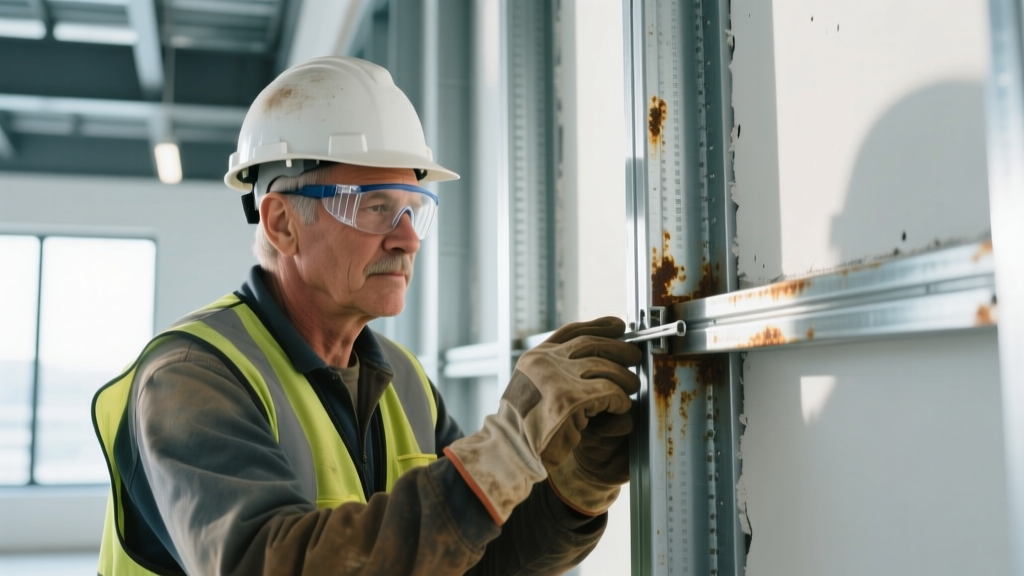
Steel stud framing contractors must isolate LGSF from more noble metals. If copper water lines or aluminum window frames rest directly against bare or scratched steel studs in the presence of an electrolyte (condensation), the steel will act as an anode and corrode rapidly. Mandate the use of neoprene gaskets, dielectric unions, or heavy-mil fluid-applied membranes at all dissimilar metal junctions. For fasteners, require Class 3 or Class 4 coated screws (e.g., ITW Buildex Stalgard) rather than standard zinc-plated drywall screws, which will rust out in exterior assemblies.
On-Site Storage and the "White Rust" Phenomenon
Zinc is highly reactive. When galvanized steel is stacked tightly and exposed to trapped moisture, it forms zinc carbonate—a chalky, white, powdery substance known as "white rust" or wet storage stain. While white rust does not immediately compromise the structural integrity of the steel, it consumes the sacrificial zinc layer, drastically reducing the lifespan of the stud and creating a poor surface for drywall adhesion.
"A framing contractor's material handling plan is just as critical as their installation plan. Stacking G90 studs flat on a muddy subfloor and tarping them tightly is a guaranteed recipe for white rust destruction within 72 hours." — Corrosion Engineering Guidelines, American Iron and Steel Institute (AISI).
Mandatory Storage Protocols to Enforce
- Elevation: Bundles must be elevated at least 4 inches off the ground using treated lumber dunnage.
- Orientation: Store bundles on edge (vertical) rather than flat to allow water to drain and air to circulate between individual studs.
- Covering: If tarps are necessary, they must be loosely draped to allow cross-ventilation. Never wrap steel bundles tightly in plastic.
- Sequencing: Just-in-time delivery is preferred. Do not allow contractors to order the entire project's steel framing on day one if the building is not yet dried in.
The GC’s Pre-Qualification Checklist
When interviewing steel stud framing contractors, integrate these specific technical questions into your RFP process. Their answers will immediately separate experienced commercial framing specialists from residential crews attempting to cross over into commercial work.
- Question 1: "What is your standard protocol for touching up field cuts on G90 exterior studs, and what specific ASTM standard does your touch-up paint meet?" (Target answer: ASTM A780, zinc-rich paint >90% zinc dust).
- Question 2: "How do you detail the bottom track where it meets a concrete slab-on-grade to prevent capillary moisture wicking?" (Target answer: Use of a sill sealer, fluid-applied waterproofing membrane, or elevated track with a gap sealed with acoustical sealant).
- Question 3: "What coating class do you specify for self-drilling screws in exterior shear wall assemblies?" (Target answer: Class 3 or Class 4 corrosion-resistant coatings, not standard electroplated zinc).
- Question 4: "If your crew encounters white rust on a bundle of studs delivered to the site, what is your remediation process?" (Target answer: Wire brushing to remove the zinc carbonate, followed by application of a zinc-rich primer. Severely affected studs are rejected and returned to the supplier).
Financial Implications of Negligence
Failing to vet your framing contractor's corrosion practices carries steep financial risks. Replacing a corroded bottom track in a completed commercial building requires demolishing the drywall, removing the baseboard and flooring, cutting out the rotted track, and rebuilding the wall base. The cost of this remediation averages $45 to $85 per linear foot in 2026, factoring in labor, material, and finish restoration. Conversely, enforcing strict cutting, fastening, and storage protocols adds less than $0.05 per square foot to the initial framing budget. By prioritizing corrosion literacy during the bidding phase, project teams secure the long-term durability of the steel framing assembly.
Written by
Elena RodriguezElena Rodriguez is a civil engineer and technical writer specializing in concrete technology, masonry systems, and ASTM/ACI compliance. She earned her B.S. in Civil Engineering from Texas A&M University and spent a decade at a materials testing laboratory, performing over 2,000 concrete compressive strength tests and masonry prism evaluations. Elena is an ACI-certified Field Testing Technician (Grade I) and a member of ASTM Committee C12 on Natural Building Stone. She currently consults on forensic engineering cases involving concrete failures and moisture intrusion. Based in San Antonio, TX, Elena is a proud member of the Society of Women Engineers (SWE) and coaches her daughter's FIRST Robotics team.
More from Elena Rodriguez
View all
Walls & Panels
Cost Analysis: Light Gauge Steel Framing Advantages and Disadvantages
Evaluate light gauge steel framing advantages and disadvantages through a strict cost analysis lens, comparing material, labor, and lifecycle expenses.
Aug 4, 2026

Walls & Panels
Gypsum Board Types: Exact Specifications, Thickness & Dimensions
Compare standard, Type X, and moisture-resistant gypsum board types. Get exact specifications, thicknesses, dimensions, and ASTM standards for your project.
Aug 4, 2026

Fire Resistance
Best Fire-Resistant Outdoor Decking Materials: 2026 Buyer Guide
Discover the best fire-resistant outdoor decking materials for 2026. Compare Class A PVC, aluminum, and hardwood options for WUI compliance and safety.
Aug 4, 2026