Galvanized Steel Deck Framing Cost Analysis & ROI Guide 2026
Analyze 2026 costs for galvanized steel deck framing vs. wood. Includes material pricing, labor variables, G90 lifespan ROI, and hidden fastener expenses.

The True Cost of Galvanized Steel Deck Framing in 2026
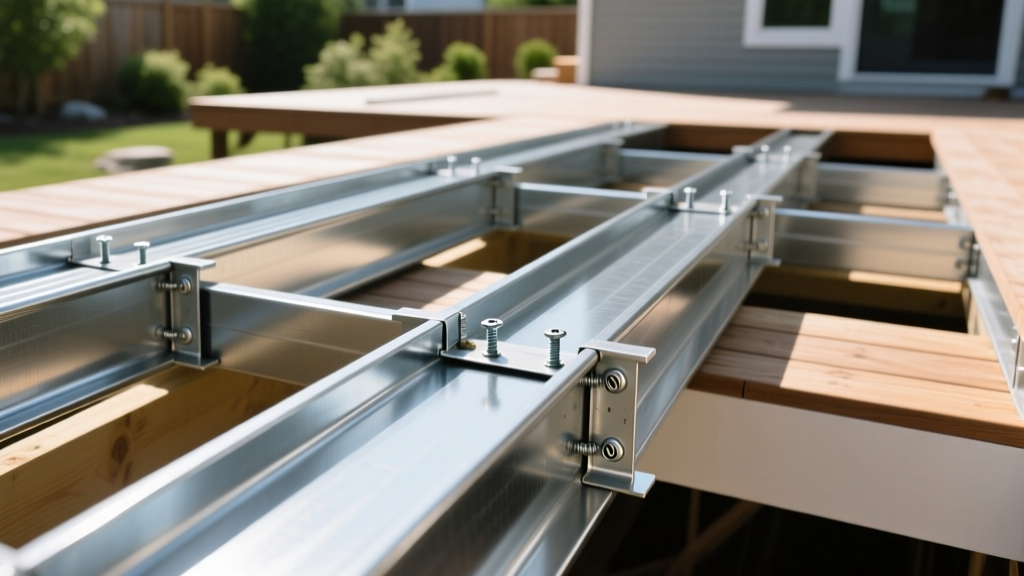
Transitioning from traditional pressure-treated lumber to galvanized steel deck framing represents a significant shift in both upfront capital expenditure and long-term asset management. While wood remains the default for budget-conscious builds, structural light-gauge steel (LGS) has captured the premium composite decking market due to its dimensional stability and extended lifespan. This cost analysis breaks down the exact material, labor, and lifecycle expenses of building with galvanized steel joists in 2026, providing a clear financial framework for contractors and homeowners.
Direct Material Costs: Steel vs. Pressure-Treated Wood
The most immediate barrier to steel framing is the raw material cost. In 2026, the price of structural steel C-channels (typically 16-gauge or 18-gauge) tracks closely with global steel indices and domestic galvanizing capacity. Below is a comparative breakdown for a standard residential deck application (40 PSF live load, 10 PSF dead load).
| Material Component | Pressure-Treated Wood (2x8) | Galvanized Steel (16-ga C-Channel) | Cost Variance |
|---|---|---|---|
| Joist Cost (per linear foot) | $14.50 - $19.00 | $28.00 - $36.00 | +85% to +95% |
| Beam Cost (per linear foot) | $18.00 - $24.00 (Built-up 2x10) | $42.00 - $55.00 (Double C-Channel) | +110% to +130% |
| Post/Column (per 8ft stick) | $22.00 - $28.00 (4x4 or 6x6) | $65.00 - $85.00 (3x3 or 4x4 Steel Tube) | +150% to +200% |
| Material Waste Factor | 10% - 15% (Crowning, splitting) | 2% - 4% (Cut-offs only) | Steel saves 8-11% in waste |
Hidden Costs: Fasteners, Tooling, and Labor Variables
Raw lumber and steel prices only tell half the story. The structural connection points and the tools required to execute them introduce hidden variables that frequently derail preliminary budgets.
Fastener Economics: Wood framing relies on hot-dipped galvanized nails or standard structural screws. Steel framing requires self-drilling structural tek screws (typically #10 or #12 hex washer head). A 250-count box of premium #10 x 1-1/2 inch self-drilling screws costs approximately $45 to $60 in 2026. Because every joist hanger, blocking joint, and beam connection requires these specialized fasteners, expect to spend $1.50 to $2.50 per square foot of deck area purely on structural screws.
Labor Rates and Efficiency: Framing carpenters typically charge a 10% to 15% premium for steel deck framing. However, this is partially offset by the elimination of wood-specific labor: there is no need to crown joists, no warped boards to force into place, and no split lumber to replace. Furthermore, steel joists are significantly lighter than wet pressure-treated wood, reducing crew fatigue and speeding up the beam-setting process.
Long-Term ROI and the G90 Galvanization Factor
The financial justification for galvanized steel deck framing relies on the concept of lifecycle cost parity. The steel used in premium deck framing systems (such as those modeled after Trex Elevations or Fortress Evolution) is coated with a G90 zinc layer. According to the American Galvanizers Association, a G90 coating provides a sacrificial barrier that prevents red rust for decades, even in high-humidity or coastal environments.
"While the initial material cost of light-gauge steel framing can be double that of wood, the elimination of footing replacements, joist sistering, and structural rot repairs over a 25-year period frequently results in a lower total cost of ownership for premium outdoor living spaces." — Steel Framing Industry Association (SFIA) Lifecycle Reports.
The Footing Reduction Advantage
A critical, often overlooked cost-saving mechanism of steel framing is its superior span capability. A standard #2 Southern Yellow Pine 2x8 joist spaced 16 inches on-center can safely span approximately 10 feet to 11 feet. A 16-gauge steel C-channel of the same dimensional profile can span up to 14 feet under identical loads. For a 12-foot deep deck, wood requires an intermediate beam and a corresponding row of concrete footings. Steel spans the entire 12 feet to a single perimeter beam. Eliminating a row of 5 concrete footings (averaging $300 each for digging, sonotubes, and concrete) saves $1,500, instantly recovering a massive portion of the steel material premium.
Maintenance Cost Matrix Over 25 Years
When evaluating ROI, maintenance and replacement schedules must be quantified. Composite decking manufacturers require strict joist spacing and flat surfaces to maintain their warranties; wood joists frequently warp, voiding these warranties. Steel guarantees a perfectly flat substructure.
| Cost Category (25-Year Horizon) | Pressure-Treated Wood Frame | Galvanized Steel Frame |
|---|---|---|
| Initial Framing Material & Labor | $8,500 | $13,200 |
| Sealant/Flashing Tape Application | $450 (Required to prevent rot) | $0 (Not required for steel) |
| Joist Replacement/Repair (Years 15-20) | $2,200 (Sistering rotting joists) | $0 |
| Hardware/Connector Replacement | $350 (Rusted joist hangers) | $0 |
| Total 25-Year Substructure Cost | $11,500 | $13,200 |
While steel maintains a slight edge in total cost over 25 years, the gap closes entirely when factoring in the preservation of the composite decking surface, which is highly susceptible to damage from uneven, warping wood joists.
Decision Framework: When Does Steel Make Financial Sense?
Galvanized steel deck framing is not a universal replacement for wood. Use this decision matrix to determine material viability for your specific project:
- Choose Steel When: Installing high-end composite or PVC decking (which requires perfectly flat, 16-inch O.C. framing to maintain 25-year warranties); building in termite-heavy zones, coastal salt-air environments, or over water; designing complex multi-level decks where reduced substructure weight and longer spans minimize footing requirements.
- Choose Wood When: Building ground-level, floating decks where moisture trapping is minimal; executing budget-constrained builds with natural wood decking (where the deck boards will need replacing before the joists fail anyway); working in remote locations where the cost to ship heavy steel C-channels exceeds local lumber yard pricing.
Frequently Asked Questions
Can I use standard decking screws to attach composite boards to steel joists?
No. Standard composite decking screws are designed to bite into wood fibers. When fastening composite or PVC decking to galvanized steel joists, you must use specialized self-drilling composite-to-steel screws (often featuring a winged reamer that clears the composite material before the threads engage the steel). Failure to use these specific fasteners will result in stripped screw heads and 'mushrooming' of the composite material around the hole.
Does steel deck framing require special permits or engineering?
Most municipal building codes (based on the IRC) accept light-gauge steel framing under prescriptive span tables, provided the steel meets ASTM A653 standards for galvanization and ASTM A1003 for structural grade. However, because steel behaves differently than wood under lateral loads, your local building inspector may require a specific engineered letter for the lateral load path (how the deck resists swaying). Always submit the steel manufacturer's ICC-ES evaluation report with your permit application to prevent inspection delays.
How do I prevent galvanic corrosion when using aluminum accessories?
Direct contact between bare aluminum and galvanized steel in the presence of an electrolyte (rainwater) causes galvanic corrosion, rapidly degrading the aluminum. If your decking system uses aluminum joist hangers, railing posts, or track systems, you must isolate the metals using a dielectric barrier. Apply a heavy coat of zinc-rich cold galvanizing compound or use specialized neoprene isolation pads between the aluminum component and the steel joist before driving the structural screws.
Written by
Priya KapoorPriya Kapoor is a real estate market analyst and construction economics researcher with expertise in housing affordability, development feasibility, and infrastructure investment. She holds a Master of Regional Planning from Cornell University and previously worked as a senior analyst at CBRE's Investment Properties group, where she modeled returns for $4B in mixed-use development pipelines. Priya now runs an independent research practice advising developers, municipalities, and REITs on construction cost forecasting and market timing. She publishes the quarterly "BuildMat Market Pulse" report tracking material price indices across 12 commodity categories. Based in Austin, TX, Priya serves on the board of Habitat for Humanity Austin and is a marathon runner.
More from Priya Kapoor
View all
Construction Cost
Cost to Build a 1600 Sq Ft Home in 2026: Full Breakdown
Accurate 2026 cost to build a 1600 sq ft home—material, labor, and regional pricing breakdowns included. Plan your budget with real-time estimates.
Aug 11, 2026

Wood & Lumber
Name the Types of Wood for Pressure Treatment and Preservation
Learn how to name the types of wood best suited for pressure treatment. Compare species treatability, chemical retention levels, and 2026 preservation costs.
Aug 4, 2026

Stone & Masonry
Stone Veneer Suppliers Lindenhurst: 2026 Cost Analysis
Analyze 2026 stone veneer costs in Lindenhurst, NY. Compare local supplier pricing, delivery fees, and Suffolk County installation labor rates.
Aug 4, 2026