Recycled Steel Building Materials vs Wood and Concrete
Compare recycled steel building materials with wood and concrete. Explore costs, structural benefits, and sustainability for modern construction projects.

The Baseline: What Qualifies as Recycled Steel?
When structural engineers specify W-shapes or Hollow Structural Sections (HSS) for commercial builds, they are almost exclusively utilizing recycled steel building materials. In North America, structural steel is primarily produced via the Electric Arc Furnace (EAF) process, which melts down 93% to 98% post-consumer and post-industrial scrap metal. This contrasts sharply with the Basic Oxygen Furnace (BOF) method, which relies on 70% to 75% virgin iron ore and yields only 25% to 30% recycled content.
For specification purposes, standard ASTM A992 Grade 50 W-shapes and ASTM A500 Grade C HSS tubing produced by EAF mills (such as Nucor or Steel Dynamics) inherently carry the highest recycled content in the heavy construction sector. Understanding how this material stacks up against engineered mass timber and reinforced concrete requires moving past superficial "green" marketing and examining lifecycle carbon, structural dead loads, and end-of-life recovery.
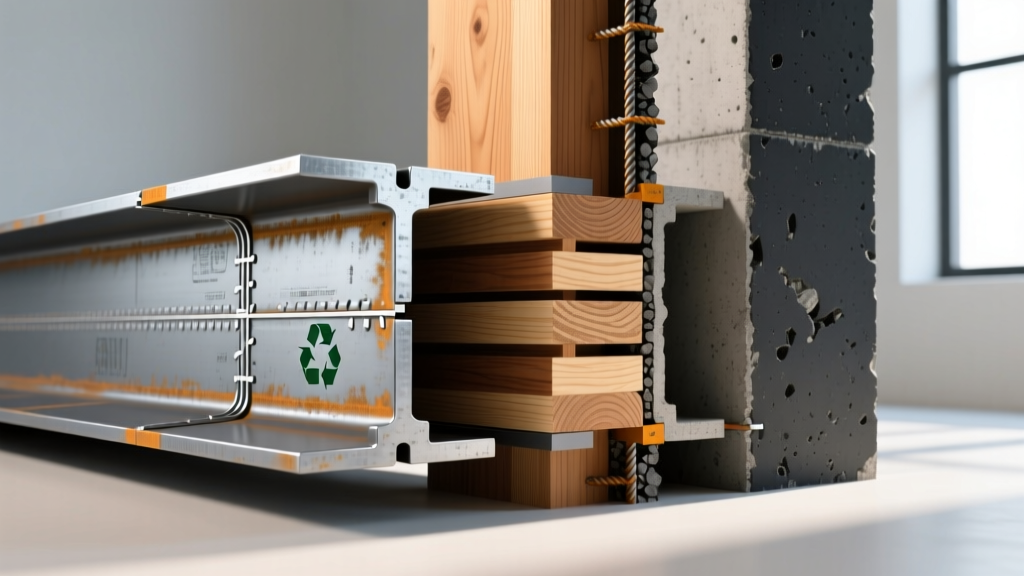
Material Comparison Matrix: Steel vs. Wood vs. Concrete
The following matrix compares EAF-produced recycled structural steel against Cross-Laminated Timber (CLT) and reinforced concrete utilizing a 30% Supplementary Cementitious Material (SCM) mix (fly ash/slag). Data reflects current commercial mid-rise construction metrics.
| Metric | EAF Recycled Steel | Mass Timber (CLT/Glulam) | Reinforced Concrete (30% SCM) |
|---|---|---|---|
| Recycled Content (Average) | 93% - 98% | 0% (Virgin harvested) | 15% - 30% (SCM + rebar) |
| Embodied Carbon (kgCO2e/kg) | 0.35 - 0.50 | -0.50 to -0.90 (Biogenic) | 0.10 - 0.15 |
| Structural Frame Cost (per sq ft) | $28 - $36 | $42 - $65 | $24 - $32 |
| Dead Load Impact on Foundation | Low (Reduces foundation size) | Very Low | High (Requires massive footings) |
| End-of-Life Recovery Rate | 98% (Infinitely recyclable) | <20% (Often landfilled/downcycled) | 85% (Crushed for road base) |
| Seismic Performance | Excellent (Ductile moment frames) | Good (Requires steel connectors) | Poor (Brittle, requires heavy shear walls) |
Recycled Steel vs. Mass Timber: The Carbon and Lifecycle Reality
Mass timber, specifically Cross-Laminated Timber (CLT) and Glulam, is frequently championed for its biogenic carbon sequestration. A cubic meter of CLT stores roughly 700 kg of CO2. However, comparing the raw material carbon of wood directly to the embodied carbon of recycled steel building materials ignores critical structural and lifecycle realities.
Connection Details and Hidden Steel
Mass timber structures cannot be built with wood alone. The structural integrity of a CLT building relies entirely on hidden steel connection plates, self-tapping steel screws, and epoxy anchors. A typical multi-story timber build still requires hundreds of tons of steel for load transfer, lateral bracing, and foundation anchoring. Recycled steel framing eliminates the intermediate material, providing a monolithic structural system where ductility and tensile strength are uniform throughout.
Moisture, Fire, and End-of-Life
While wood sequesters carbon during its growth phase, the US EPA estimates that a significant percentage of construction wood waste ends up in landfills. As timber decomposes anaerobically in a landfill, it releases methane—a greenhouse gas roughly 25 times more potent than CO2 over a 100-year period. Recycled steel does not degrade, off-gas, or lose its metallurgical properties when melted down for its next lifecycle.
Regarding fire performance, heavy timber relies on a predictable charring rate (typically 1.5 inches per hour) to protect its inner core. Recycled steel, while non-combustible, loses tensile strength at temperatures exceeding 1,000°F (538°C). To achieve a 2-hour fire rating, steel beams must be protected with intumescent paint, gypsum board encasement, or cementitious spray fire-resistive materials (SFRM). The cost of SFRM application ($4.50 to $7.00 per square foot of steel surface area) must be factored into the total project budget when comparing against timber's inherent charring properties.
Recycled Steel vs. Reinforced Concrete: Weight and Schedule Economics
Concrete remains the default for core walls and below-grade foundations, but utilizing it for the primary above-grade structural frame introduces severe dead-load penalties. Reinforced concrete weighs approximately 150 pounds per cubic foot (pcf), whereas structural steel frames, including the weight of metal decking and lightweight concrete fill, impose a fraction of that load on the soil.
Foundation Savings and Seismic Advantages
Because recycled steel framing drastically reduces the building's overall dead load, structural engineers can design smaller, less expensive foundations. In regions with poor soil bearing capacity, switching from a concrete frame to a recycled steel frame can reduce foundation costs by 15% to 25%, offsetting the higher per-ton material cost of the steel itself. Furthermore, in high seismic zones, the lighter mass of a steel frame reduces the inertial forces generated during an earthquake, allowing for more ductile, energy-absorbing moment frames compared to the brittle nature of concrete shear walls.
Schedule and Weather Constraints
Concrete requires time to cure to reach its design strength (often 28 days for full compressive capacity), and pouring is highly sensitive to ambient temperatures. Recycled steel components are fabricated off-site using CNC machinery to exact tolerances. Once delivered to the site, a steel erection crew can typically install 5,000 to 8,000 square feet of framing per day, regardless of freezing temperatures, accelerating the dry-in schedule and reducing financing carrying costs.
Procurement: Sourcing and Verifying Recycled Content
For projects targeting LEED v4.1, BREEAM, or the Living Building Challenge, simply specifying "steel" is insufficient. Project managers must verify the exact recycled content to secure Environmental Product Declaration (EPD) credits.
- Demand Mill-Specific EPDs: Do not accept industry-average EPDs. Require the fabricator to provide mill-specific EPDs from the actual EAF producer (e.g., Nucor, Steel Dynamics, or Commercial Metals Company) that detail the exact post-consumer and pre-consumer scrap percentages.
- Track the Heat Numbers: Every piece of structural steel is stamped with a heat number. Ensure your steel detailer and fabricator maintain a ledger mapping these heat numbers to the corresponding mill test reports (MTRs) to prove the recycled content to the commissioning agent.
- Specify EAF over BOF: Explicitly state in the structural notes that W-shapes and HSS must be sourced from EAF mills. While BOF mills produce excellent steel, their lower recycled content (approx. 28%) can jeopardize targeted sustainability thresholds.
Technical Decision Framework: When to Specify Recycled Steel
Use the following decision matrix to determine if recycled steel is the optimal primary framing material for your specific project parameters:
- The site has poor soil conditions where minimizing dead load is critical to avoiding deep pile foundations.
- The project requires long, column-free spans (e.g., open-plan offices, gymnasiums) where steel castellated beams outperform timber and concrete.
- The construction schedule is compressed, and winter weather will halt concrete curing operations.
- The project targets high circular-economy metrics, requiring 90%+ end-of-life material recovery.
Frequently Asked Questions
Does recycled steel have the same structural yield strength as virgin steel?
Yes. The EAF melting process, combined with modern micro-alloying and thermomechanical rolling, produces steel that perfectly meets ASTM A992 specifications (50 ksi minimum yield strength). There is no structural degradation or "downcycling" when steel is melted and reformed.
How does the cost of recycled steel fluctuate compared to timber?
Recycled steel pricing is tied to the global scrap metal market and energy costs, typically ranging from $1,200 to $1,600 per fabricated ton. Mass timber pricing is heavily dependent on regional forestry yields, resin costs, and specialized fabrication monopolies, often resulting in higher volatility and a 20% to 40% premium over steel for the structural frame.
Can recycled steel be used in highly corrosive environments?
Yes, but it requires specific protective coatings. For coastal or high-humidity environments, specify hot-dip galvanizing per ASTM A123 or utilize advanced weathering steel (ASTM A588), which forms a stable, protective rust patina that halts further corrosion without the need for paint.
Written by
Priya KapoorPriya Kapoor is a real estate market analyst and construction economics researcher with expertise in housing affordability, development feasibility, and infrastructure investment. She holds a Master of Regional Planning from Cornell University and previously worked as a senior analyst at CBRE's Investment Properties group, where she modeled returns for $4B in mixed-use development pipelines. Priya now runs an independent research practice advising developers, municipalities, and REITs on construction cost forecasting and market timing. She publishes the quarterly "BuildMat Market Pulse" report tracking material price indices across 12 commodity categories. Based in Austin, TX, Priya serves on the board of Habitat for Humanity Austin and is a marathon runner.
More from Priya Kapoor
View all
Construction Cost
Cost to Build a 1600 Sq Ft Home in 2026: Full Breakdown
Accurate 2026 cost to build a 1600 sq ft home—material, labor, and regional pricing breakdowns included. Plan your budget with real-time estimates.
Aug 11, 2026

Wood & Lumber
Name the Types of Wood for Pressure Treatment and Preservation
Learn how to name the types of wood best suited for pressure treatment. Compare species treatability, chemical retention levels, and 2026 preservation costs.
Aug 4, 2026

Stone & Masonry
Stone Veneer Suppliers Lindenhurst: 2026 Cost Analysis
Analyze 2026 stone veneer costs in Lindenhurst, NY. Compare local supplier pricing, delivery fees, and Suffolk County installation labor rates.
Aug 4, 2026