What Building Materials Were Used to Construct Old Ironsides? Oak to Steel
Discover what building materials were used to construct Old Ironsides and how historical live oak compares to modern marine-grade structural steel.

The Historical Reality: What Building Materials Were Used to Construct Old Ironsides?
Despite the legendary nickname 'Old Ironsides,' the USS Constitution was not constructed from iron or steel. When addressing the question of what building materials were used to construct Old Ironsides, the answer lies in advanced 18th-century timber engineering and early American metallurgy. Launched in 1797, the frigate's hull was a composite of specific hardwoods and non-ferrous metals designed to withstand cannon fire and marine borers.
The Primary Timber: Southern Live Oak
The structural framing of the USS Constitution relied heavily on Southern Live Oak (Quercus virginiana). Sourced primarily from the coastal regions of Georgia and South Carolina, live oak possesses a density of approximately 75 pounds per cubic foot—nearly double that of standard white oak. Its interlocking grain structure provided immense compressive and bending strength, allowing the hull to absorb and deflect kinetic energy from cannonballs rather than splintering.
- Outer Planking: White oak was used for the outer hull planking, measuring up to 7 inches thick.
- Inner Planking: The inner ceiling planking was also white oak, creating a massive sandwich-like hull.
- Structural Frame: Live oak ribs were spaced mere inches apart, creating a nearly solid wall of timber.
Metallurgy and Fasteners: Copper and Iron
While the hull was wood, the fasteners and protective sheathing were metallic. To protect against the teredo worm (shipworm), the bottom of the hull was sheathed in over 150 tons of copper sheets. The fastening bolts were a mix of copper and iron. Notably, American patriot and silversmith Paul Revere was contracted to forge copper bolts and hardware for the ship's refitting, representing some of the earliest specialized marine metallurgy in the United States.
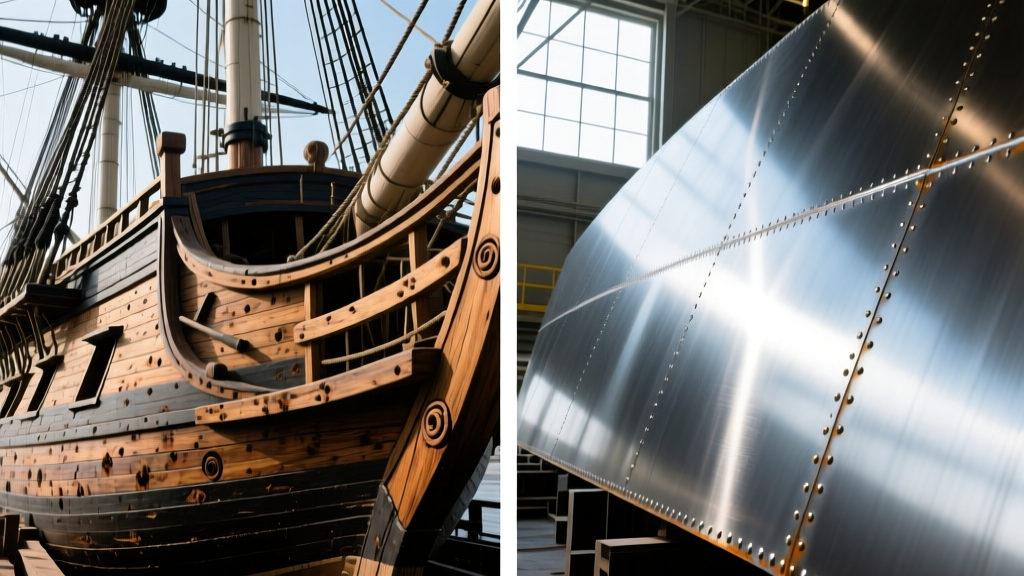
From Live Oak to High-Tensile Steel: The Marine Material Evolution
The impenetrable reputation of Old Ironsides inadvertently set a psychological benchmark for naval armor, eventually driving the transition from timber to ironclads in the 1860s, and ultimately to modern marine-grade structural steel. Today, the building materials used in coastal and marine construction have shifted entirely to advanced alloys governed by strict classification societies like the American Bureau of Shipping (ABS).
Modern shipbuilding and coastal infrastructure rely on high-tensile structural steels that offer the strength of the historical live oak frame but with predictable, engineered material properties. According to the USS Constitution Museum, maintaining the original wooden hull requires continuous, specialized timber sourcing, whereas modern marine steel offers standardized, scalable fabrication.
Modern Marine Steel Classifications (ASTM A131)
Contemporary marine construction utilizes steel graded under ASTM A131 / ABS rules. These steels are categorized by their yield strength and impact toughness at varying temperatures:
- Grade A (Mild Steel): Minimum yield strength of 34 ksi (235 MPa). Used for general, non-critical structural framing.
- AH36 / DH36 / EH36 (High-Strength Steel): Minimum yield strength of 51 ksi (355 MPa). The 'H' denotes high strength, while the prefix letter (A, D, E) dictates the impact testing temperature (Ambient, 0°C, and -20°C respectively). EH36 is standard for hull plating in vessels operating in icy or extreme coastal environments.
Material Comparison: Old Ironsides vs. Modern Marine Steel
To understand the engineering leap from 1797 to modern coastal construction, we must compare the physical properties of the historical materials against modern structural equivalents.
| Material | Era / Application | Yield / Crushing Strength | Vulnerability |
|---|---|---|---|
| Southern Live Oak | 1797 Hull Framing | ~8,000 psi (Compressive) | Rot, fire, shipworm |
| Copper Sheathing | 1797 Anti-fouling | ~10,000 psi | Galvanic corrosion if mixed with iron |
| AH36 Marine Steel | Modern Ship Hulls | 51,000 psi (355 MPa) | Oxidation (rust), chloride pitting |
| 316L Stainless Steel | Modern Coastal Fittings | 30,000 psi (205 MPa) | Crevice corrosion in stagnant saltwater |
Corrosion Protection: From Copper Nails to Cathodic Anodes
The builders of Old Ironsides learned the hard way that mixing dissimilar metals in a saltwater electrolyte causes rapid galvanic corrosion. Early iron bolts driven through copper sheathing deteriorated quickly. Modern marine steel construction solves this through advanced coating systems and cathodic protection.
Modern Anti-Corrosion Frameworks
For structural steel used in marine environments (such as pier pilings, offshore platforms, and coastal retaining walls), the 2026 standard practice involves a multi-tiered defense:
- Surface Preparation: Blast cleaning to SSPC-SP10 (Near-White Metal) standard to remove all mill scale.
- Primer Coat: Zinc-rich epoxy primer (minimum 3.0 mils dry film thickness) providing sacrificial galvanic protection similar to the historical copper sheathing.
- Topcoat: Polyurethane or polysiloxane topcoat for UV and chloride resistance.
- Sacrificial Anodes: For submerged steel pilings, aluminum or zinc galvanic anodes are welded to the structure to corrode preferentially, protecting the primary steel matrix.
Applying Marine-Grade Steel to Land-Based Coastal Construction
The principles that govern modern shipbuilding have heavily influenced land-based coastal architecture. When specifying steel for beachfront properties, boardwalks, or marine terminals, standard A36 carbon steel is insufficient due to the high chloride content in sea spray.
Specifying for the Splash Zone
The 'splash zone'—the area of a structure subjected to alternating wetting and drying from wave action—is the most aggressive environment for steel. For these applications, structural engineers specify:
- Corten Steel (ASTM A588): A weathering steel that forms a dense, protective rust patina. While excellent for atmospheric coastal exposure, it should not be used in continuously submerged or heavy salt-spray zones without supplemental coating.
- Hot-Dip Galvanizing (ASTM A123): Provides a thick metallurgical zinc coating. For coastal structures, a duplex system (galvanizing plus a marine-grade epoxy topcoat) extends the maintenance-free lifespan to over 50 years.
- Duplex Stainless Steel (e.g., 2205): For critical load-bearing pins, tie-rods, or fasteners in coastal tension structures, 2205 duplex stainless offers double the yield strength of 316L with superior resistance to chloride stress corrosion cracking.
While the USS Constitution remains a triumph of organic material engineering, the transition to marine-grade steel has allowed modern builders to construct coastal infrastructure with mathematical precision, predictable lifespans, and unparalleled tensile strength. Understanding the historical baseline of Old Ironsides highlights exactly why modern ASTM and ABS steel standards are non-negotiable in today's marine and coastal construction projects.
Written by
Sarah WhitfieldSarah Whitfield is a chartered quantity surveyor (MRICS) and construction cost analyst with 15 years of experience in material pricing, procurement strategy, and project budgeting. She earned her degree in Construction Management from the University of Reading (UK) and has worked on projects ranging from $2M custom homes to $180M mixed-use developments across North America and Europe. Sarah currently leads cost estimating for BuildMat Insight, maintaining a proprietary database of 4,000+ material price points updated quarterly. She is a frequent contributor to RSMeans cost data panels and has presented at the International Cost Engineering Council (ICEC) congress. Based in Denver, CO, Sarah is an avid trail runner and volunteer mentor for Women in Construction.
More from Sarah Whitfield
View all
Wood & Lumber
What Are the Different Types of Wood? A Builder's Guide
Compare structural softwoods, finish hardwoods, and engineered lumber. Analyze Janka ratings, MOE values, and 2026 pricing for construction.
Aug 4, 2026

Walls & Panels
Steel Framing vs Wood Framing: Corrosion and Moisture Defense
Compare steel framing vs wood framing for moisture resistance. Learn about galvanized coatings, condensation risks, and corrosion protection strategies.
Jul 21, 2026

Stone & Masonry
How to Cut Stone Veneer: Wet Saw vs Grinder Comparison
Compare the best tools for cutting stone veneer. We review wet saws, angle grinders, and chop saws to help you achieve clean, chip-free cuts.
Jul 21, 2026