Sourcing Steel Framing Near Me: A Contractor's Selection Framework
Discover a contractor's framework for sourcing steel framing near me. Compare local suppliers, evaluate EQ vs structural studs, and optimize freight costs.

The Strategic Reality of Local Steel Sourcing
When commercial estimators and project managers search for 'steel framing near me,' the objective extends far beyond simple convenience. Cold-formed steel (CFS) is a high-volume, low-density material. Sourcing from a distributor outside a 150-mile radius typically triggers Less Than Truckload (LTL) freight classifications, which can inflate total material costs by 15% to 25%. Furthermore, long-haul transit increases the risk of camber (bowing) and edge damage to galvanized coatings.
However, proximity does not guarantee quality. The local building materials market is saturated with suppliers offering varying grades of steel, from certified structural framing to uncertified 'equivalent' studs. This selection framework provides a systematic approach to vetting local steel framing suppliers, ensuring your procurement strategy aligns with both structural engineering requirements and project budgets.
Phase 1: Material Specification and the 'EQ' Trap
Before evaluating local yards, you must lock in your material specifications based on the project's structural engineering documents. The most critical distinction in local CFS procurement is understanding the difference between true structural studs and non-structural or 'EQ' (Equivalent) studs.
Decoding Gauge, Mils, and Yield Strength
Local suppliers often use gauge numbers colloquially, but procurement must be specified in minimum mil thickness and yield strength (ksi) per the Cold-Formed Steel Engineers Institute (CFSEI) guidelines.
| Designation | Min. Thickness (Mils) | Yield Strength (ksi) | Primary Application |
|---|---|---|---|
| 33 mil (20 ga) | 33 | 33 ksi | Non-load-bearing interior partitions |
| 43 mil (18 ga) | 43 | 33 ksi / 50 ksi | Tall interior partitions, light curtain walls |
| 54 mil (16 ga) | 54 | 50 ksi | Load-bearing exterior walls, floor joists |
| 68 mil (14 ga) | 68 | 50 ksi | Heavy load-bearing, high wind/seismic zones |
Procurement Warning: Many local yards stock 'EQ' studs (e.g., labeled as 600S162-54 EQ). These studs match the physical dimensions of a 54-mil structural stud but are manufactured from lower-grade steel or feature modified web punch-outs that compromise shear capacity. They are strictly prohibited for load-bearing applications. Always require the supplier's mill certificate and manufacturer's certification mark verifying compliance with AISI S100.
Galvanization Coatings: G60 vs. G90
Verify the zinc coating weight. G60 (0.60 oz/sq ft) is the industry standard for interior, climate-controlled framing. If your project involves exterior sheathing, high-humidity environments (e.g., indoor aquatic centers), or agricultural facilities, you must source G90 (0.90 oz/sq ft) coated steel. Not all local suppliers stock G90 on the shelf; it often requires a 2-to-3 week lead time from the regional roll-former.
Phase 2: Evaluating the Local Supplier Matrix
Once specifications are set, audit the local suppliers within your freight radius. Use this weighted scoring matrix to evaluate their capability to support your project timeline and quality standards.
| Evaluation Criteria | Weight | What to Look For | Red Flags |
|---|---|---|---|
| On-Site Roll-Forming | 30% | Ability to custom-cut tracks and punch custom web holes on-site. | Only stocks pre-cut 10ft/12ft lengths; relies entirely on regional plants. |
| Inventory Depth | 25% | Full stock of 54-mil and 68-mil structural studs, plus compatible fasteners. | Frequent 'stock-outs' requiring split deliveries to the job site. |
| Mill Certification | 25% | Readily provides AISI-compliant mill certs and ICC-ES evaluation reports. | Hesitant to provide paperwork; pushes 'EQ' studs for structural bids. |
| Delivery Fleet | 20% | Dedicated flatbeds with A-frame or cantilever racks to prevent bowing. | Uses third-party LTL couriers; bundles studs tightly with heavy banding. |
Phase 3: Freight Logistics and Site Delivery
The financial advantage of searching for 'steel framing near me' is realized in the logistics phase. Steel studs are highly susceptible to transit damage. Improper handling destroys the straightness tolerances required for drywall finishing.
Optimizing the Delivery Drop
- Flatbed vs. Box Truck: Insist on flatbed delivery with cantilever racks for lengths exceeding 16 feet. Box trucks require manual unloading, which drastically increases labor hours and the risk of bending the flanges.
- Nesting and Bundling: Request that the supplier nest the studs (stacking them inside one another) and bundle them in quantities of 50 or 100. Ensure the steel banding is padded with edge protectors; bare steel banding will crush the lips of the outer studs, rendering them useless for track engagement.
- Just-In-Time (JIT) Sequencing: If your local supplier has a robust fleet, negotiate JIT deliveries by floor or zone. Storing steel framing on-site in damp conditions before the building is dried-in can lead to white rust (zinc oxide), which compromises the fire rating of the assembly and causes fastener corrosion.
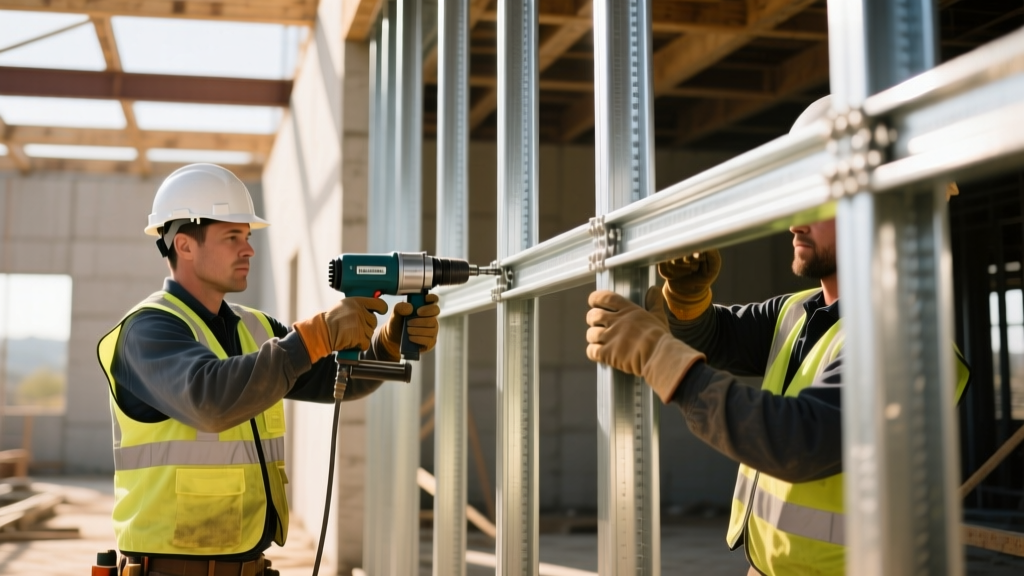
Phase 4: Vetting the Installation Subcontractor
If your scope includes installation, sourcing the material is only half the battle. The Association of the Wall and Ceiling Industry (AWCI) emphasizes that improper fastener selection and spacing are the leading causes of CFS framing failures. When vetting local framing contractors, apply this technical checklist:
- Fastener Protocols: Do they understand the difference between a #8 self-drilling screw with a low-profile head (for drywall tracks) and a #10 or #12 structural hex-washer head screw (for shear walls and moment frames)?
- Tooling Calibration: Pneumatic screw guns must have adjustable depth-sensitive noses. Over-driving a screw strips the thin steel, reducing the pull-out strength by up to 60%.
- Thermal Bridging Mitigation: For exterior walls, verify the contractor's experience with installing thermal break strips and continuous insulation to prevent condensation and energy loss through the highly conductive steel studs.
'The weakest link in a cold-formed steel assembly is rarely the steel itself; it is almost always the connection. A contractor who treats steel framing like wood framing will inevitably fail the structural shear wall inspections.' — Steel Framing Industry Association (SFIA) Technical Guidelines
Execution Checklist for Local Procurement
Before issuing your next purchase order, run your local supplier and material selection through this final verification loop:
- [ ] Spec Lock: Confirmed mil thickness, ksi yield, and G60/G90 coating requirements with the project engineer.
- [ ] EQ Audit: Explicitly excluded 'EQ' or non-structural studs from the structural framing takeoff.
- [ ] Supplier Certs: Secured ICC-ES reports and mill certificates from the local distributor prior to mobilization.
- [ ] Logistics Plan: Scheduled flatbed delivery with padded banding and edge protectors.
- [ ] Fastener Match: Ordered structural and drywall-specific self-drilling screws from the same local yard to ensure compatibility and single-source accountability.
By applying this rigorous selection framework, contractors transform a simple localized search into a strategic procurement advantage, securing code-compliant materials while protecting project margins from hidden freight and rework costs.
Written by
James ThorntonJames Thornton is a construction industry veteran with 25 years of hands-on experience in wood framing, lumber grading, and residential building codes. He started as a framing carpenter in rural Oregon, earned his ICC Residential Building Inspector certification, and eventually became a senior plan reviewer for the City of Portland Bureau of Development Services. James holds a B.S. in Wood Science & Technology from Oregon State University and is a certified lumber grader through the West Coast Lumber Inspection Bureau (WCLIB). He has inspected over 3,000 residential construction sites and authored the city's internal guide on advanced framing techniques (2x6 at 24" O.C.). James lives in Bend, OR, where he builds custom timber-frame cabins and competes in lumberjack sports.
More from James Thornton
View all
Insulation
Best Home Insulation Materials: Complete 2026 Guide
Compare top home insulation materials for 2026. Find R-values, installed costs per square foot, and best uses for fiberglass, spray foam, and mineral wool.
Aug 4, 2026

Sustainable Building
Certify Your Green Building Material for LEED and WELL
Step-by-step guide to certifying a green building material for LEED v5 and WELL v2. Master EPDs, HPDs, and VOC limits for 2026 project specifications.
Aug 4, 2026

Stone & Masonry
Veneer Stacked Stone Panels: Interior Design & Style Showcase
Discover how veneer stacked stone panels transform interiors. Explore modern design profiles, material pairings, and technical installation specs.
Aug 4, 2026