MRI Steel Framing: Grades, Vibration, and Non-Magnetic Specs
Specify the exact steel grades, vibration criteria, and non-magnetic requirements for MRI steel framing to ensure imaging accuracy and safety.

The Dual Challenge: Magnetism and Micro-Vibrations
Designing mri steel framing requires navigating two conflicting physical forces: the immense gravitational load of superconducting magnets and the extreme sensitivity of those same magnets to environmental interference. A modern 3T or 7T MRI system is not merely a heavy piece of medical equipment; it is a precision instrument that demands absolute structural rigidity and zero magnetic distortion. Standard commercial framing practices will result in severe image artifacts, quenched magnets, or catastrophic projectile accidents.
The structural engineering of an MRI suite is divided into distinct spatial zones, each governed by specific steel alloys, fastening protocols, and vibration thresholds. Understanding the transition from heavy carbon steel structural supports to low-permeability austenitic stainless framing is critical for general contractors and specialty medical builders in 2026.
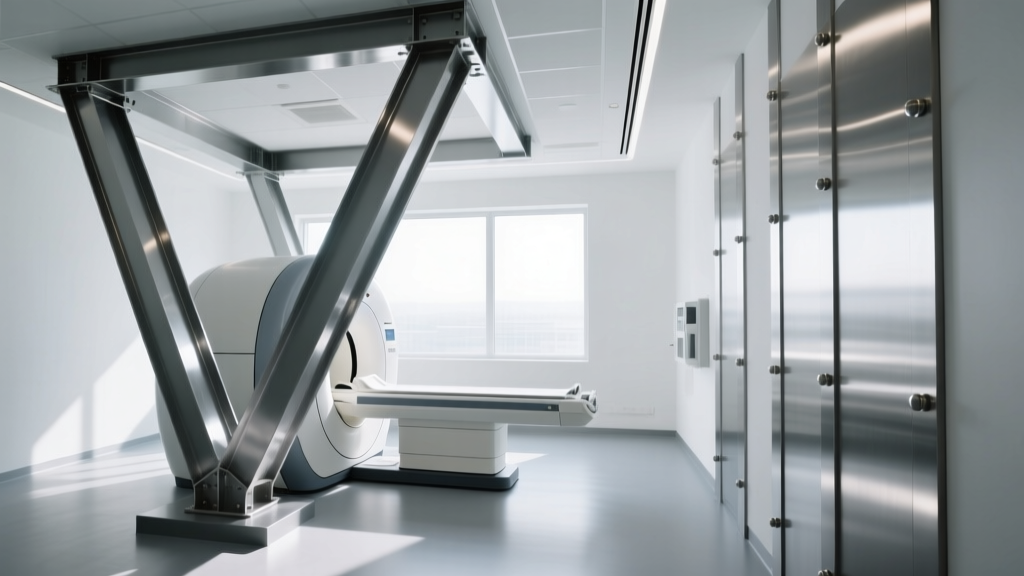
Structural Support: Bearing the 20,000-Pound Magnet
The MRI magnet itself typically weighs between 15,000 and 22,000 pounds, with a highly concentrated center of gravity. The primary structural steel framing supporting the magnet must resist both static deflection and dynamic micro-vibrations. Standard floor assemblies designed for hospital live loads (85 psf) will fail the stringent Vibration Criterion (VC) curves required for high-resolution imaging.
For the magnet's primary support pad and underlying structural grid, engineers specify ASTM A992 Grade 50 wide-flange shapes (W-shapes). W14x109 or larger columns are frequently utilized to minimize lateral sway. The floor system often employs a dedicated concrete plinth isolated from the main hospital slab, reinforced with heavy structural steel dunnage.
Standard hospital corridors operate at VC-A or VC-B (32 to 64 µm/s). However, a 3T MRI requires a minimum of VC-E (8 µm/s), while next-generation 7T research systems demand VC-F (4 µm/s). Achieving VC-F in steel framing requires massive stiffness-to-weight ratios, often necessitating constrained layer damping treatments applied directly to the steel web and flanges to absorb low-frequency ambient vibrations from nearby elevators or HVAC chillers.
To ensure these deflection limits are met, structural connections must be fully moment-resisting. Shear-only connections allow micro-movements that translate into phase-encoding artifacts on the resulting MRI scans. According to the AISC Design Guide 11 on Floor Vibrations, continuous composite action between the steel beams and the concrete topping slab is mandatory to shift the natural frequency of the floor system above the 15-20 Hz range generated by foot traffic and mechanical equipment.
Inside the 5-Gauss Line: Austenitic Stainless Steel
The 5-Gauss line defines the boundary where the MRI's magnetic field drops to 5 Gauss (0.5 milliTesla), the threshold considered safe for pacemakers and general public access. Any ferromagnetic material placed inside this zone will distort the B0 homogeneity field, causing geometric distortion in the images, or worse, become a lethal projectile.
Inside the RF-shielded room (the Faraday cage), standard carbon steel studs (ASTM C645) are strictly prohibited. Instead, interior partition framing, ceiling grids, and equipment supports must utilize austenitic stainless steel, specifically ASTM A240 Type 316L or 304L. The "L" denotes low carbon, which is vital for maintaining non-magnetic properties after welding.
| Steel Grade / Alloy | Relative Magnetic Permeability (µ) | MRI Suitability (Inside 5-Gauss) | Primary Application |
|---|---|---|---|
| Carbon Steel (ASTM A36 / A992) | 100 to 1,000+ | STRICTLY PROHIBITED | Primary structural support (outside shield) |
| Ferritic Stainless (Type 430) | 600 to 900 | STRICTLY PROHIBITED | Never use in MRI suites |
| Martensitic Stainless (Type 410) | 700 to 1,000+ | STRICTLY PROHIBITED | Never use in MRI suites |
| Austenitic Stainless (Type 304) | 1.02 to 1.05 | ACCEPTABLE | Interior partitions, ceiling grids |
| Austenitic Stainless (Type 316L) | 1.01 to 1.02 | OPTIMAL | RF shield supports, wet areas, heavy mounts |
It is a common misconception that all stainless steel is non-magnetic. Ferritic and martensitic stainless steels are highly magnetic. Only the nickel-rich austenitic grades (Series 300) possess the face-centered cubic crystal structure required for low magnetic permeability. The FDA MRI Safety Guidelines mandate rigorous screening of all materials entering the scan room, making certified 316L mill test reports a non-negotiable submittal requirement.
RF Shielding Integration and Framing Tolerances
The mri steel framing inside the suite must also support the copper or aluminum RF (Radio Frequency) shield without compromising its integrity. The RF shield prevents external radio waves from entering the room and causing "zipper" artifacts on the scans.
When anchoring the 316L stainless steel studs to the primary carbon steel structure, direct metal-to-metal contact must be avoided to prevent galvanic corrosion and to maintain the electrical isolation of the RF cage. Builders must use dielectric isolation pads (typically neoprene or high-density fiberglass) between the stainless steel track and the carbon steel dunnage. Furthermore, all penetrations through the RF shield for electrical conduits or HVAC ducts require specialized waveguides and filter boxes, which must be bolted to the stainless framing using non-magnetic hardware.
Quick-Reference Specification Matrix
| Spatial Zone | Framing Material | Fastener Requirement | Vibration Target |
|---|---|---|---|
| Magnet Support Plinth | ASTM A992 Carbon Steel W-Shapes | A325 Structural Bolts | VC-E or VC-F (4-8 µm/s) |
| Equipment / Control Room | Standard Galvanized Steel Studs | Standard Phosphatized Screws | VC-C (16 µm/s) |
| Inside RF Shield (Dry) | ASTM A240 Type 304L Stainless | Type 305 SS Self-Drilling Screws | N/A (Shielded Environment) |
| Inside RF Shield (Wet/Cryogen) | ASTM A240 Type 316L Stainless | Type 316 SS Fasteners | N/A (Shielded Environment) |
Acoustic Decoupling and Resonance Control
An often-overlooked aspect of MRI steel framing is acoustic transmission. During a scan, the gradient coils pulse rapidly within the magnetic field, generating Lorentz forces that produce acoustic noise levels up to 120 dB. If the interior stainless steel framing is rigidly tied to the exterior hospital structure, this structure-borne noise will radiate into adjacent patient rooms and offices.
To mitigate this, the stainless steel wall tracks must be installed with acoustic isolation tape or poured urethane sealant at the floor and ceiling junctions. Additionally, resilient channels (also manufactured from 300-series stainless steel) should be used to mount the interior gypsum board, effectively decoupling the wall finish from the structural studs and breaking the acoustic vibration path.
Critical Installation Failures to Avoid
Even with perfect engineering specifications, field execution errors can compromise the entire MRI suite. The American College of Radiology (ACR) Manual on MR Safety highlights several recurring failures in medical construction:
- Carbon Steel Fastener Contamination: Drywall installers frequently use standard carbon steel drywall screws out of habit. A single box of standard screws hidden inside a 316L stainless steel wall will trigger a massive magnetic susceptibility artifact, rendering the room unusable until the walls are demolished and rebuilt. Only certified 300-series stainless fasteners may enter the RF shielded zone.
- Welding-Induced Magnetism: When welding 304 or 316 stainless steel studs, the intense heat can cause localized "sensitization" or the formation of martensite in the heat-affected zone (HAZ), rendering the weld joint magnetic. Fabricators must use low-carbon "L" grades (316L) and match them with ER316L filler wire, keeping interpass temperatures below 350°F (175°C) to preserve the austenitic crystal structure.
- Rebar in the Concrete Plinth: While not steel framing per se, the concrete plinth supporting the steel dunnage must utilize non-magnetic reinforcement (such as fiberglass rebar or austenitic stainless rebar) if it falls within the 5-Gauss line. Standard epoxy-coated carbon rebar will still interact with the magnetic field.
2026 Procurement and Cost Realities
Sourcing certified non-magnetic stainless steel framing requires specialized medical construction suppliers. As of 2026, the premium for 316L stainless steel studs and tracks over standard galvanized carbon steel is approximately 350% to 450%. A standard 20x30 foot MRI scan room will require roughly $45,000 to $65,000 in non-magnetic framing materials alone, compared to under $10,000 for a similarly sized commercial office space.
Lead times for custom-extruded stainless steel tracks and specialized dielectric isolation hardware can stretch from 8 to 14 weeks. General contractors must front-load the procurement of these specific mri steel framing components during the submittal phase, long before the primary hospital shell is completed. Attempting to substitute materials or value-engineer the vibration damping systems post-bid will inevitably result in failed commissioning tests and costly retrofitting.
Written by
Priya KapoorPriya Kapoor is a real estate market analyst and construction economics researcher with expertise in housing affordability, development feasibility, and infrastructure investment. She holds a Master of Regional Planning from Cornell University and previously worked as a senior analyst at CBRE's Investment Properties group, where she modeled returns for $4B in mixed-use development pipelines. Priya now runs an independent research practice advising developers, municipalities, and REITs on construction cost forecasting and market timing. She publishes the quarterly "BuildMat Market Pulse" report tracking material price indices across 12 commodity categories. Based in Austin, TX, Priya serves on the board of Habitat for Humanity Austin and is a marathon runner.
More from Priya Kapoor
View all
Construction Cost
Cost to Build a 1600 Sq Ft Home in 2026: Full Breakdown
Accurate 2026 cost to build a 1600 sq ft home—material, labor, and regional pricing breakdowns included. Plan your budget with real-time estimates.
Aug 11, 2026

Wood & Lumber
Name the Types of Wood for Pressure Treatment and Preservation
Learn how to name the types of wood best suited for pressure treatment. Compare species treatability, chemical retention levels, and 2026 preservation costs.
Aug 4, 2026

Stone & Masonry
Stone Veneer Suppliers Lindenhurst: 2026 Cost Analysis
Analyze 2026 stone veneer costs in Lindenhurst, NY. Compare local supplier pricing, delivery fees, and Suffolk County installation labor rates.
Aug 4, 2026