Corrosion Protection for Steel Framing Materials: G60 vs G90 Guide
Compare G60, G90, and G185 galvanization for steel framing materials. Learn corrosion protection strategies, ZAM coatings, and lifecycle cost analysis.

The Hidden Cost of Corrosion in Light Gauge Steel
Light gauge steel (LGS) framing offers unmatched dimensional stability, non-combustibility, and precision. However, when exposed to high-humidity environments, coastal salt spray, or interior wet areas, the protective zinc layer on these components can degrade, leading to structural compromise. Often searched by international and bilingual crews as steel framing materiales, the selection of properly coated metal studs and tracks is a critical decision that dictates the lifecycle of a wall assembly. Selecting the wrong coating grade for a specific environmental exposure category can result in premature red rust, fastener failure, and costly remediation.
Decoding Galvanization: G60 vs. G90 vs. G185
The American Iron and Steel Institute (AISI) and ASTM A653 standards dictate the zinc coating weights for hot-dip galvanized steel framing. The "G" designation refers to the total weight of zinc on both sides of the steel sheet in ounces per square foot (oz/ft²). Understanding the exact mil thickness and sacrificial capacity of each grade is essential for specification.
| Coating Grade | Zinc Weight (oz/ft²) | Approx. Thickness (mils) | Primary Application | Cost Premium vs G60 |
|---|---|---|---|---|
| G60 | 0.60 | 0.50 mils (per side) | Standard interior dry partitions, low humidity | Baseline |
| G90 | 0.90 | 0.75 mils (per side) | Interior wet areas, exterior soffits, high humidity | +6% to +8% |
| G185 | 1.85 | 1.50 mils (per side) | Coastal zones, agricultural, high-chloride exposure | +15% to +18% |
For standard commercial office partitions, 33-mil (20-gauge) or 43-mil (18-gauge) studs with a G60 coating from manufacturers like ClarkDietrich or MarinoWARE are perfectly adequate. However, the moment the assembly crosses into an environmental category defined by the Association for Materials Protection and Performance (AMPP) as C3 (medium corrosivity) or higher, G90 becomes the mandatory minimum to prevent white rust from converting into structural red rust.
The ZAM Revolution: Zinc-Aluminum-Magnesium Coatings
While traditional hot-dip galvanizing relies purely on zinc as a sacrificial anode, advanced steel framing materials now utilize ZAM (Zinc-Aluminum-Magnesium) alloy coatings, such as SuperDyma or ZAM. These coatings fundamentally alter the corrosion protection mechanism.
Why ZAM Outperforms Traditional Galvanization
- Self-Healing Cut Edges: The magnesium in the alloy promotes the formation of a dense, stable zinc hydroxychloride layer at cut edges and scratches, effectively sealing the exposed steel from oxygen and moisture.
- Superior Alkali Resistance: ZAM coatings resist degradation from the high pH environment of wet concrete and Portland cement-based plasters, making them ideal for exterior sheathing backing and stucco framing.
- Thinner Coating, Higher Protection: An AZM100 (ZAM) coating provides equivalent or superior corrosion resistance to a standard G90 zinc coating but with a smoother surface that improves paint adhesion and reduces friction during screw driving.
Installation Mistakes That Destroy Corrosion Resistance
Specifying G90 steel framing materials is only half the battle. Field execution frequently compromises the protective coating. Contractors must enforce strict protocols to maintain the integrity of the sacrificial zinc layer.
Field Modification Protocol
When a 54-mil (16-gauge) structural stud is cut with a chop saw or snips, the heat and mechanical shearing destroy the zinc matrix at the cut line. Action: All field cuts, drilled holes, and weld burns must be immediately treated with a cold galvanizing compound containing a minimum of 93% zinc dust by weight in the dried film (e.g., ZRC Cold Galvanizing Compound). Standard silver spray paint does not provide sacrificial cathodic protection.
Bimetallic (Galvanic) Corrosion Traps
Bimetallic corrosion occurs when two dissimilar metals are in electrical contact in the presence of an electrolyte (moisture). A common failure mode in modern construction is the use of aluminum window bucks or aluminum curtain wall clips attached directly to galvanized steel framing. Because aluminum is more anodic than zinc in certain pH ranges, or because the steel acts as a massive cathode, rapid localized corrosion will occur at the connection point.
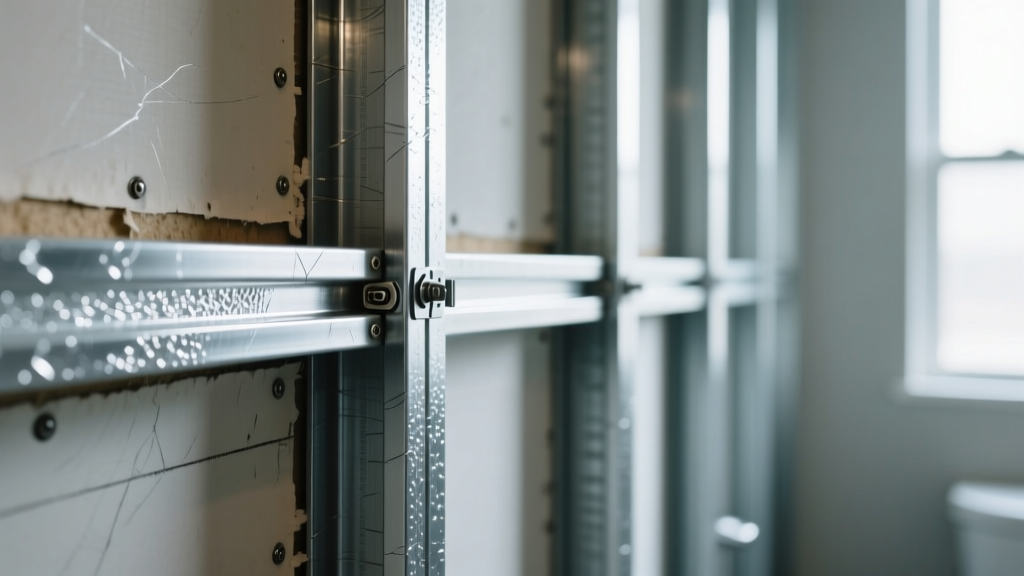
The Fix: Always isolate aluminum components from steel framing materials using neoprene pads, heavy-duty bituminous tape, or by specifying stainless steel (Series 300) fasteners and isolation shims. Furthermore, never use standard phosphate-coated drywall screws to attach exterior sheathing to steel studs; always specify zinc-flake coated or ceramic-coated self-drilling screws (such as Buildex TEKS with Stalgard coating) that match or exceed the galvanic potential of the G90 stud.
Cost Analysis: Upfront Premium vs. Lifecycle Value
Value engineering frequently targets the coating grade of steel framing materials to reduce immediate material costs. However, this is a false economy in moisture-prone environments. Below is a cost breakdown for a 10,000 linear foot (LF) commercial pool enclosure framing package, comparing standard G60 against G90 and ZAM-coated alternatives.
| Material Specification | Material Cost (per LF) | Total Material Cost (10k LF) | Estimated Lifecycle (Pool Environment) | Risk of Premature Failure |
|---|---|---|---|---|
| Standard G60 (33 mil) | $1.15 | $11,500 | 3 - 5 Years | Critical (100%) |
| G90 Hot-Dip (33 mil) | $1.24 | $12,400 | 15 - 20 Years | Moderate (if cut edges untreated) |
| ZAM Alloy (AZM100) | $1.35 | $13,500 | 40+ Years | Negligible |
As demonstrated, upgrading an entire 10,000 LF project from G60 to ZAM-coated steel framing materials adds only $2,000 to the raw material budget. When factored against the labor cost of framing (typically $4.50 to $7.00 per LF) and the catastrophic cost of tearing out tile, waterproofing membranes, and drywall to replace rusted studs, the upfront premium for advanced corrosion protection is mathematically insignificant.
Designing for Moisture Management
Corrosion protection is not solely reliant on the metallurgy of the steel framing materials; it requires holistic assembly design. To protect metal studs in exterior wall cavities or below-grade furring applications, incorporate the following detailing:
- Capillary Breaks: Never allow the bottom track of a steel stud wall to sit directly on a concrete slab where hydrostatic pressure or wicking moisture is present. Use a 30-mil minimum sill sealer or a composite track system with an integrated plastic webbing to elevate the steel above the concrete.
- Ventilated Rainscreens: For exterior steel framing, ensure a minimum 3/8-inch air gap between the sheathing and the exterior cladding to allow convective drying, preventing the sustained high-humidity microclimates that accelerate zinc depletion.
- Weeep Hole Integration: When framing exterior window and door openings, ensure the bottom track is detailed with weep holes to allow any incidental water intrusion to drain out of the framing cavity rather than pooling in the track channel.
By aligning the specific galvanization grade or ZAM coating with the exact environmental exposure category, and enforcing strict field protocols for cut-edge treatment and bimetallic isolation, builders can guarantee that their steel framing materials will outlast the architectural finishes they support.
Written by
Elena RodriguezElena Rodriguez is a civil engineer and technical writer specializing in concrete technology, masonry systems, and ASTM/ACI compliance. She earned her B.S. in Civil Engineering from Texas A&M University and spent a decade at a materials testing laboratory, performing over 2,000 concrete compressive strength tests and masonry prism evaluations. Elena is an ACI-certified Field Testing Technician (Grade I) and a member of ASTM Committee C12 on Natural Building Stone. She currently consults on forensic engineering cases involving concrete failures and moisture intrusion. Based in San Antonio, TX, Elena is a proud member of the Society of Women Engineers (SWE) and coaches her daughter's FIRST Robotics team.
More from Elena Rodriguez
View all
Walls & Panels
Cost Analysis: Light Gauge Steel Framing Advantages and Disadvantages
Evaluate light gauge steel framing advantages and disadvantages through a strict cost analysis lens, comparing material, labor, and lifecycle expenses.
Aug 4, 2026

Walls & Panels
Gypsum Board Types: Exact Specifications, Thickness & Dimensions
Compare standard, Type X, and moisture-resistant gypsum board types. Get exact specifications, thicknesses, dimensions, and ASTM standards for your project.
Aug 4, 2026

Fire Resistance
Best Fire-Resistant Outdoor Decking Materials: 2026 Buyer Guide
Discover the best fire-resistant outdoor decking materials for 2026. Compare Class A PVC, aluminum, and hardwood options for WUI compliance and safety.
Aug 4, 2026