Preventing Galvanic Corrosion in Steel Framing Connections
Learn how to prevent galvanic corrosion in steel framing connections using proper coatings, fastener selection, and isolation techniques for lasting durability.

The Electrochemical Threat at the Joint
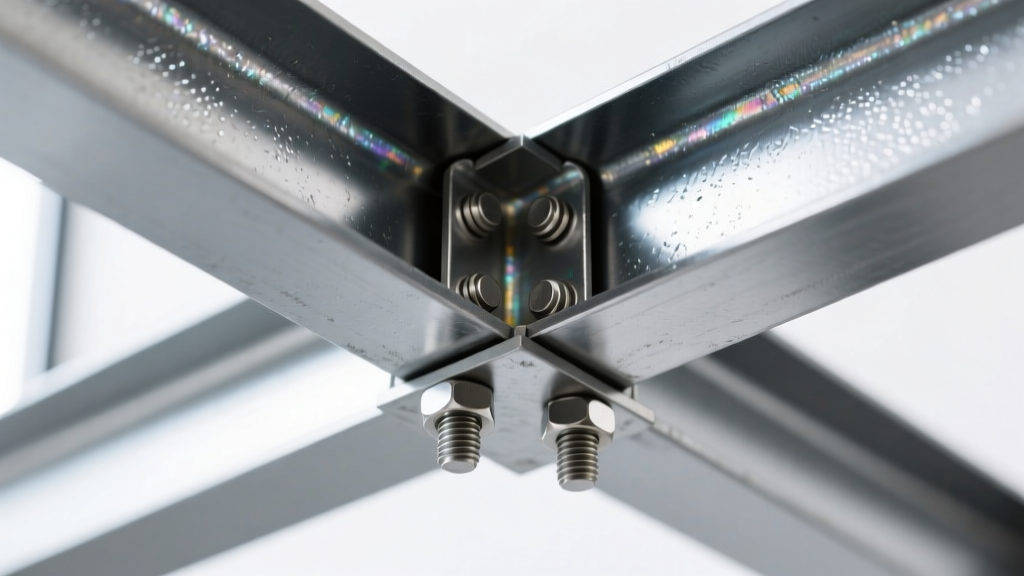
When designing structural and cold-formed steel envelopes, engineers often focus on the corrosion resistance of the primary members while treating the hardware as an afterthought. This is a critical error. Steel framing connections represent the highest risk for localized galvanic corrosion due to the convergence of dissimilar metals, crevice geometries, and field-installed fasteners. According to the American Galvanizers Association, a connection failure typically initiates not from uniform surface rust, but from micro-galvanic cells formed when a less noble fastener is driven through a more noble coating, or when moisture becomes trapped in slip-critical joint interfaces.
In 2026, with building codes demanding tighter thermal envelopes and increased use of vapor-retarding membranes, moisture that penetrates the cladding is often trapped near the connection points. Specifying the correct protective hierarchy for clips, angles, anchors, and fasteners is no longer optional; it is a structural necessity.
Coating Hierarchy and Thickness Specifications
The protective capacity of a connection is dictated by its coating weight and application method. Electroplated zinc (commonly found in standard interior drywall screws) provides merely a cosmetic barrier that fails within months in exterior or high-humidity applications. For steel framing connections, specifiers must rely on sacrificial anode coatings that continue to protect the base steel even when scratched.
| Coating Type | Designation / Standard | Zinc Thickness (Approx.) | Best Application | Relative Cost Multiplier |
|---|---|---|---|---|
| Electroplated Zinc | ASTM B633 (SC2) | 0.2 - 0.5 mils | Interior, climate-controlled only | 1.0x (Baseline) |
| G90 Galvanized | ASTM A653 (0.90 oz/ft²) | 1.0 - 1.2 mils | Interior framing, protected exterior | 1.3x |
| G185 / ZMAX | ASTM A653 (1.85 oz/ft²) | 2.0 - 2.5 mils | Exterior CFS framing, high humidity | 1.8x |
| Hot-Dip Galvanized (HDG) | ASTM A153 (Hardware) | 3.0 - 5.0 mils | Structural connections, exposed exterior | 2.5x - 3.0x |
| 316 Stainless Steel | ASTM F593 (Alloy Group 2) | N/A (Solid Alloy) | Coastal (C5), chemical exposure | 6.0x - 9.0x |
Fastener Compatibility and Galvanic Isolation
The most frequent cause of premature connection failure is the mating of dissimilar metals without dielectric isolation. When a zinc-plated carbon steel screw is used to attach an aluminum track to a galvanized steel stud, the zinc acts as a sacrificial anode. Once the thin zinc layer is consumed, the carbon steel screw becomes the anode and corrodes rapidly, losing its shear capacity.
The Compatibility Matrix for Cold-Formed Steel (CFS)
Following guidelines aligned with the Cold-Formed Steel Engineers Institute (CFSEI), use this matrix to select fasteners for CFS connections:
- G90 Stud to G90 Track (Interior): Standard zinc-plated self-drilling screws (e.g., #10 x 3/4" hex washer head) are acceptable.
- G185 Stud to G185 Track (Exterior Sheathing): Must use G185-coated fasteners (e.g., Simpson Strong-Tie ZMAX equivalents) or 410 Stainless Steel with a corrosion-resistant coating.
- Carbon Steel to Aluminum Track: Must use 304 or 316 Stainless Steel fasteners. Carbon steel will aggressively corrode the aluminum via galvanic action if in direct contact.
- HDG Structural Member to HDG Clip: Use ASTM A325 HDG bolts. Do not mix HDG bolts with unpainted carbon steel nuts; the nut will corrode rapidly to protect the massive surface area of the HDG beam.
Crevice Corrosion in Slip-Critical Connections
In structural steel framing, slip-critical connections rely on high-tension bolting to create friction between faying surfaces. However, the microscopic gap between the two steel plates creates an ideal environment for crevice corrosion. Oxygen becomes depleted in the gap, breaking down the passive zinc oxide layer and initiating localized acidic attack.
To mitigate this in ISO 9223 Category C3 (Medium) or higher environments, structural engineers must specify sealed faying surfaces. Applying a zinc-rich primer or a specialized polyurethane sealant to the faying surfaces before tensioning the bolts prevents moisture ingress. Alternatively, designing the connection as a bearing-type joint and fully encapsulating the connection in an intumescent or epoxy coating system post-installation eliminates the crevice entirely.
Field Cutting and ASTM A780 Touch-Up Protocols
No matter how perfectly a connection is detailed in the shop, field modifications happen. Drilling holes through HDG connection plates or cutting G185 cold-formed steel clips exposes raw, unprotected carbon steel. The American Institute of Steel Construction (AISC) mandates that all damaged or cut galvanized coatings be repaired in accordance with ASTM A780.
- Preparation: Remove all white rust, red rust, and mill scale from the exposed steel using power wire brushing or abrasive blasting to SSPC-SP 3 standards.
- Material Selection: Apply a high-zinc-dust-content paint (e.g., ZRC Cold Galvanize or Galvafroid). Standard "galvanized look" spray paints contain less than 10% zinc dust and offer zero cathodic protection.
- Application Thickness: The touch-up coating must be applied to a minimum Dry Film Thickness (DFT) of 3.0 mils to match the sacrificial capacity of the surrounding HDG or G185 coating.
- Curing: Allow the zinc-rich primer to cure fully before applying any secondary topcoats or fireproofing materials.
Cost Implications of Field Repairs vs. Shop Precision
While field touch-up is code-compliant, it is economically inefficient. Applying zinc-rich primer in the field costs approximately $4.50 to $7.00 per linear foot of exposed edge when factoring in labor, surface prep, and material. Conversely, specifying punch-out holes and pre-cut connection angles fabricated and galvanized in the shop adds only $0.08 to $0.12 per pound to the raw material cost. Designing connections to avoid field cutting is the most cost-effective corrosion protection strategy available.
Environmental Exposure Categories and Final Selection
Before finalizing connection schedules, cross-reference the project site with the ISO 9223 Environmental Corrosivity Categories. A connection assembly that performs flawlessly in a C2 (Low/Inland) environment will fail in less than five years in a C5 (Very High/Coastal) environment if the fastener hierarchy is not upgraded.
For C4 and C5 environments, abandon sacrificial zinc coatings for exterior framing connections entirely. The zinc will be consumed too rapidly. Transition all primary connection hardware, shear tabs, and structural fasteners to 316 Stainless Steel, and ensure that isolation washers are used where 316 SS hardware contacts galvanized primary framing members to prevent the stainless steel from acting as a cathode and accelerating the corrosion of the surrounding zinc.
Written by
Marcus ChenMarcus Chen is a licensed structural engineer (PE) and building materials analyst with over 12 years of experience across residential, commercial, and industrial construction. He holds a Master of Science in Civil Engineering from UC Berkeley and spent six years at Thornton Tomasetti before transitioning to independent consulting and technical writing. Marcus specializes in material selection for seismic-prone regions, concrete reinforcement strategies, and lifecycle cost analysis. His work has been cited by the American Concrete Institute (ACI) and the Structural Engineers Association of California (SEAOC). When he is not on a job site or at his desk, you will find him hiking the Sierra Nevada or restoring a 1920s craftsman bungalow in Oakland, CA.
More from Marcus Chen
View all
Construction Cost
How Much Did the Eiffel Tower Cost to Build?
How much did the Eiffel Tower cost to build in 1889? We adjust for inflation and compare its budget to modern skyscraper construction.
Aug 4, 2026

Fire Resistance
What Is a Fire Resistant Material? Testing & Certification Guide
Discover what is a fire resistant material through ASTM and UL testing. Learn how fire ratings, certifications, and assemblies work in construction.
Aug 4, 2026

Construction Cost
How Much Did the Burj Khalifa Cost to Build?
How much did the Burj Khalifa cost to build? We break down the $1.5B project and extract 5 money-saving strategies for your next build.
Jul 30, 2026