Steel Roof Materials: Grades, Gauges & 2026 Cost Guide
Compare top steel roof materials for 2026. Explore Galvalume vs. galvanized grades, gauge thicknesses, coating standards, and installed costs per square foot.

Selecting the correct steel roof materials requires navigating a complex matrix of metallic coatings, gauge thicknesses, and yield strengths. A misspecified panel can lead to premature corrosion, oil canning, or catastrophic wind uplift failure. According to the Metal Construction Association (MCA), the majority of premature roofing failures stem from improper gauge selection for specific purlin spacing or incompatible metallurgical flashing details. This guide breaks down the exact ASTM standards, structural grades, and 2026 market pricing for commercial and residential steel roofing systems.
Metallurgical Coatings: Galvalume vs. Galvanized
The longevity of steel roof materials is dictated by their sacrificial metallic coating. The two industry standards are Galvalume and Galvanized steel, each governed by distinct ASTM specifications.
Galvalume (ASTM A792)
Galvalume is an aluminum-zinc alloy coating consisting of 55% aluminum, 43.4% zinc, and 1.6% silicon. The standard coating weight for roofing is AZ55 (0.55 ounces per square foot). The aluminum provides long-term barrier protection against atmospheric corrosion, while the zinc offers galvanic sacrifice at cut edges and scratches. In 2026, AZ55 Galvalume remains the premium baseline for architectural standing seam roofs, offering two to four times the lifespan of standard galvanized steel in non-coastal environments.
Galvanized (ASTM A653)
Galvanized steel is coated with 100% zinc. The standard roofing grade is G90 (0.90 ounces per square foot). While G90 provides excellent galvanic cut-edge protection, the pure zinc coating degrades faster than aluminum-zinc alloys when exposed to UV radiation and standing water. Galvanized panels are typically reserved for agricultural buildings, interior liner panels, or painted systems where the substrate is entirely encapsulated by a high-quality PVDF (Kynar 500) paint system.
Decoding Gauge Thickness and Structural Grades
In steel roofing, a lower gauge number indicates a thicker panel. However, thickness alone does not determine structural capacity; the yield strength (measured in ksi) is equally critical. The American Iron and Steel Institute (AISI) categorizes roofing steel into distinct structural grades based on minimum yield strength.
| Gauge | Decimal Thickness | Typical Yield Grade | Primary Application & Span Limits |
|---|---|---|---|
| 24 | 0.0239" | Grade 50 (50 ksi) | Architectural standing seam; high-wind (HVHZ) zones; spans up to 5'0" on structural purlins. |
| 26 | 0.0179" | Grade 50 / Grade 80 | Commercial exposed fastener; residential standing seam; spans up to 4'0" on purlins. |
| 29 | 0.0135" | Grade 40 / Grade 50 | Agricultural corrugated; light residential; requires continuous decking or max 2'6" purlin spacing. |
For structural standing seam systems that span open framing (purlins) without a solid deck, 24-gauge Grade 50 or 26-gauge Grade 80 is mandatory. Grade 80 steel achieves higher strength through cold-rolling work hardening, allowing a thinner 26-gauge panel to match the load-bearing capacity of a 24-gauge Grade 50 panel, though it is more susceptible to oil canning due to its reduced thickness.
Profile Types: Architectural vs. Structural
The physical geometry of steel roof materials dictates their water-shedding capabilities and structural behavior.
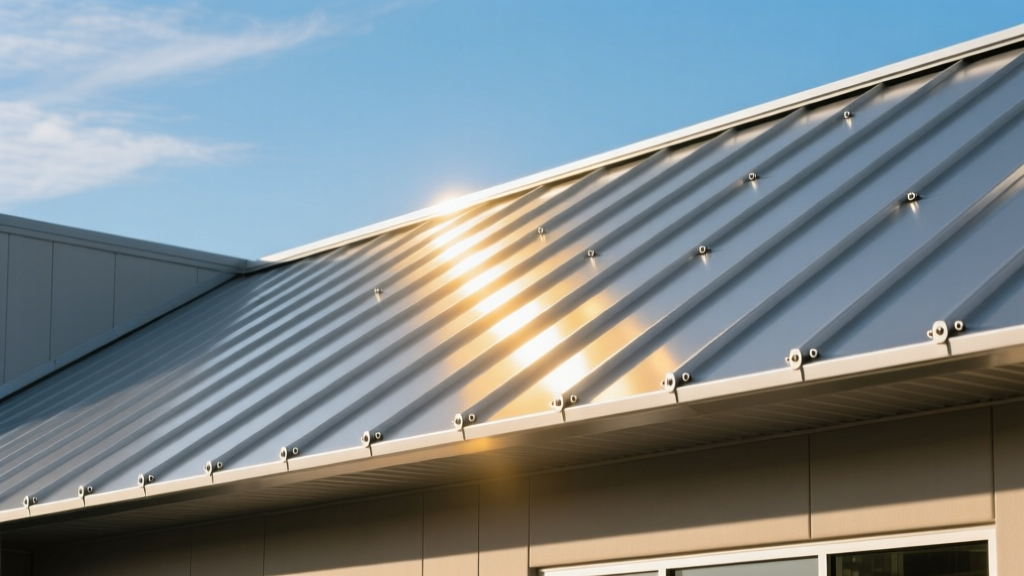
- Architectural Standing Seam: Features a minimum 1.5-inch to 2-inch tall rib and utilizes concealed sliding clips. These panels require a continuous solid substrate (plywood, OSB, or steel roof deck) and rely on the deck for structural support. The sliding clips allow for thermal expansion and contraction, preventing panel distortion.
- Structural Standing Seam: Features a 3-inch to 4-inch tall trapezoidal rib with integral stiffening beads. These panels span open steel bar joists or Z-purlins up to 6 feet on center. They utilize fixed or floating clips engineered to handle significant wind uplift loads and are standard for large commercial warehouses and aviation hangars.
- Exposed Fastener (Corrugated / R-Panel): Fasteners penetrate the face of the panel directly into the substrate. While highly cost-effective, the exposed neoprene/EPDM washers degrade over 15-20 years and require maintenance. These panels rely on the overlapping ribs for lateral strength.
2026 Pricing Breakdown: Material and Installed Costs
Pricing for steel roof materials fluctuates with raw commodity indices, but 2026 market averages have stabilized following the supply chain disruptions of the early 2020s. The costs below reflect fully installed systems, including underlayment, flashings, and labor for a standard 10,000 sq. ft. commercial roof with a 4:12 pitch.
| System Profile | Gauge & Coating | Material Cost (per sq. ft.) | Installed Cost (per sq. ft.) |
|---|---|---|---|
| Architectural Standing Seam | 24-ga AZ55 Galvalume | $5.50 - $7.50 | $13.50 - $17.50 |
| Structural Standing Seam | 24-ga AZ55 Galvalume | $6.00 - $8.50 | $14.00 - $19.00 |
| Exposed Fastener (R-Panel) | 26-ga G90 Galvanized | $2.50 - $3.50 | $7.50 - $10.50 |
| Corrugated Agricultural | 29-ga G90 Galvanized | $1.75 - $2.50 | $6.00 - $8.50 |
Common Failure Modes and Prevention Protocols
Even premium steel roof materials will fail if installation protocols ignore metallurgical and structural realities. The National Roofing Contractors Association (NRCA) identifies the following as the most frequent causes of premature steel roof failure:
1. Oil Canning
Oil canning manifests as wavy, stressed ripples in the flat pan areas of standing seam panels. It is caused by thermal expansion restricted by over-driven fasteners, inadequate purlin alignment, or using steel that was improperly tensioned during the coil slitting process.
Prevention: Specify 24-gauge steel for flat pans wider than 12 inches. Require the manufacturer to add structural striations (roll-formed ribs) in the flat pan to stiffen the metal. Ensure installers use slotted clip holes that allow the panel to glide during thermal cycling.
2. Galvanic Corrosion
When steel roof panels come into direct contact with dissimilar metals like copper flashing, untreated aluminum gutters, or pressure-treated lumber (which contains copper-based preservatives like ACQ), a galvanic cell is created. The steel acts as the anode and corrodes rapidly.
Prevention: Isolate all dissimilar metals. Use butyl tape, EPDM separation membranes, or heavy plastic slip sheets between steel panels and copper/aluminum flashings. Never allow runoff from copper parapet caps to drain directly onto steel roofing.
3. Fastener Back-Out and Over-Driving
In exposed fastener systems, installers frequently use high-torque impact drivers that over-compress the EPDM washer, causing it to split and leak, or strip the threads in the steel purlin, leading to back-out under wind vibration.
Prevention: Mandate the use of depth-sensitive screw guns (not impact drivers) calibrated to the exact thickness of the steel and purlin. Specify pancake-head fasteners with a precision-bonded EPDM washer, and require a pull-test on the first 10 fasteners of every shift to verify torque settings.
Sourcing and Specification Checklist
When drafting your project specifications or evaluating contractor bids, verify that the proposed steel roof materials explicitly state the following parameters:
- Coating Designation: Must state AZ55 (Galvalume) or G90 (Galvanized). Reject vague terms like "commercial grade coating."
- Paint System: If pre-painted, specify a 70% PVDF (Kynar 500® or Hylar 5000®) resin system with a minimum 1.0 mil topcoat thickness over a 0.2 mil primer. Avoid standard polyester (PE) or siliconized modified polyester (SMP) for architectural applications, as they chalk and fade within 10 years.
- Yield Strength: Explicitly state Grade 50 (50 ksi minimum yield) or Grade 80 to ensure the panels meet the structural engineer's span tables.
- Testing Standards: Require the manufacturer to provide UL 580 (wind uplift) and ASTM E1592 (structural performance) test reports specific to the exact panel profile and gauge being installed.
Written by
Marcus ChenMarcus Chen is a licensed structural engineer (PE) and building materials analyst with over 12 years of experience across residential, commercial, and industrial construction. He holds a Master of Science in Civil Engineering from UC Berkeley and spent six years at Thornton Tomasetti before transitioning to independent consulting and technical writing. Marcus specializes in material selection for seismic-prone regions, concrete reinforcement strategies, and lifecycle cost analysis. His work has been cited by the American Concrete Institute (ACI) and the Structural Engineers Association of California (SEAOC). When he is not on a job site or at his desk, you will find him hiking the Sierra Nevada or restoring a 1920s craftsman bungalow in Oakland, CA.
More from Marcus Chen
View all
Construction Cost
How Much Did the Eiffel Tower Cost to Build?
How much did the Eiffel Tower cost to build in 1889? We adjust for inflation and compare its budget to modern skyscraper construction.
Aug 4, 2026

Fire Resistance
What Is a Fire Resistant Material? Testing & Certification Guide
Discover what is a fire resistant material through ASTM and UL testing. Learn how fire ratings, certifications, and assemblies work in construction.
Aug 4, 2026

Construction Cost
How Much Did the Burj Khalifa Cost to Build?
How much did the Burj Khalifa cost to build? We break down the $1.5B project and extract 5 money-saving strategies for your next build.
Jul 30, 2026