Decoding Steel Siding Specs: Gauge, Coatings, and Performance Ratings
Compare steel siding performance ratings, gauge thicknesses, and paint coatings. Learn UL impact, wind load, and fire specs for your next build.
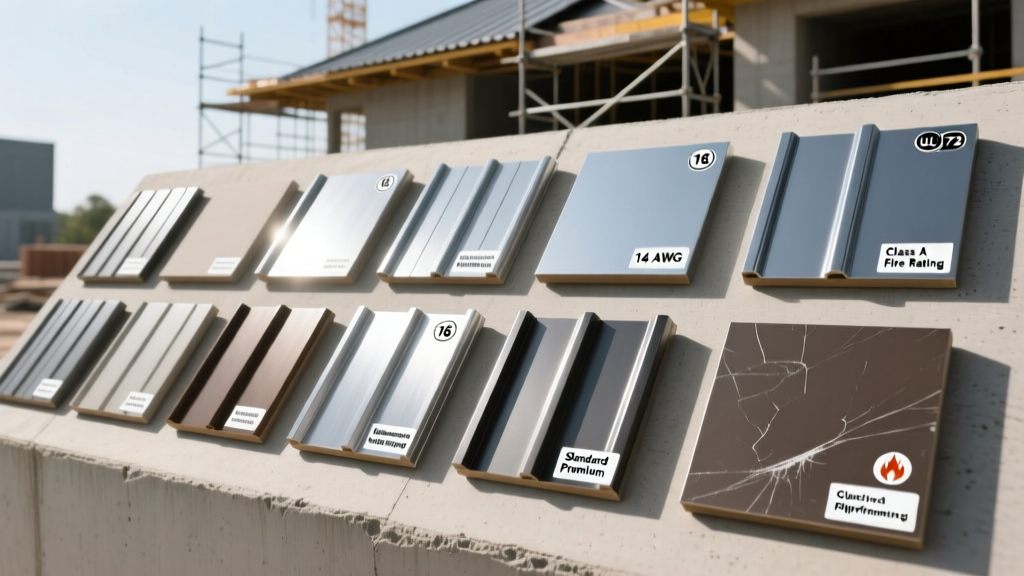
Substrate Thickness and Yield Strength Specifications
When procuring steel siding for commercial, agricultural, or high-end residential applications, the term "gauge" is frequently misunderstood. In the steel industry, a lower gauge number indicates a thicker panel, but the actual decimal thickness varies depending on the manufacturer's rolling tolerances. For structural siding applications, relying solely on the gauge number is insufficient; you must specify the minimum decimal thickness and the yield strength (measured in ksi, or kilopounds per square inch).
According to the Metal Construction Association (MCA), modern steel siding substrates are typically cold-rolled to Grade 50 (50 ksi yield strength) or Grade 80 (80 ksi yield strength). Grade 80 is increasingly standard for 24-gauge and 22-gauge profiles to maintain rigidity while reducing material weight.
| Nominal Gauge | Minimum Decimal Thickness (Inches) | Standard Yield Strength | Primary Application |
|---|---|---|---|
| 29-Gauge | 0.0149" | Grade 50 (50 ksi) | Residential pole barns, interior liners |
| 26-Gauge | 0.0179" | Grade 50 / Grade 80 | Standard residential, light commercial |
| 24-Gauge | 0.0239" | Grade 80 (80 ksi) | Commercial facades, high-wind zones |
| 22-Gauge | 0.0299" | Grade 80 (80 ksi) | Heavy industrial, extreme impact zones |
Metallic Coatings: Galvalume vs. Galvanized Substrates
Before paint is applied, the steel substrate must be treated with a metallic coating to prevent oxidation. The two dominant specifications are Galvalume (AZ50) and Galvanized (G90). Understanding the chemical composition of these coatings is critical for predicting the siding's lifespan, particularly at the cut edges where the raw steel is exposed.
AZ50 Galvalume (Aluminum-Zinc Alloy)
Galvalume consists of 55% aluminum, 43.4% zinc, and 1.6% silicon. The aluminum provides long-term barrier protection and heat reflectivity, while the zinc offers galvanic (sacrificial) protection at cut edges. AZ50 is the industry standard for exterior steel siding, offering two to four times the lifespan of standard galvanized steel in marine and industrial environments. It routinely exceeds 1,500 hours in ASTM B117 salt spray testing without red rust.
G90 Galvanized (Pure Zinc)
Galvanized steel is coated with pure zinc. While it provides excellent sacrificial protection at cut edges and sheared lines, it lacks the barrier protection of aluminum. G90 is generally reserved for agricultural buildings, interior applications, or regions with low humidity and minimal salt exposure. In coastal environments, G90 galvanized siding will typically show white rust (zinc oxidation) within 3 to 5 years, followed by red rust.
Paint Systems and UV Performance Ratings
The metallic coating protects against corrosion, but the paint system dictates the siding's aesthetic longevity, chalk resistance, and fade performance. In 2026, the market is strictly divided into two primary resin chemistries, governed by the American Architectural Manufacturers Association (AAMA) specifications.
Silicone Modified Polyester (SMP) - AAMA 2604
SMP coatings are cost-effective and offer excellent hardness, making them highly resistant to scratching and marring during installation. However, their UV stability is moderate. Under AAMA 2604 standards, SMP paints are tested to ensure a maximum Delta E (fade) of 5 Hunter units after 5 years of South Florida exposure. SMP is ideal for agricultural buildings, warehouses, and residential applications where a 25-to-30-year warranty is acceptable and vibrant, dark colors are not specified (as dark SMP colors chalk faster).
Polyvinylidene Fluoride (PVDF) - AAMA 2605
PVDF coatings (commonly known by the trade names Kynar 500 or Hylar 5000) are the premium standard for commercial and architectural steel siding. To meet AAMA 2605 specifications, the coating must contain a minimum of 70% PVDF resin by weight in the color coat. PVDF molecules are exceptionally stable under UV radiation, resulting in a maximum Delta E fade of just 5 Hunter units after 10 years of exposure. PVDF systems maintain their color integrity and chalk resistance for 40+ years, making them mandatory for high-visibility commercial facades and dark color profiles.
Structural and Environmental Performance Ratings
Beyond material composition, steel siding must be engineered to withstand specific environmental loads. Architects and builders must specify panels that have been independently tested and rated for the following criteria:
- Wind Uplift and Structural Load (ASTM E1592 / UL 580): Steel siding panels are tested in a vacuum chamber to simulate negative wind pressures. For standard commercial buildings, panels should be rated for a minimum of 90 psf (pounds per square foot) design pressure. In coastal hurricane zones (HVHZ), specify panels tested to 150+ psf under ASTM E1592 protocols.
- Impact Resistance (UL 2218 Class 4): Hail is a primary failure mode for exterior cladding. UL 2218 Class 4 is the highest impact rating, requiring the panel to withstand a 2-inch diameter steel ball dropped from 20 feet without cracking, tearing, or fracturing the paint film. Specifying Class 4 is critical in the Midwest and Southern US, and often qualifies the building owner for significant property insurance premium reductions.
- Fire Resistance (ASTM E84 Class A): Steel is inherently non-combustible. However, the paint and foam insulation backings must be evaluated. Properly specified steel siding assemblies easily achieve a Class A fire rating (Flame Spread Index 0-25, Smoke Developed Index 0-450), making them compliant for Wildland-Urban Interface (WUI) zones in California and Colorado.
Thermal Dynamics and Fastener Specifications
One of the most common aesthetic and structural failures in steel siding is "oil canning"—a visible waviness or rippling across the flat areas of the panel. This is rarely a defect in the steel itself; rather, it is a failure to account for the coefficient of thermal expansion (CTE) during installation.
Steel expands at a rate of approximately 6.5 x 10^-6 inches per inch per degree Fahrenheit. A 20-foot long steel siding panel will expand and contract by roughly 0.15 inches over a 100°F temperature swing. If the panel is pinned tightly to the substructure, this thermal movement forces the steel to buckle outward, creating the oil-canning effect.
Installation Mandate: To prevent thermal buckling, specify siding profiles with slotted fastener holes (typically 1/4" x 3/4" slots). Fasteners must be driven into the exact center of the slot and tightened only until the EPDM neoprene washer is fully compressed and forms a visible seal—never over-torqued. Over-driving the screw restricts lateral thermal movement and guarantees oil canning.
Procurement Decision Matrix
Selecting the correct steel siding specification requires balancing initial capital expenditure against lifecycle maintenance and environmental risks. Use the following matrix to align your material specs with your project parameters.
| Project Environment | Recommended Gauge | Metallic Coating | Paint System | Required Ratings |
|---|---|---|---|---|
| Agricultural / Rural Interior | 29 or 26-Gauge | G90 Galvanized | Polyester (AAMA 2603) | Standard Load |
| Standard Residential / Suburban | 26-Gauge | AZ50 Galvalume | SMP (AAMA 2604) | UL 2218 Class 3 |
| Commercial / Architectural Facade | 24-Gauge | AZ50 Galvalume | PVDF (AAMA 2605) | ASTM E1592 (110+ psf) |
| Coastal / Hurricane Zone (HVHZ) | 22 or 24-Gauge | AZ55 Galvalume (Heavy) | PVDF (AAMA 2605) | ASTM E1592 (150+ psf), Miami-Dade NOA |
| Hail-Prone / WUI Fire Zone | 24-Gauge | AZ50 Galvalume | PVDF (AAMA 2605) | UL 2218 Class 4, ASTM E84 Class A |
By strictly adhering to these performance ratings, decimal thicknesses, and coating specifications, builders and architects can eliminate premature fading, structural tear-offs, and thermal distortion, ensuring the steel siding performs flawlessly over its 40-to-60-year lifecycle.