Steel Stud Nominal Sizes vs Actual: Brand Deep-Dive & Spec Guide
Decode steel stud nominal sizes vs actual dimensions. Deep-dive into ClarkDietrich, USG, and MarinoWARE product lines, ASTM tolerances, and spec guide.
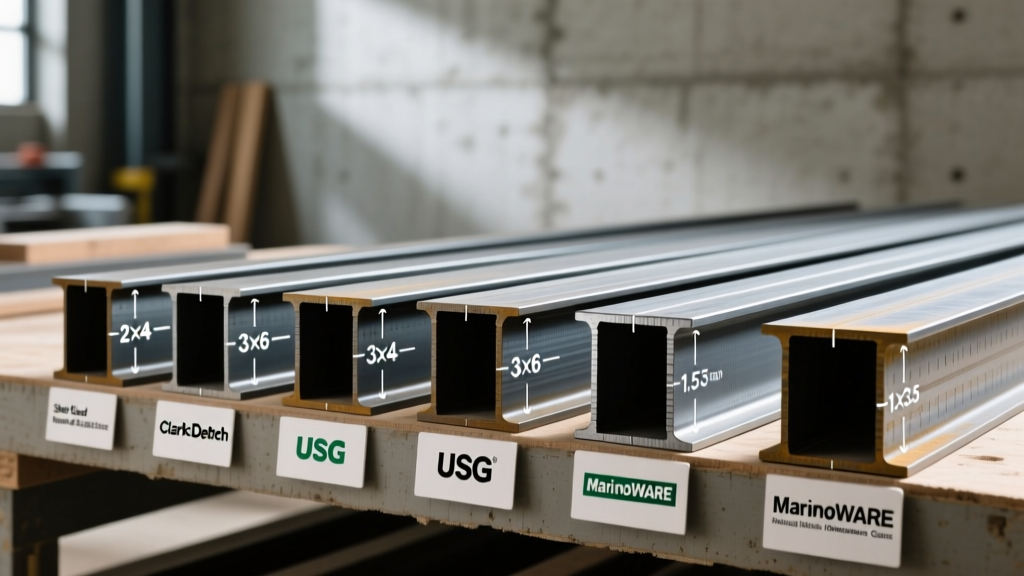
The Wood Parity Legacy: Why Nominal Sizing Persists in Steel
When architectural specifications call for a 6-inch metal stud partition, the physical material delivered to the job site will measure exactly 5.5 inches across the web. This discrepancy between steel stud nominal sizes and actual dimensions is not a manufacturing defect; it is a deliberate industry standard rooted in historical wood framing parity. Early cold-formed steel (CFS) manufacturers adopted the dimensional nomenclature of dimensional lumber (where a nominal 2x6 is actually 1.5" x 5.5") so that drywall, insulation, and finish materials could scale identically across both framing mediums.
However, in modern commercial construction—particularly in BIM-coordinated prefabrication and high-performance acoustic assemblies—confusing nominal nomenclature with actual dimensions leads to catastrophic spatial clashes, compressed insulation (altering STC ratings), and misaligned MEP knockouts. This guide decodes the exact dimensional matrices, brand-specific manufacturing nuances, and ASTM C645 tolerances required to specify and procure CFS framing accurately.
Nominal vs. Actual Dimensions Matrix
The following matrix maps standard industry nomenclature to the physical tape-measure dimensions you will encounter on the job site. These dimensions represent the web depth (the distance between the two flanges), which dictates the wall cavity depth.
| Nominal Size | Actual Web Depth | Standard Flange Widths | Primary Application & Cavity Use |
|---|---|---|---|
| 1-5/8" | 1.625" | 1-1/4", 1-5/8" | Shaftwall liners, furring, low-profile chases |
| 2-1/2" | 2.500" | 1-5/8", 2" | Residential interior partitions, low-clearance soffits |
| 3-1/2" | 3.500" | 1-5/8", 2" | Standard residential walls, basic commercial demising |
| 3-5/8" | 3.625" | 1-5/8", 2", 2-1/2" | Standard commercial partitions, 1-hour fire assemblies |
| 4" | 4.000" | 1-5/8", 2", 2-1/2" | Acoustic partitions requiring specific batt thickness |
| 5-1/2" (6" Nom) | 5.500" | 1-5/8", 2", 2-1/2", 3" | Plumbing walls, high-STC acoustic walls, heavy MEP routing |
| 6" | 6.000" | 2", 2-1/2", 3" | Specialty acoustic labs, thick insulation cavities |
| 8" | 7.500" or 8.000"* | 2-1/2", 3" | Elevator shafts, heavy vertical MEP risers, tall atriums |
| 10" | 9.500" or 10.000"* | 2-1/2", 3" | Structural load-bearing walls, massive shaftwall systems |
Brand Deep-Dive: How Top Manufacturers Execute Sizing
While ASTM C645 governs the baseline tolerances for nonstructural steel framing, major manufacturers introduce proprietary geometric variations that affect how nominal sizes translate to physical performance.
ClarkDietrich (ProSTUD & ProTRACK)
ClarkDietrich's ProSTUD line is the industry benchmark for commercial framing. Their approach to steel stud nominal sizes focuses on MEP integration. A nominal 6" ProSTUD (actual 5.5" web) features precision-punched, slotted knockout holes. Because the actual web is 5.5", ClarkDietrich engineers the H-shaped knockouts to accommodate standard 1/2" EMT and 3/4" rigid conduit without compromising the structural integrity of the web. Furthermore, their ProTRACK system is manufactured with an inside dimension that perfectly matches the outside dimension of the ProSTUD, plus a 1/16" tolerance gap to ensure friction-fit nesting without flaring the track flanges.
USG (Donn & Sheetrock Brand Framing)
USG approaches framing primarily through the lens of acoustic and fire-rated assembly optimization. When specifying USG framing for their high-performance Soundbreak partitions, the actual dimension of the stud is critical for their specialized isolation clips and resilient channel spacing. USG's framing lines strictly adhere to the 5.5" actual depth for a 6" nominal stud, but they offer specialized wider flanges (up to 3") on their heavier mil products (54 and 68 mil) to provide broader attachment surfaces for multi-layer Type X gypsum board, reducing the risk of edge-cracking at the fastener points.
MarinoWARE (M-Stud)
MarinoWARE differentiates its M-Stud line with a dimpled surface texture designed to increase friction with gypsum panels and reduce fastener spin-out. Regarding sizing, MarinoWARE strictly adheres to the Cold-Formed Steel Structural Alliance (CFSSA) guidelines. Their 8" nominal studs are manufactured at a true 7.5" actual web depth, maintaining the wood-parity standard. However, MarinoWARE offers custom web depths for specialized prefabrication facilities that require exact 8.0" or 10.0" cavities for specialized HVAC duct routing, bypassing the nominal naming convention entirely via direct mill-order specifications.
Application-Specific Sizing Framework
Choosing the correct nominal size requires balancing structural limits, fire ratings, and MEP constraints. Use this decision framework during the schematic design phase.
🔊 Acoustic Assemblies (STC 50+)
- Requirement: Minimum 5.5" actual cavity (6" nominal stud) to accommodate 3" of acoustic batt insulation on one side, leaving a 2.5" air gap, or staggered-stud configurations on a single track.
- Brand Spec: Use 6" nominal (5.5" actual) studs at 24" o.c. with 54 mil (16ga) thickness to prevent low-frequency resonance.
🔥 2-Hour Fire-Rated Shaftwalls
- Requirement: Typically relies on 1-5/8" or 2-1/2" nominal C-H studs and J-tracks for elevator shafts.
- Brand Spec: The actual web depth of 1.625" is designed specifically to accept two layers of 1" shaftwall liner panels. Do not substitute 2" nominal studs in a 1-5/8" shaftwall detail; the liner panels will not lock into the H-stud flanges correctly, violating the UL assembly listing.
ASTM C645 Tolerances: The Allowable Margins of Error
Procurement professionals and prefab shop managers must account for manufacturing tolerances. According to ASTM C645 (Standard Specification for Nonstructural Steel Framing Members), the allowable deviations for steel stud nominal sizes are strictly defined:
- Web Depth (Actual Size): ± 1/16" (1.6 mm)
- Flange Width: ± 1/32" (0.8 mm)
- Lip Return: ± 1/32" (0.8 mm)
- Length: -0" to +1/8" (Studs can be slightly long, but never short)
Real-World Implication: If you are ordering 6" nominal studs (5.5" actual) for a prefabricated bathroom pod, and the mill runs the batch at the positive tolerance limit (+1/16"), your actual web depth is 5.5625". If your track was rolled at the negative tolerance limit (-1/16"), the inside track dimension is 5.4375". The stud will not fit into the track without mechanical deformation, which compromises the axial load capacity and ruins the straightness of the wall. Always specify matched stud-and-track sets from the same manufacturer coil run for prefab applications.
Procurement & Cost Implications of Mis-Sizing
Misunderstanding steel stud nominal sizes directly impacts project budgets, particularly regarding material yields and nesting efficiency.
The 3-5/8" vs. 4" Premium
The 3-5/8" nominal stud (3.625" actual) is the most highly produced commercial stud in North America, resulting in economies of scale. A 4" nominal stud (4.0" actual) is considered a specialty size. Despite requiring only 10% more raw steel coil width, the 4" stud often carries a 15-20% price premium per linear foot due to lower production volume and separate warehousing requirements. Unless a specific acoustic assembly (like a specialized USG Soundbreak detail) explicitly mandates a true 4" cavity for uncompressed 4" mineral wool, value-engineering the design to a 3-5/8" stud with high-density 3.5" batt insulation will yield identical STC results at a significantly lower cost.
Nesting and Shipping Logistics
Steel studs are shipped nested (stacked inside one another) to maximize truckload efficiency. Nominal sizes dictate the nesting geometry. A bundle of 6" nominal studs (5.5" actual) nests tightly. If a contractor attempts to mix a 6" nominal stud from Manufacturer A with a 6" nominal track from Manufacturer B, slight variations in the flange hem (some manufacturers use a 90-degree return, others a 135-degree flare) can prevent proper nesting during transport, leading to damaged flanges and rejected material upon delivery.
Frequently Asked Questions
Why do steel studs use wood framing dimensions?
When metal framing was introduced to commercial construction in the mid-20th century, architects and contractors were already accustomed to wood framing dimensions. By matching the actual dimensions of wood (e.g., 5.5" for a 2x6), steel manufacturers ensured that existing drywall sizes, door jamb depths, and window buck dimensions could be used interchangeably without redesigning the entire building materials supply chain.
Can I use a 6" wood stud detail for a 6" steel stud?
Yes, but with caveats regarding fastening and structural capacity. While the physical cavity depth (5.5") is identical, a 6" nominal wood stud is 1.5" wide on the face, whereas a 6" nominal steel stud typically has a 1-5/8" or 2" flange. This narrower nailing surface requires more precision when hanging heavy cabinetry or applying multiple layers of 5/8" Type X gypsum board.
What is the actual size of a 250S162-33 stud?
In the standardized AISI/SNI nomenclature, '250' designates the nominal web depth in hundredths of an inch (2.50"), 'S' denotes a Stud, '162' is the flange width in hundredths (1.62"), and '33' is the thickness in mils (33 mil, or 20 gauge). Therefore, a 250S162-33 has an actual web depth of 2.5 inches, matching the 2-1/2" nominal size category.