Why Steel Tops Environmentally Friendly Roofing Materials in 2026
Discover why steel leads environmentally friendly roofing materials in 2026. Compare costs, cool-roof coatings, and lifecycle impacts against alternatives.

The Eco-Hierarchy: Where Steel Stands Among Green Roofs
Evaluating environmentally friendly roofing materials requires separating marketing claims from lifecycle physics. While living roofs and solar shingles dominate eco-conscious brochures, structural steel roofing consistently outperforms them in comprehensive Lifecycle Assessments (LCA). The distinction lies in the triad of sustainable building: embodied carbon, operational energy reduction, and end-of-life circularity.
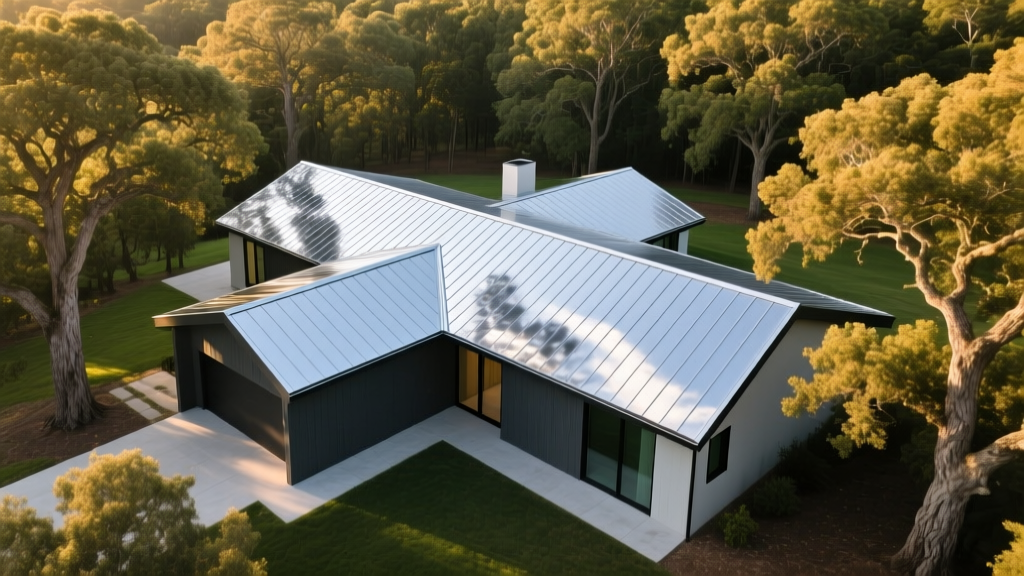
Steel roofing—specifically 24-gauge and 26-gauge standing seam profiles—achieves a 100% recycling rate at the end of its 50-to-60-year service life. Unlike asphalt shingles, which contribute 12 million tons of waste to landfills annually, or composite rubber membranes that degrade into microplastics, steel retains its metallurgical properties indefinitely. When paired with high-SRI (Solar Reflectance Index) cool roof coatings, steel transforms from a mere shelter into an active energy-reduction asset.
Deconstructing Steel’s Environmental Lifecycle
To specify steel as one of the premier environmentally friendly roofing materials, architects and builders must understand the substrate. The industry standard for eco-optimized steel roofing is Galvalume (ASTM A792), featuring an AZ55 coating (55% aluminum, 43.4% zinc, 1.6% silicon). This specific metallurgical blend provides sacrificial galvanic protection and barrier protection, preventing the red rust that compromises structural integrity.
| Material | Expected Lifespan | End-of-Life Recyclability | Operational Energy Impact |
|---|---|---|---|
| Standing Seam Steel | 50 - 60+ Years | 100% Infinitely Recyclable | High (with cool-roof coatings) |
| Architectural Asphalt | 15 - 20 Years | < 10% (Mostly landfilled) | Low (High thermal absorption) |
| Recycled Rubber/Slate | 30 - 50 Years | Difficult to reprocess | Moderate |
| Clay/Concrete Tile | 50+ Years | Downcycled as aggregate | Moderate (Thermal mass benefits) |
Cool Roof Technology: Maximizing Solar Reflectance
A steel roof is only as environmentally friendly as its coating. Bare Galvalume reflects sunlight initially but loses reflectivity as it oxidizes and accumulates particulate matter. To qualify as a premium green building material, steel panels must be factory-finished with a Polyvinylidene Fluoride (PVDF) resin system, commonly known by the trade names Kynar 500 or Hylar 5000.
According to the Department of Energy, cool roofs can reduce peak cooling demand by 10% to 15%. PVDF-coated steel panels in 'cool' color palettes (like cool bronze, slate gray, or white) maintain a Solar Reflectance Index (SRI) of 50 or higher over their lifespan, meeting ENERGY STAR and LEED v4.1 requirements. The Environmental Protection Agency notes that mitigating the urban heat island effect through high-SRI roofing directly lowers ambient city temperatures and reduces smog formation.
Specification Guide: Choosing the Right Coating
- PVDF (Kynar 500): Mandatory for eco-certifications. Resists UV degradation, chalking, and fading. Maintains SRI > 50 for 30+ years. Cost premium: 15-20% over standard polyesters.
- SMP (Silicone Modified Polyester): Suitable only for agricultural or unconditioned structures. Fades and chalks within 10 years, destroying the roof's solar reflectance and negating its 'cool roof' operational benefits.
- Granular-Coated Stone Steel: Uses acrylic-bonded stone granules. While aesthetically pleasing, the textured surface traps dirt and pollen, reducing SRI by up to 30% within five years compared to smooth PVDF finishes.
Cost vs. Carbon: The 2026 Financial Reality
Procuring environmentally friendly roofing materials requires analyzing the Total Cost of Ownership (TCO). In 2026, supply chain stabilization has brought 24-gauge Galvalume standing seam steel pricing to a range of $14.50 to $19.00 per square foot (installed). While this represents a 120% premium over architectural asphalt ($6.50 - $8.50/sq. ft.), the financial and environmental ROI diverges significantly at the 20-year mark.
At year 20, an asphalt roof requires a complete tear-off and replacement, generating waste and incurring a second installation cost. The steel roof requires only a fastener inspection (if exposed) or a recoating assessment. Furthermore, the Cool Roof Rating Council provides rated product directories that contractors use to verify SRI values, ensuring homeowners and commercial developers can secure local utility rebates and federal energy-efficiency tax credits, effectively reducing the net capital expenditure by 10% to 30%.
The fastest way to destroy the environmental and financial viability of a steel roof is through improper flashing. Never use copper or untreated lead flashings with Galvalume or galvanized steel panels. The dissimilar metals will cause rapid galvanic corrosion, eating through the steel within 3 to 5 years. Always specify aluminum, galvanized steel, or zinc flashings, and use dielectric separators (like peel-and-stick butyl tape) where steel must interface with other metals or pressure-treated lumber.
Steel vs. The 'Green' Alternatives
How does steel compare to other heavily marketed eco-roofing systems? The matrix below evaluates real-world performance metrics.
| Feature | Steel Standing Seam | Integrated Solar Shingles | Vegetative (Green) Roof |
|---|---|---|---|
| Structural Load | Very Low (1.5 lbs/sq ft) | Moderate (3-4 lbs/sq ft) | Extreme (20-150 lbs/sq ft) |
| Roof Pitch Minimum | 1/4:12 (with sealant) | 4:12 | Flat to 2:12 |
| Maintenance Needs | Minimal (Debris clearing) | High (Inverter/micro-converter checks) | Intense (Irrigation, weeding, root barriers) |
| End-of-Life | Scrap value (Recyclable) | E-waste hazard (Complex disposal) | Organic waste / Membrane landfill |
Actionable Procurement & Installation Checklist
To ensure your steel roof performs as an elite environmentally friendly roofing material, enforce these specifications in your contract documents:
- Substrate Specification: Mandate ASTM A792 Galvalume (AZ55) rather than standard G90 galvanized steel. Galvalume offers up to four times the cut-edge protection of galvanized coatings.
- Gauge Selection: Specify 24-gauge for residential and light commercial applications to resist wind uplift and hail impact (UL 2218 Class 4 rating). Use 26-gauge only for protected porch ceilings or non-critical overlays.
- Fastener Systems: Reject exposed-fastener (corrugated/R-panel) profiles for primary structures. Exposed neoprene washers degrade under UV exposure and require re-tightening every 10-15 years due to thermal expansion/contraction. Specify a concealed-clip standing seam system (e.g., a 2-inch mechanical lock seam) which allows the panels to float and expand without compromising the weather seal.
- Underlayment: Use a high-temperature synthetic underlayment or a self-adhering ice and water shield (peel-and-stick) rated for 240°F. Standard asphalt felt will melt and adhere to the back of the steel panels in high-heat environments, voiding warranties and trapping moisture.
- Verification: Require the contractor to submit the CRRC (Cool Roof Rating Council) label for the specific color and coating batch being installed to verify the SRI meets local energy code requirements.
Written by
Sarah WhitfieldSarah Whitfield is a chartered quantity surveyor (MRICS) and construction cost analyst with 15 years of experience in material pricing, procurement strategy, and project budgeting. She earned her degree in Construction Management from the University of Reading (UK) and has worked on projects ranging from $2M custom homes to $180M mixed-use developments across North America and Europe. Sarah currently leads cost estimating for BuildMat Insight, maintaining a proprietary database of 4,000+ material price points updated quarterly. She is a frequent contributor to RSMeans cost data panels and has presented at the International Cost Engineering Council (ICEC) congress. Based in Denver, CO, Sarah is an avid trail runner and volunteer mentor for Women in Construction.
More from Sarah Whitfield
View all
Wood & Lumber
What Are the Different Types of Wood? A Builder's Guide
Compare structural softwoods, finish hardwoods, and engineered lumber. Analyze Janka ratings, MOE values, and 2026 pricing for construction.
Aug 4, 2026

Walls & Panels
Steel Framing vs Wood Framing: Corrosion and Moisture Defense
Compare steel framing vs wood framing for moisture resistance. Learn about galvanized coatings, condensation risks, and corrosion protection strategies.
Jul 21, 2026

Stone & Masonry
How to Cut Stone Veneer: Wet Saw vs Grinder Comparison
Compare the best tools for cutting stone veneer. We review wet saws, angle grinders, and chop saws to help you achieve clean, chip-free cuts.
Jul 21, 2026