Labor Cost to Erect a Steel Building in 2026: Structural Guide
Analyze the 2026 labor cost to erect a steel building. Breakdowns of structural framing rates, crane logistics, and ironworker wages by region.
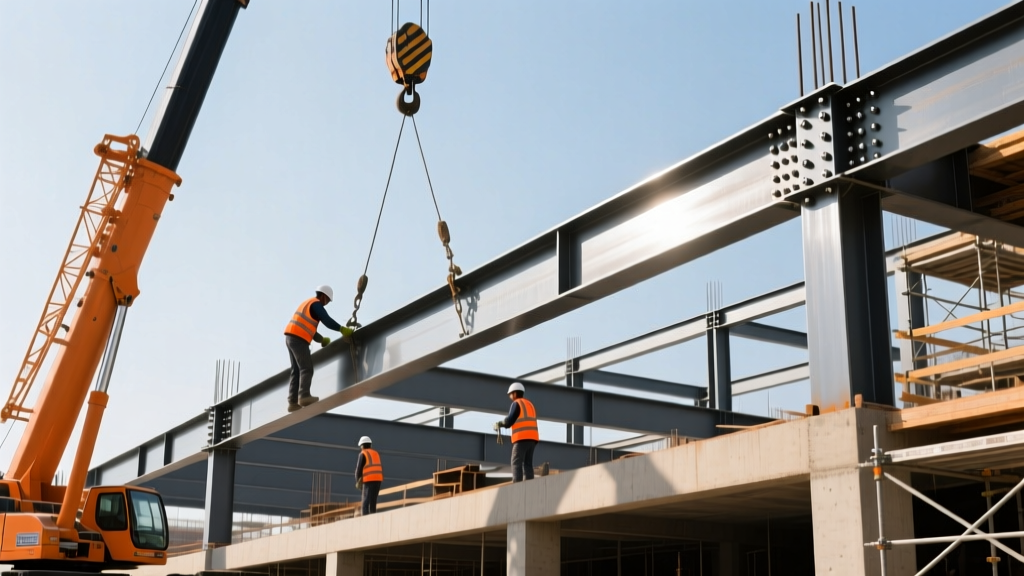
The True Cost of Structural Steel Erection in 2026
Calculating the labor cost to erect a steel building requires moving beyond simplistic per-square-foot averages. In 2026, the structural steel erection market is defined by a widening gap between union and open-shop labor rates, stringent OSHA compliance mandates, and the increasing complexity of moment-resisting frames. While material costs fluctuate with global supply chains, erection labor remains a localized, highly variable expense driven by regional ironworker availability and site-specific logistics.
2026 National Erection Labor Benchmarks
- Simple Warehouse/Industrial (Clearspan): $4.50 – $7.00 per sq. ft.
- Multi-Story Commercial (Braced Frame): $9.00 – $14.50 per sq. ft.
- Complex Moment-Resisting Structures: $16.00 – $24.00+ per sq. ft.
- Average Tonnage Rate (Labor Only): $450 – $850 per erected ton.
According to the Bureau of Labor Statistics (BLS), the median hourly wage for structural iron and steel workers has steadily climbed, but the fully burdened labor rate—including insurance, equipment, and per diems—often exceeds $85 to $135 per hour depending on the jurisdiction. Understanding where these hours are consumed is critical for accurate project forecasting.
Breakdown of Labor Costs by Structural Phase
Erecting a steel building is not a monolithic task; it is a sequenced operation where labor efficiency compounds or degrades based on the phase. Here is how labor hours are typically distributed across a standard 50,000 sq. ft. structural steel project.
1. Foundation Anchor Bolt Setting & Plumbing
Before the first column is lifted, anchor bolts must be set with extreme precision. In 2026, relying on traditional wooden templates is a liability. Top-tier erection crews use 3D laser scanning and adjustable steel template jigs to set J-bolts and threaded rods. Labor cost here is minimal compared to the structural phase (roughly 3-5% of total erection labor), but a 1/2-inch deviation in bolt placement can result in thousands of dollars in corrective labor, such as thermal cutting and re-welding base plates.
2. Primary Frame Erection (Columns & Rafters)
This phase consumes the bulk of crane time and high-skill ironworker hours. Crews must adhere strictly to the AISC Code of Standard Practice for plumbness and alignment. Labor inefficiencies here usually stem from poor crane positioning. A 150-ton hydraulic mobile crane can easily handle single-story clearspan rafters, but multi-story structures may require a 300-ton crawler crane, doubling the mobilization cost and requiring specialized rigging crews to manage heavier, multi-piece column splices.
3. Secondary Framing (Purlins, Girts, & Eave Struts)
Secondary framing is highly repetitive but voluminous. Labor productivity is measured in linear feet installed per man-hour. The introduction of pre-punched, nested Z-purlins has reduced secondary framing labor by roughly 15% over the last decade. However, installing rod bridging and strap bracing remains labor-intensive, often requiring scissor lifts or specialized buggies to maintain safety and speed.
4. Structural Decking & Bracing Installation
Installing composite floor decking or roof decking requires rapid attachment to prevent wind uplift hazards. While powder-actuated fasteners (like the Hilti DX5) remain common for thin-gauge roof decking, structural floor decking on multi-story projects is increasingly welded using automated stud welders or manual arc welding, which requires certified welders and commands a 20-30% higher hourly labor rate than standard connector crews.
2026 Labor Rate Matrix: Regional & Union Variance
The labor cost to erect a steel building is heavily dictated by geography and labor agreements. The matrix below illustrates the fully burdened hourly rates for a standard 4-man erection crew (1 foreman, 3 journeyman/apprentice ironworkers) across major US regions in 2026.
| Region | Open-Shop Rate (Avg) | Union Prevailing Rate (Avg) | Primary Cost Drivers |
|---|---|---|---|
| Northeast (NY, MA, PA) | $75 - $95 / hr | $130 - $165 / hr | High union density, strict site safety mandates, logistical constraints. |
| Midwest (IL, OH, MI) | $65 - $85 / hr | $105 - $135 / hr | Weather delays in Q1/Q4, strong prevailing wage laws in public works. |
| South (TX, FL, GA) | $55 - $75 / hr | $85 - $115 / hr | Highly competitive open-shop market, heat stress mitigation in summer. |
| West Coast (CA, WA, OR) | $80 - $105 / hr | $140 - $180 / hr | Seismic bracing complexity, stringent environmental and labor regulations. |
Hidden Labor Multipliers That Inflate Erection Costs
General contractors frequently underestimate the labor cost to erect a steel building by ignoring secondary multipliers. These edge cases can inflate the final labor budget by 15% to 25% if not accounted for during the estimating phase.
⚠️ Warning: OSHA Subpart R Compliance
Under OSHA 1926 Subpart R, steel erection requires specific safety protocols that directly consume labor hours. Double-connecting columns, installing perimeter safety cables, and establishing Controlled Decking Zones (CDZ) require dedicated time from highly trained connectors. Budget an additional 8-12% in labor hours strictly for Subpart R compliance and safety supervision on multi-story structures.
- Crane Mobilization & Demobilization: Moving a 250-ton crane to a remote site can cost $15,000 to $30,000. If the erection sequence is delayed, requiring the crane to remain on-site or be remobilized, labor costs skyrocket due to idle ironworker time.
- Site Access & Laydown Limitations: In dense urban environments, 'just-in-time' delivery is mandatory. Ironworkers spend up to 20% of their shift unhooking and re-sorting members because they lack the square footage to organize bundles logically.
- Field Welding vs. Bolted Connections: Every field-welded moment connection requires a certified welder, a welding inspector, and non-destructive testing (NDT). Transitioning to bolted connections using ASTM F3125 Grade A325 tension-control (TC) bolts can reduce connection labor time by up to 40%.
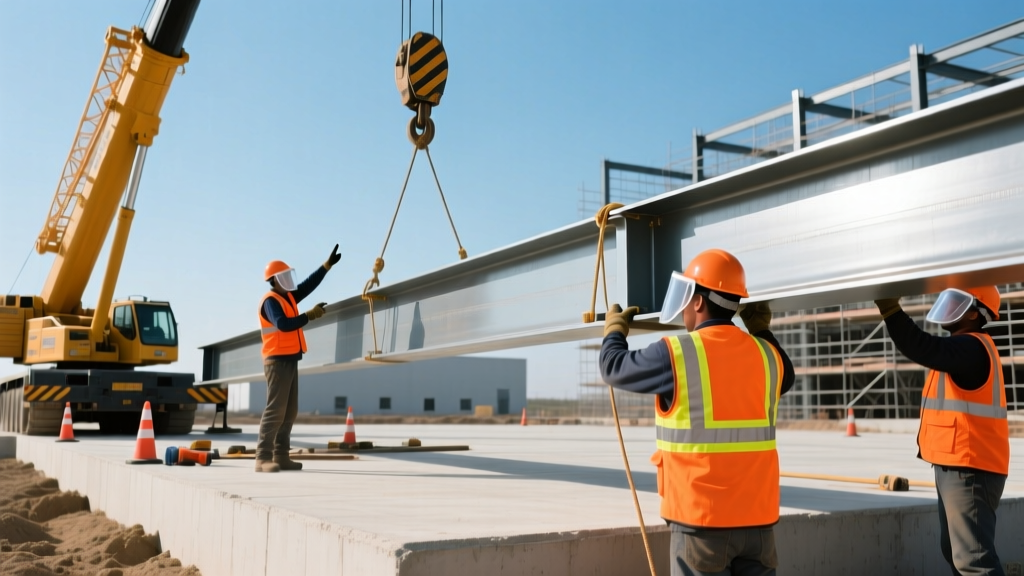
Strategic Framework: Reducing Erection Labor Hours
To optimize the labor cost to erect a steel building, structural engineers and detailers must design for erection efficiency, not just material optimization. Implement the following framework during the LOD 400 (Level of Development) BIM coordination phase:
- Optimize Splice Locations: Design column splices to occur at floor levels where ironworkers can stand on the erected deck to bolt the connection, rather than requiring expensive man-lifts or hanging scaffolding mid-shaft.
- Standardize Connection Hardware: Utilize a uniform bolt diameter (e.g., 3/4-inch A325) across all shear connections. Forcing ironworkers to switch between 3/4-inch, 7/8-inch, and 1-inch wrenches and impact guns during a single lift drastically reduces connection speed.
- Pre-Assembled Bundles: Require the fabricator to bundle purlins, girts, and associated bridging in the exact sequence of erection. A fabricator charging $50/ton for specialized sequencing will easily pay for itself by saving $150/hour in crane and ironworker sorting time on-site.
- Maximize Shop Welding: Shift all base plate welding, shear tab welding, and stiffener installation to the controlled shop environment. Shop welding is typically 3 to 4 times faster and cheaper than field welding due to automated processes and the absence of weather delays.
Frequently Asked Questions on Steel Erection Labor
Does the labor cost to erect a steel building include the crane operator?
Typically, no. In most standard erection contracts, the crane and operator are billed as a separate equipment line item or a daily/weekly rental rate, distinct from the ironworker labor crew. However, the operator's time is inextricably linked to the ironworkers' productivity; if the crew is delayed, the crane cost continues to accrue.
How do weather delays impact structural steel labor contracts?
Most erection subcontracts include a 'weather day' allowance (e.g., 5-8 days per year). If high winds (typically exceeding 25-30 mph for lifting) or lightning halt crane operations, the ironworkers may be sent home, but the contractor may still be liable for show-up pay or minimum shift guarantees, artificially inflating the effective hourly labor cost.
Are tension-control (TC) bolts faster to install than hex-head bolts?
Yes. TC bolts (ASTM F3125 Grade A325 or A490) feature a splined end that shears off when the correct installation tension is reached using a specialized shear wrench. This eliminates the need for manual torque checking and match-marking required for standard hex-head bolts, reducing connection labor time by approximately 25% to 30% on high-volume structural frames.
Written by
Marcus ChenMarcus Chen is a licensed structural engineer (PE) and building materials analyst with over 12 years of experience across residential, commercial, and industrial construction. He holds a Master of Science in Civil Engineering from UC Berkeley and spent six years at Thornton Tomasetti before transitioning to independent consulting and technical writing. Marcus specializes in material selection for seismic-prone regions, concrete reinforcement strategies, and lifecycle cost analysis. His work has been cited by the American Concrete Institute (ACI) and the Structural Engineers Association of California (SEAOC). When he is not on a job site or at his desk, you will find him hiking the Sierra Nevada or restoring a 1920s craftsman bungalow in Oakland, CA.
More from Marcus Chen
View all
Construction Cost
How Much Did the Eiffel Tower Cost to Build?
How much did the Eiffel Tower cost to build in 1889? We adjust for inflation and compare its budget to modern skyscraper construction.
Aug 4, 2026

Fire Resistance
What Is a Fire Resistant Material? Testing & Certification Guide
Discover what is a fire resistant material through ASTM and UL testing. Learn how fire ratings, certifications, and assemblies work in construction.
Aug 4, 2026

Construction Cost
How Much Did the Burj Khalifa Cost to Build?
How much did the Burj Khalifa cost to build? We break down the $1.5B project and extract 5 money-saving strategies for your next build.
Jul 30, 2026