Baltic Birch Plywood: Brand Deep-Dive, Grades & 2026 Pricing
Deep dive into Baltic birch plywood: compare top brands like Riga and WISA, decode BB/BB grades, and review 2026 pricing and CNC specs.
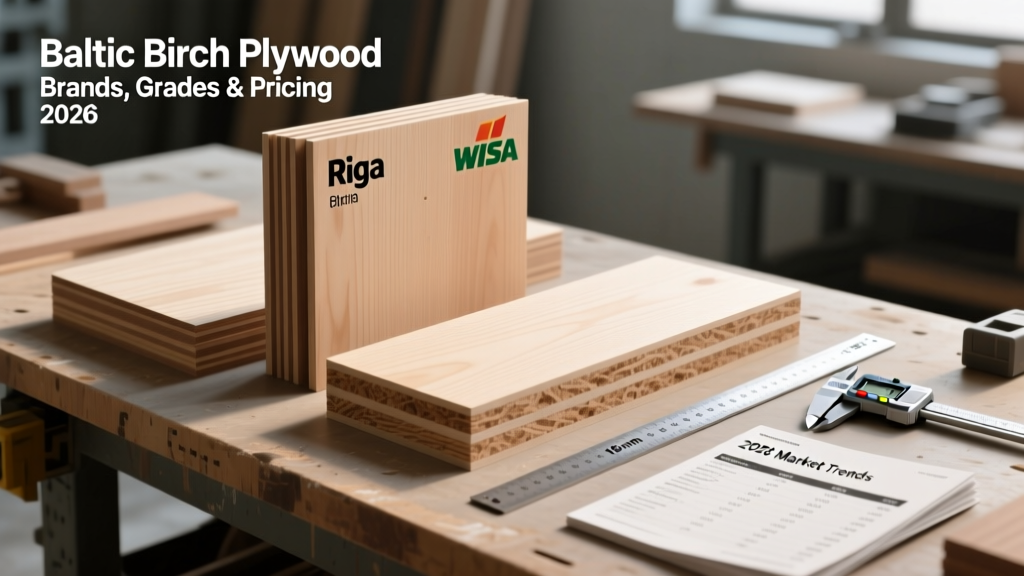
The Anatomy of True Baltic Birch vs. Domestic Alternatives
True Baltic birch plywood is engineered from the veneers of Betula pendula (European white birch) and Betula pubescens (downy birch), harvested primarily from the sustainably managed boreal forests of Latvia, Finland, and northwestern Russia. Unlike standard domestic plywood, which often utilizes a softwood core (like Douglas fir or pine) with a thin hardwood face veneer, authentic Baltic birch is a 100% hardwood, cross-banded laminate. Every single ply is cut from birch logs, resulting in a panel with exceptional screw-holding strength, uniform density, and a completely void-free core.
The distinction between true Baltic birch and domestic or imported "birch" plywood is critical for high-tolerance applications like CNC cabinetry, laser cutting, and precision shop jigs. According to data compiled by The Wood Database, European white birch boasts a Janka hardness of 1,260 lbf and a specific gravity of 0.51, providing a significantly stiffer and more stable substrate than North American yellow birch (Betula alleghaniensis) or the mixed-hardwood cores found in big-box store alternatives.
| Feature | True Baltic Birch (European) | Domestic "Birch" Cabinet Ply | Import "Birch" (Asian Core) |
|---|---|---|---|
| Core Material | 100% Birch Veneer | Softwood or Mixed Hardwood | Poplar, Meranti, or Mixed |
| Core Voids | None (Void-Free) | Frequent in inner plies | Highly variable, often patched |
| Ply Count (18mm) | 13 Plies | 7 to 9 Plies | 7 to 11 Plies |
| Standard Sheet Size | 5' x 5' (1525 x 1525 mm) | 4' x 8' (1220 x 2440 mm) | 4' x 8' (1220 x 2440 mm) |
| Edge Appearance | Distinct, attractive striping | Thick core plies, visible gaps | Irregular, requires heavy banding |
Decoding the Grades: BB/BB, B/BB, CP/BB Explained
Baltic birch plywood grading follows European and Eurasian standards (such as GOST 3916.1-2018), which evaluate the face and back veneers independently. The grade is always written as a fraction or hyphenated pair (e.g., B/BB or CP/BB), where the first letter represents the face and the second represents the back.
- Grade B (Premium): The highest commercially available grade. The veneer is uniform in color, completely free of knots, patches, or mineral streaks. Pin knots (under 2mm) are occasionally permitted but rare. Ideal for clear-coated architectural millwork and high-end furniture.
- Grade BB (Cabinet/Furniture): The industry workhorse. Allows for slight color variations, small mineral streaks, and neatly repaired pin knots. It is smooth, sanded to 120-grit or higher, and perfect for painted cabinetry or shop furniture where absolute color uniformity is not required.
- Grade CP (Cabinet Ply): Permits larger, sound knots (up to 6mm) and minor veneer splices. Often used for the backs of cabinets, drawer bottoms, or structural components that will be painted or concealed.
- Grade C (Utility): Allows open defects, knot holes up to 40mm, and edge patches. Strictly used for structural shop jigs, packing crates, or concealed sub-assemblies.
Many North American distributors stamp 4x8 sheets of Asian-manufactured plywood with "Baltic Birch" simply because the face veneer is rotary-peeled birch. If the sheet is 4x8, lacks the dense 13-ply edge striping on 18mm stock, or features a softwood core, it is not true Baltic birch. Always verify the country of origin (Latvia, Finland, or Estonia) and request the manufacturer's technical data sheet before purchasing in bulk.
Top Brands & Product Lines: Riga, WISA, and Koskisen
When sourcing authentic material, specifying the manufacturer is just as important as specifying the grade. The Baltic plywood market is dominated by a few heritage manufacturers who control the entire process from forest to press.
Riga Wood (Latvijas Finieris)
Based in Latvia, Latvijas Finieris produces the legendary Riga brand. Their Riga Prime line represents the absolute pinnacle of B/BB grading, offering flawless faces for UV-cured clear finishes. For standard cabinetry, Riga Basic (BB/BB) is the most widely specified product line in North America. They utilize a water-boiled-proof (WBP) phenolic resin glue, making even their interior panels highly resistant to moisture ingress during machining.
WISA Birch (UPM Plywood)
Finnish manufacturer UPM produces the WISA-Birch line. WISA is renowned for its rigorous thickness tolerances and exceptional face veneer calibration. Their WISA-Birch Pro features a specialized surface treatment that optimizes the panel for direct digital printing and high-pressure laminate (HPL) bonding without the need for aggressive sanding prep.
Koskisen Birch
Finland’s Koskisen offers KoskiPly Birch, heavily favored in the European motorhome, caravan, and marine interior markets. Their birch plywood is often overlaid with a phenolic film (KoskiHexa or KoskiPly Color) for extreme wear resistance, though their raw, sanded birch lines remain highly competitive for custom joinery.
Dimensional Tolerances and Ply-Count Matrix
True Baltic birch plywood is manufactured in metric dimensions, which leads to frequent confusion when North American builders attempt to match it with imperial hardware or edge banding. The standard sheet size is 1525 mm x 1525 mm (exactly 5' x 5'). Below is the precise ply-count and weight matrix for standard metric thicknesses.
| Nominal Metric | Imperial Equivalent | Actual Thickness | Ply Count | Weight (5x5 Sheet) |
|---|---|---|---|---|
| 4 mm | 1/8" | 3.8 - 4.0 mm | 3 | 11 lbs |
| 6 mm | 1/4" | 5.8 - 6.0 mm | 5 | 16 lbs |
| 9 mm | 3/8" | 8.8 - 9.0 mm | 7 | 24 lbs |
| 12 mm | 1/2" | 11.8 - 12.0 mm | 9 | 32 lbs |
| 15 mm | 5/8" | 14.8 - 15.0 mm | 11 | 40 lbs |
| 18 mm | 3/4" | 17.8 - 18.0 mm | 13 | 48 lbs |
2026 Pricing Breakdown & Sourcing Strategy
Due to geopolitical shifts and supply chain reorganizations over the past few years, the North American supply of Baltic birch has transitioned heavily toward Latvian and Finnish imports, with Russian stock largely restricted. As of early 2026, pricing for authentic, void-free Baltic birch reflects these premium logistics.
2026 Market Pricing (North America, per 5x5 sheet):
• 18mm (3/4") BB/BB: $165 – $195
• 12mm (1/2") BB/BB: $125 – $145
• 6mm (1/4") B/BB: $75 – $90
Note: Prices vary by regional distributor and volume. Full-unit purchases (22-26 sheets) typically yield a 12-15% discount.
Sourcing Strategy: Avoid general-purpose lumber yards, which rarely stock true 5x5 metric panels. Instead, source from specialized hardwood distributors (e.g., Austin Hardwoods, MacBeath, or regional equivalent) that explicitly list the manufacturer (Riga, WISA) and the GOST/EN grading standards on their invoices.
CNC Machining and Edge Finishing Protocols
The uniform density of Baltic birch makes it the premier substrate for CNC routing, but its high glue content and hardwood composition require specific tooling and feed-rate adjustments to prevent delamination or edge burning.
- Tooling Selection: Use a 2-flute solid carbide compression bit (e.g., 1/4" or 3/8" shank) for through-cutting. The compression geometry pulls the top and bottom veneers toward the center of the panel, completely eliminating tear-out on the delicate B-grade face veneers.
- Feed Rate and RPM: For 18mm material on a standard 3HP CNC spindle, maintain an RPM of 16,000 to 18,000 with a feed rate of 120 to 150 IPM (inches per minute). Slower feed rates will cause the phenolic glue lines to melt and burnish the edge, creating a surface that rejects wood glue and edge-banding adhesives.
- Edge Preparation for Banding: If applying PVC or wood veneer edge banding, run a 120-grit orbital sanding pass over the machined edges to open the wood pores. The WBP glue lines in Baltic birch are non-porous; if left glazed from the CNC bit, hot-melt EVA or PUR edge banding adhesives will fail under thermal stress.
- Exposed Edge Finishing: For projects utilizing the signature ply-striping as a design feature, sand the edges progressively to 220-grit. Apply a 50/50 wash coat of dewaxed shellac before applying a hardwax oil (like Rubio Monocoat or Osmo). This prevents the end-grain of the alternate plies from absorbing oil unevenly and turning dark.