Best Type of Wood for Deck Installation: A Pro Builder's Guide
Discover the best type of wood for deck construction. Learn installation best practices, moisture management, and fastener specs for lasting results.

Deck failures are rarely caused by the wood species itself; they are almost always the result of installing a specific wood type using the wrong fasteners, spacing, or moisture management protocols. Determining the best type of wood for deck construction requires matching the material's physical properties—specifically its density, tannin content, and dimensional movement coefficient—to exact installation methodologies.
This guide bypasses generic material overviews to provide structural and finishing contractors with the precise installation parameters required for the most common high-performance decking and framing lumbers used in modern exterior construction.
Framing Lumber: Specifying Pressure-Treated Southern Yellow Pine
While composite and PVC dominate decking board discussions, the substructure remains predominantly wood. The best type of wood for deck framing is #2 Grade or better Pressure-Treated Southern Yellow Pine (PT SYP). However, specifying the wood is only the first step; specifying the correct treatment retention level is where installation best practices begin.
The American Wood Protection Association (AWPA) classifies treated lumber by Use Categories (UC). Misapplying these categories is a primary cause of premature joist rot.
Never use UC3B (Above Ground) treated lumber for joists that are less than 6 inches from the ground, or for any structural members that will be in contact with concrete footings. You must specify UC4A (Ground Contact) for ledger boards attached to masonry, posts embedded in concrete, and low-clearance joists. UC4A contains a higher chemical retention rate (typically 0.40 pcf for ACQ or CA-C) compared to UC3B (0.25 pcf), providing the necessary protection against capillary moisture wicking.
The KDAT Advantage for Framing
Standard pressure-treated lumber is installed wet and shrinks as it dries, leading to warped joists and squeaky decking. For premium installations, specify Kiln-Dried After Treatment (KDAT) SYP. KDAT lumber is stabilized at the mill to a moisture content of roughly 15%, minimizing post-installation shrinkage and ensuring the deck framing remains true and level when the decking boards are fastened.
Decking Board Selection: Hardwood, Softwood, and Modified Matrices
When selecting the best type of wood for deck surface boards, contractors must balance Janka hardness (which dictates fastener requirements) with tangential shrinkage (which dictates spacing). Below is a technical comparison of the three dominant wood categories.
| Wood Species | Janka Hardness (lbf) | Tangential Shrinkage | Required Board Gap |
|---|---|---|---|
| Ipe (Handroanthus spp.) | 3,680 | 6.2% | 3/32" (Standard) |
| Western Red Cedar | 350 | 5.0% | 1/8" to 1/4" |
| Thermally Modified Ash | 1,320 | 3.8% | 1/16" to 3/32" |
Acclimation Protocols and Moisture Equilibrium
Wood is hygroscopic. Installing decking boards without allowing them to reach Equilibrium Moisture Content (EMC) with the local environment guarantees dimensional failure. According to the USDA Forest Products Laboratory Wood Handbook, wood will continually absorb or release moisture until it balances with the surrounding relative humidity and temperature.
Acclimation Best Practices by Species
- Tropical Hardwoods (Ipe, Cumaru): These are typically kiln-dried to 12-15% moisture content before shipping. If installed in a humid coastal environment, they will expand. If installed in a dry, arid climate (like the US Southwest), they will shrink. Store the lumber on-site, off the ground, and covered with a breathable tarp for 7 to 14 days before installation.
- Western Red Cedar: Often sold green or air-dried. Cedar requires significant cross-ventilation during the acclimation phase. Stack the boards with 3/4" wooden stickers between every layer to allow airflow. Expect a 5 to 10-day acclimation period.
- Thermally Modified Wood: The thermal modification process permanently alters the cell structure, reducing moisture absorption by up to 50%. Acclimation time is drastically reduced, often requiring only 3 to 5 days on-site.
Fastener Metallurgy and Spacing Tolerances
The interaction between wood tannins, preservative chemicals, and fastener metallurgy is a frequent point of failure. Using the wrong screw type will result in severe black staining or catastrophic fastener corrosion.
Fastener Selection Matrix
For Tropical Hardwoods (Ipe, Cumaru, Garapa): You must use Type 316 Marine-Grade Stainless Steel. Type 304 stainless will eventually pit and stain the wood due to the high tannic acid content and density of the timber. For hidden fastener systems, use stainless steel clips (e.g., CAMO or Eb-Ty) rather than carbon steel coated alternatives.
For Pressure-Treated Framing: Modern PT lumber uses copper-based preservatives (ACQ, CA-C, or MCA) which are highly corrosive to standard zinc. You must use hot-dipped galvanized (HDG) fasteners meeting ASTM A153 Class D standards, or polymer-coated structural screws rated for treated lumber.
For Western Red Cedar: Cedar contains natural preservatives that react violently with iron and standard zinc, causing unsightly black streaks. Use Type 304 or 316 stainless steel, or hot-dipped galvanized nails/screws. Avoid electroplated (bright) zinc entirely.
Pre-Drilling Requirements for Dense Hardwoods
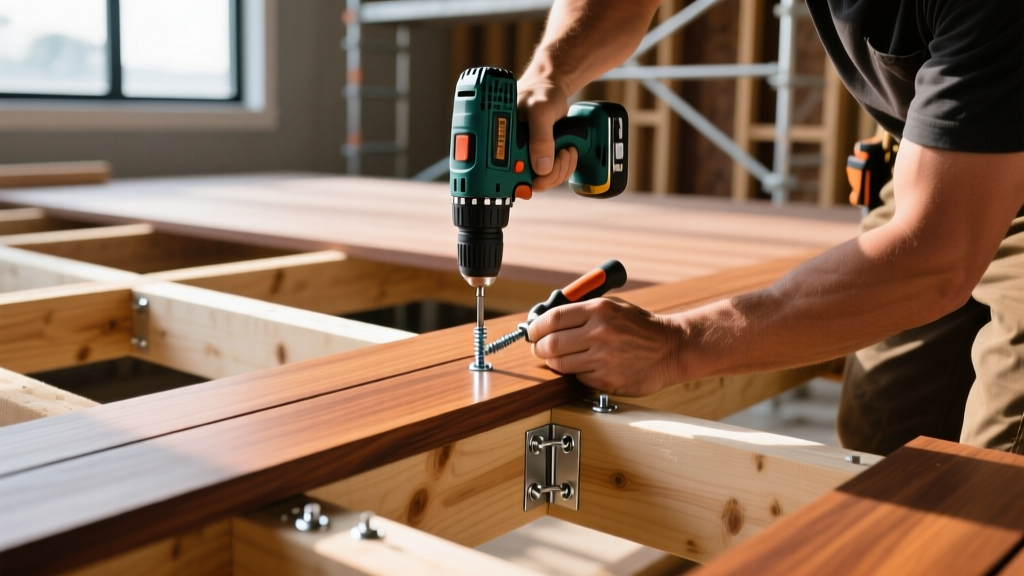
When face-screwing Ipe or Cumaru, driving a screw directly into the board will cause the wood fibers to compress and bulge upward (mushrooming), or snap the screw head. You must use a two-step pre-drilling process:
- Pilot Hole: Drill through the joist using a bit slightly smaller than the screw's root diameter.
- Clearance Hole: Drill through the decking board using a bit exactly matching the screw's outer thread diameter. This allows the screw to pull the board tight against the joist without binding in the top layer.
End-Grain Sealing and Edge Mitigation
Moisture enters and exits wood 10 to 15 times faster through the end grain than through the face grain. Failing to seal end cuts is the primary cause of severe checking (splitting) at the board ends.
"Every time a tropical hardwood or cedar board is cut on-site, the exposed end grain must be immediately sealed with a wax-based emulsion sealer, such as Anchorseal. Standard exterior paints or polyurethanes do not possess the elasticity to handle the end-grain movement and will quickly peel, leaving the wood vulnerable."
— Best Practice Standard for Exterior Hardwoods
Apply the wax sealer heavily to the end grain within 5 minutes of making the cut. For a cleaner aesthetic, trim the sealed ends by 1/8" after the sealer dries to remove the waxy buildup, then apply a final thin coat.
Troubleshooting Common Installation Failures
Symptom: Board Cupping (Edges curling upward)
Cause: Cupping occurs when the bottom of the board is significantly wetter than the top. This is almost always caused by inadequate joist spacing or poor under-deck ventilation, trapping moisture against the board's underside.
Fix: Ensure joists are spaced a maximum of 16" on-center (12" for 5/4x6 tropical hardwoods installed on a diagonal). Maintain at least 18 inches of clearance from the ground to the bottom of the joists for cross-ventilation, as recommended by the Western Red Cedar Lumber Association.
Symptom: Black Staining Around Fastener Holes
Cause: Tannin bleed reacting with non-stainless steel fasteners, or water pooling in a countersink hole that was not properly plugged.
Fix: Switch to 316 stainless steel. If face-fastening hardwoods, do not over-countersink. Use a tapered plug cutter to create a wood plug from the same species, glue it in with exterior-grade PVA or polyurethane adhesive, and sand flush.
Expert FAQ
Q: Can I use hidden fasteners on Western Red Cedar?
A: Yes, but with caution. Cedar is a softwood (350 Janka) and lacks the shear strength of hardwoods. If using a hidden clip system, ensure the clips are specifically rated for softwoods, and reduce joist spacing to 12" on-center to prevent the board from flexing and popping out of the clips under heavy foot traffic.
Q: What is the best gap spacing for Ipe decking in a humid climate?
A: In high-humidity environments (like the US Southeast), Ipe will be closer to its maximum expansion state upon delivery. A 3/32" gap (often achieved by using a 16d nail as a spacer during installation) is standard. If installing during the dry winter months, increase the gap to 1/8" to allow for summer expansion.
Q: Should I sand tropical hardwood decking before installation?
A: No. Sanding opens the wood pores and removes the dense, natural surface layer, making the wood more susceptible to UV graying and moisture ingress. If the boards have mill glaze or surface dirt, clean them with a dedicated hardwood deck cleaner and a stiff bristle brush, but avoid mechanical sanding prior to installation.
Written by
Priya KapoorPriya Kapoor is a real estate market analyst and construction economics researcher with expertise in housing affordability, development feasibility, and infrastructure investment. She holds a Master of Regional Planning from Cornell University and previously worked as a senior analyst at CBRE's Investment Properties group, where she modeled returns for $4B in mixed-use development pipelines. Priya now runs an independent research practice advising developers, municipalities, and REITs on construction cost forecasting and market timing. She publishes the quarterly "BuildMat Market Pulse" report tracking material price indices across 12 commodity categories. Based in Austin, TX, Priya serves on the board of Habitat for Humanity Austin and is a marathon runner.
More from Priya Kapoor
View all
Construction Cost
Cost to Build a 1600 Sq Ft Home in 2026: Full Breakdown
Accurate 2026 cost to build a 1600 sq ft home—material, labor, and regional pricing breakdowns included. Plan your budget with real-time estimates.
Aug 11, 2026

Wood & Lumber
Name the Types of Wood for Pressure Treatment and Preservation
Learn how to name the types of wood best suited for pressure treatment. Compare species treatability, chemical retention levels, and 2026 preservation costs.
Aug 4, 2026

Stone & Masonry
Stone Veneer Suppliers Lindenhurst: 2026 Cost Analysis
Analyze 2026 stone veneer costs in Lindenhurst, NY. Compare local supplier pricing, delivery fees, and Suffolk County installation labor rates.
Aug 4, 2026