MDF Boards Selection Guide: Taxonomy of Densities and Grades
Navigate the MDF boards taxonomy. Compare densities, moisture ratings, and formaldehyde grades to select the exact engineered panel for your project.
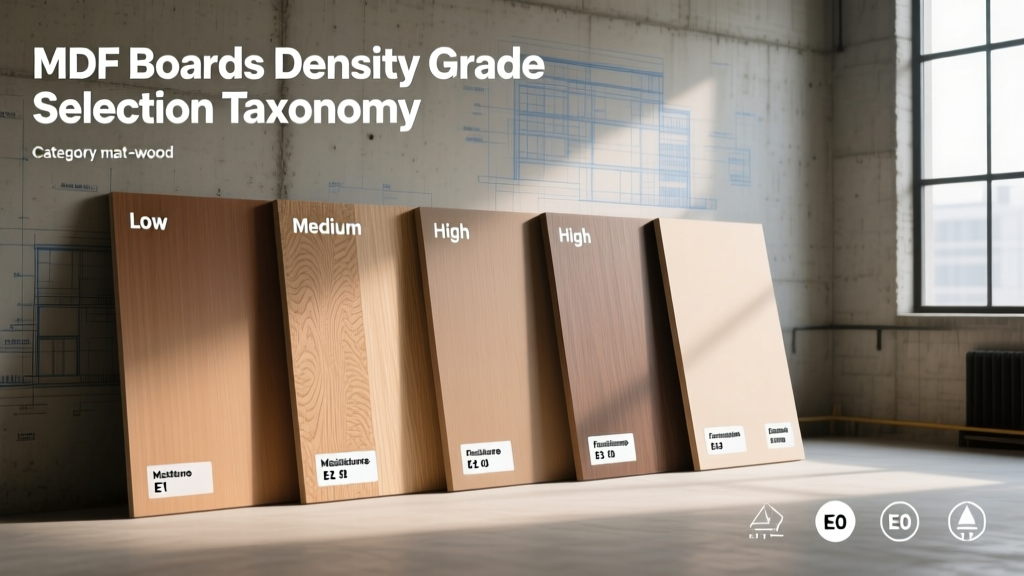
The Core Taxonomy: Standard vs. Specialized MDF Boards
Medium Density Fiberboard (MDF) is not a single, uniform material. It is a broad category of engineered wood panels defined by specific resin chemistries, fiber densities, and performance grades. Selecting the wrong variant for a specific application leads to catastrophic failures, such as edge swelling in high-humidity environments or structural sagging in wide shelving. The ANSI A208.2 standard governs MDF manufacturing in North America, classifying boards into distinct taxonomic grades based on their physical properties and intended use cases.
Standard Interior MDF (Grade 110/120)
Manufactured using urea-formaldehyde (UF) resins and refined wood fibers, standard MDF offers a perfectly smooth, grain-free surface ideal for painted millwork and veneer substrates. It possesses high internal bond strength but lacks any inherent resistance to moisture or fire. It is strictly limited to interior, climate-controlled environments where relative humidity remains between 30% and 50%.
Moisture Resistant (MR) MDF (Grade 130)
MR MDF incorporates melamine-urea-formaldehyde (MUF) resins or specialized wax emulsions during the mat-forming process to retard moisture absorption. While frequently dyed green for visual identification on the job site, color is not a reliable indicator; always verify the manufacturer's stamp for ANSI Grade 130 compliance. In standardized 24-hour water soak tests, standard MDF exhibits a thickness swelling (TS) of 15% to 25%, whereas high-quality MR MDF limits TS to under 8%.
MR MDF is moisture-resistant, not waterproof. It will withstand occasional humidity spikes and minor condensation, but it cannot survive direct water exposure or prolonged pooling. For areas subject to direct liquid contact (e.g., shower surrounds or exterior soffits), you must transition to Exterior Grade MDF (Grade 150) utilizing MDI resins, or abandon MDF entirely in favor of marine-grade plywood or PVC trim boards.
Fire Retardant (FR) MDF
FR MDF is treated with proprietary chemical fire retardants (often ammonium polyphosphate or borate-based compounds) integrated directly into the fiber mat. It achieves a Class A / Class 1 flame spread and smoke developed index (ASTM E84), making it mandatory for commercial egress routes, elevator lobbies, and public assembly spaces. Note that FR MDF is highly corrosive to standard steel fasteners; you must use zinc-plated or stainless-steel hardware to prevent rust staining.
Density Classifications: Why Weight Dictates Machinability
The term 'Medium Density' is a baseline, but modern manufacturing has bifurcated the market into ultralight, standard, and high-density panels. Density directly impacts the panel's weight, screw-holding capacity, and machinability.
| Classification | Density (lbs/ft³) | Weight per 3/4" 4x8 Sheet | Primary Applications |
|---|---|---|---|
| Ultralight (UL-MDF) | 28 - 34 | ~60 lbs | Exhibition booths, RV cabinetry, theater sets, large-format wall paneling |
| Standard MDF | 42 - 50 | ~90 - 105 lbs | Painted cabinet doors, baseboards, furniture substrates, CNC routing |
| High Density (HDF) | 55 - 65+ | ~120 - 140 lbs | Laminate flooring cores, heavy-duty shelving, acoustic door cores |
Ultralight MDF reduces installer fatigue and shipping costs but sacrifices internal bond strength. It cannot be routed for deep 3D profiles without severe edge fuzzing, and it requires specialized hollow-core fastening techniques. Standard MDF remains the gold standard for CNC machining and painted cabinet doors due to its homogeneous core, which yields crisp, tear-out-free profiles when cut with sharp tooling.
Resin Chemistry and Formaldehyde Emissions
Historically, MDF relied heavily on urea-formaldehyde (UF) resins, which off-gas volatile organic compounds (VOCs) as they cure and degrade. Today, stringent indoor air quality regulations have forced a taxonomy shift in resin chemistry. When sourcing MDF boards, you must specify the emission grade to comply with local building codes and protect occupant health.
- CARB Phase 2 / TSCA Title VI Compliant: The current legal baseline in North America. Limits formaldehyde emissions to 0.11 ppm for MDF. Achieved by optimizing the catalyst ratios in standard UF resins.
- ULEF (Ultra-Low Emitting Formaldehyde): Emits at or below 0.05 ppm. Utilizes advanced scavenger chemicals added to the resin mix to bind free formaldehyde.
- NAF (No Added Formaldehyde): The premium tier. NAF boards utilize methylene diphenyl diisocyanate (MDI) resins. MDI is a polyurethane-based binder that contains zero formaldehyde. NAF MDF is mandatory for LEED-certified commercial projects, healthcare facilities, and schools. According to the EPA Formaldehyde Standards, NAF products are exempt from certain third-party testing requirements due to their inherent chemical composition.
Application-Specific Selection Matrix
Use this decision framework to match the project requirements with the correct MDF taxonomy:
Painted Cabinet Doors
Selection: Standard MDF (Grade 120), 3/4" thickness.
Rationale: Requires a dense, uniform core for routing raised panel profiles without tear-out. The smooth surface minimizes primer absorption compared to solid wood.
Bathroom Vanity Substrate
Selection: MR MDF (Grade 130), 3/4" thickness.
Rationale: Must withstand ambient humidity spikes from showers. Must be fully encapsulated in a waterproof edge-banding and sealed with a catalyzed conversion varnish.
Acoustic Wall Paneling
Selection: Ultralight MDF, 1/2" thickness.
Rationale: Reduces dead-load on wall framing and adhesive shear stress. Slotted or micro-perforated on a CNC for sound absorption without excessive weight.
Commercial Elevator Lobbies
Selection: Fire Retardant (FR) MDF, 5/8" thickness.
Rationale: Mandated by IBC (International Building Code) for non-combustible interior finishes in high-rise egress paths.
Machining, Fastening, and Edge Sealing Protocols
MDF's homogeneous structure makes it a dream to machine but a nightmare to fasten and finish if improper protocols are ignored. The Composite Panel Association outlines strict handling guidelines to prevent structural degradation.
Tooling and Feed Rates
MDF is highly abrasive. The silica content in the wood fibers and the cured resins will dull High-Speed Steel (HSS) router bits within a few linear feet. You must use solid carbide up-cut or compression spiral bits. When routing deep 3D profiles, maintain a consistent feed rate; lingering in one spot generates friction heat, which glazes the resin and creates a burnished edge that will reject paint primer.
Fastening Strategies
Standard wood screws will strip out and cause 'telegraphing' (visible bulging on the opposite face) or catastrophic edge blowout. For structural cabinet joints, abandon wood screws entirely. Instead, use 5mm x 50mm Confirmat screws, which feature massive, coarse threads designed specifically to bite into fibrous composite cores. For face-fastening, use specialized MDF screws (such as SPAX MDF) that feature a cutting thread at the tip to displace fibers rather than compressing them, eliminating the need for pre-drilling and preventing surface bulging.
The Edge Sealing Imperative
The edges of MDF are essentially microscopic straws. If you apply water-based latex paint directly to a raw MDF edge, the fibers will swell, creating a permanently rough, textured finish. Before painting, edges must be sized. Apply a 50/50 mixture of water and PVA wood glue, or use a dedicated shellac-based sanding sealer (like Zinsser BIN). This locks the fibers down, creating a glass-smooth substrate for your topcoats.
2026 Procurement and Cost Benchmarks
Pricing for MDF boards fluctuates based on resin costs and global fiber availability. As of current market benchmarks, expect the following wholesale-to-retail pricing for standard 4x8 sheets:
- Standard 3/4" MDF (Grade 120): $45 - $60 per sheet.
- Moisture Resistant 3/4" MR MDF (Grade 130): $65 - $85 per sheet.
- NAF (No Added Formaldehyde) 3/4" MDF: $75 - $95 per sheet.
- Fire Retardant 5/8" FR MDF: $110 - $140 per sheet.
When procuring for large-scale millwork or cabinetry, always request the manufacturer's Technical Data Sheet (TDS) to verify the specific ANSI grade, formaldehyde emission tier, and thickness swelling metrics. Relying on generic supplier descriptions often results in the delivery of standard interior boards mislabeled as moisture-resistant, leading to costly callbacks and warranty claims down the line.