Sourcing Oak Cliff Building Materials: A Wood Selection Framework
Master the selection framework for Oak Cliff building materials. Learn which wood species and milling profiles match historic Dallas architectural styles.

The Architectural DNA of Oak Cliff: Why Wood Selection Matters
Restoring or building in Dallas’s historic Oak Cliff neighborhoods—such as Winnetka Heights, Kessler Park, and Kidd Springs—requires more than just a general contractor and a permit. It demands a rigorous understanding of early 20th-century architectural vernacular. When professionals and homeowners search for oak cliff building materials, they are rarely looking for generic big-box lumber. They are hunting for specific grain patterns, old-growth density, and historically accurate milling profiles that define the Craftsman, Prairie, and Tudor revival styles prevalent in the area.
Using modern, fast-grown substitutes in a historic overlay district not only triggers rejections from the Dallas Landmark Commission but also results in premature material failure. Modern Loblolly pine (Pinus taeda), for instance, has a Janka hardness of roughly 420 lbf, making it highly susceptible to denting and wear. In contrast, the original Longleaf heart pine (Pinus palustris) used in 1910s Oak Cliff homes boasts a Janka hardness of 870 lbf. This guide provides a definitive selection framework for sourcing, specifying, and installing authentic wood materials for Oak Cliff projects.
The Oak Cliff Material Selection Decision Tree
- Step 1: Identify the Architectural Era. Pre-1915 (Victorian/Queen Anne) favors ornate, painted softwoods. 1915-1930 (Craftsman/Prairie) demands stained, quarter-sawn hardwoods and exposed structural timber.
- Step 2: Determine the Preservation Status. Is the property in a Conservation District or a Historic Overlay? Overlay districts mandate strict adherence to City of Dallas Historic Preservation guidelines regarding visible exterior materials.
- Step 3: Match the Milling Profile. Do not just match the species; match the cut. A 1x4 clapboard with a 3.5-inch reveal requires custom milling if original stock is unavailable.
- Step 4: Verify Acclimation Metrics. Ensure reclaimed or newly milled lumber is kiln-dried or acclimated to Dallas’s specific 8-10% Equilibrium Moisture Content (EMC) before installation.
Core Species Framework: Matching Wood to Application
To successfully navigate the market for oak cliff building materials, you must segment your selection by application. The structural and aesthetic demands of flooring, exterior siding, and interior millwork require entirely different botanical and milling specifications.
1. Flooring: Longleaf Heart Pine vs. Modern Substitutes
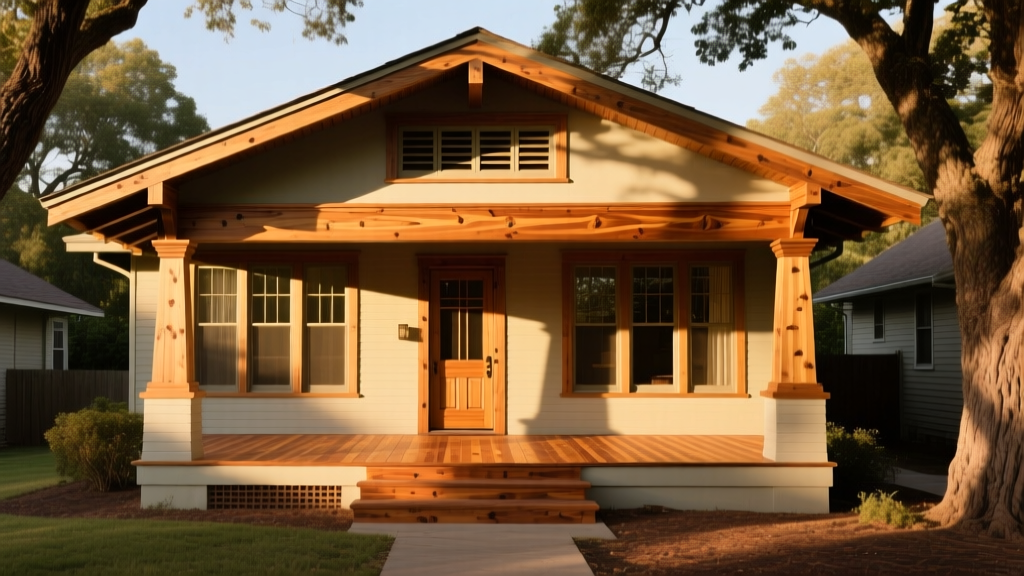
The hallmark of an authentic Oak Cliff Craftsman bungalow is wide-plank heart pine flooring. Sourcing this requires understanding the difference between 'river-reclaimed' (logs pulled from riverbeds, offering high density and dark, rich patinas) and 'de-nailed reclaimed' (salvaged from demolished barns or factories, featuring nail holes and oxidation stains). According to The Wood Database, true Longleaf pine contains a high concentration of resin, which naturally deters pests and provides superior dimensional stability compared to modern Southern Yellow Pine.
Specification Rule: For living areas, mandate 100% heartwood content with a minimum of 8-12 growth rings per inch. Avoid sapwood edges, which lack the resinous durability required for high-traffic historic restorations.
2. Interior Millwork: The Quarter-Sawn White Oak Imperative
For built-in cabinetry, wainscoting, and pocket door surrounds typical of the Prairie and Craftsman styles, plain-sawn oak is a visual failure. You must specify Quarter-Sawn White Oak (Quercus alba). Quarter-sawing cuts the log at a 90-degree angle to the growth rings, exposing the medullary rays. This produces the distinctive 'tiger stripe' or 'flake' pattern that is synonymous with Gustav Stickley furniture and authentic 1920s Oak Cliff millwork.
Furthermore, quarter-sawn white oak is significantly more dimensionally stable than plain-sawn oak, meaning it shrinks and swells less across its width. This is critical for Dallas’s humid summers and dry, HVAC-heated winters, preventing the millwork joints from splitting.
3. Exterior Siding and Trim: Old-Growth Cypress and Western Red Cedar
Exterior materials in Oak Cliff face brutal UV exposure and high summer humidity. While original homes often utilized old-growth Bald Cypress (Taxodium distichum) for its exceptional rot resistance, true old-growth cypress is now scarce and prohibitively expensive. The modern selection framework pivots to high-grade Western Red Cedar or sustainably harvested second-growth cypress for exterior clapboard, shingles, and fascia.
Material Sourcing Matrix: Where to Find Authentic Lumber
Finding genuine oak cliff building materials requires bypassing standard commercial suppliers. The table below outlines the optimal sourcing channels based on project scope and budget.
| Source Channel | Best Application | Lead Time | Cost Premium (vs. Big Box) |
|---|---|---|---|
| Architectural Salvage Yards (e.g., local Dallas reclaimers) | Whole-home flooring, original mantels, salvaged doors | 1-4 Weeks | +40% to +80% |
| Specialty Reclaiming Mills (e.g., Goodwin Heart Pine) | Matched T&G flooring, custom stair treads | 6-10 Weeks | +100% to +150% |
| Custom Millwork Shops | Replicating specific casing/baseboard profiles | 3-6 Weeks | +60% to +120% |
| Premium Retailers (e.g., specialty lumber yards) | Quarter-sawn oak for new cabinetry, cedar siding | 1-3 Weeks | +20% to +50% |
Navigating Preservation Guidelines and NPS Standards
When altering the exterior envelope or visible interior elements of a designated historic structure in Oak Cliff, your material choices are subject to review. The National Park Service Preservation Brief 9: Repair of Historic Wooden Buildings serves as the foundational text for these reviews. The core tenet is 'repair over replace.' If original wood siding is deteriorated, the framework dictates using epoxy consolidants and Dutchman patches rather than wholesale replacement.
"When replacement is absolutely necessary, the new material must match the old in species, grade, cut, and dimensional profile. Substituting a modern composite or a visually dissimilar wood species will result in a Certificate of Appropriateness denial in strict historic overlay districts."
Climate-Specific Installation: The Dallas Acclimation Factor
A critical failure mode in historic wood restoration occurs when contractors ignore regional hygrometry. Dallas experiences severe humidity swings, ranging from 30% relative humidity (RH) in winter to over 70% RH in late summer. Wood is hygroscopic; it will absorb or release moisture until it reaches equilibrium with the surrounding air.
Never install reclaimed heart pine or quarter-sawn oak directly off the delivery truck. The lumber must be delivered to the job site, unstacked (stickers placed every 16 inches), and allowed to acclimate in the room where it will be installed for a minimum of 7 to 14 days. The HVAC system must be operational and set to the home's normal living temperature (68-72°F) during this period. Failure to acclimate will result in severe cupping, gapping, and structural stress on the fasteners.
Cost Analysis: Budgeting for Authentic Materials
Authentic oak cliff building materials command a premium, but they yield unmatched longevity and property value retention in historic districts. Below is a baseline pricing framework for 2026 material costs (excluding labor and finishing):
- Reclaimed Longleaf Heart Pine Flooring (3" to 5" widths): $12.00 - $18.50 per square foot, depending on nail-hole density and patina.
- Quarter-Sawn White Oak (4/4 thickness, S2S): $9.50 - $15.00 per board foot. Expect a 20% upcharge for custom thicknesses required for matching historic wainscot panels.
- Western Red Cedar Clapboard Siding (Clear Vertical Grain): $6.50 - $9.00 per linear foot. Ensure the siding is back-primed before installation to prevent tannin bleed and moisture intrusion.
- Custom Profile Milling (Matching historic baseboards/casing): $800 - $1,500 for the initial custom knife setup at a local millwork shop, plus $4.00 - $8.00 per linear foot for the actual run.
Final Framework Execution
Sourcing the correct wood for an Oak Cliff project is an exercise in architectural forensics. By adhering to this selection framework—prioritizing old-growth density, demanding historically accurate milling profiles, and respecting the local climate's impact on moisture content—you ensure the structural integrity and historical authenticity of the property. Always consult with a specialized historic preservation architect before finalizing your lumber schedule to ensure full compliance with local overlay mandates.
Written by
Priya KapoorPriya Kapoor is a real estate market analyst and construction economics researcher with expertise in housing affordability, development feasibility, and infrastructure investment. She holds a Master of Regional Planning from Cornell University and previously worked as a senior analyst at CBRE's Investment Properties group, where she modeled returns for $4B in mixed-use development pipelines. Priya now runs an independent research practice advising developers, municipalities, and REITs on construction cost forecasting and market timing. She publishes the quarterly "BuildMat Market Pulse" report tracking material price indices across 12 commodity categories. Based in Austin, TX, Priya serves on the board of Habitat for Humanity Austin and is a marathon runner.
More from Priya Kapoor
View all
Construction Cost
Cost to Build a 1600 Sq Ft Home in 2026: Full Breakdown
Accurate 2026 cost to build a 1600 sq ft home—material, labor, and regional pricing breakdowns included. Plan your budget with real-time estimates.
Aug 11, 2026

Wood & Lumber
Name the Types of Wood for Pressure Treatment and Preservation
Learn how to name the types of wood best suited for pressure treatment. Compare species treatability, chemical retention levels, and 2026 preservation costs.
Aug 4, 2026

Stone & Masonry
Stone Veneer Suppliers Lindenhurst: 2026 Cost Analysis
Analyze 2026 stone veneer costs in Lindenhurst, NY. Compare local supplier pricing, delivery fees, and Suffolk County installation labor rates.
Aug 4, 2026