Top Black Wood Flooring Brands & Product Lines 2026
Compare top black wood flooring brands for 2026. Deep dive into Monarch Plank, Kährs, and Nakamoto Forestry lines, pricing, and installation specs.
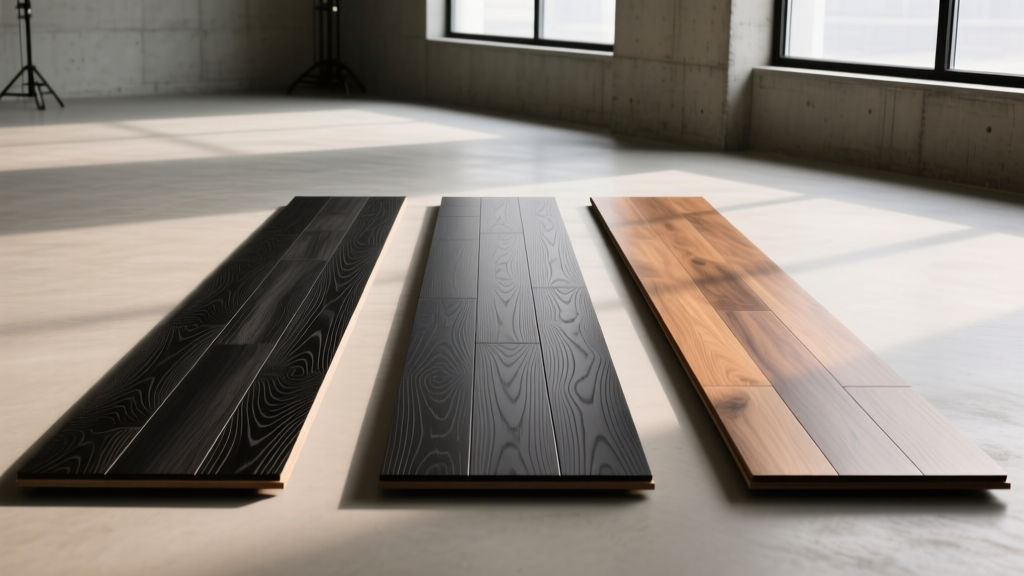
The Chemistry and Mechanics of Black Wood Flooring
Specifying black wood flooring requires navigating a complex matrix of chemical treatments, veneer thicknesses, and finish sheens. Unlike natural dark species like Gaboon Ebony—which are heavily restricted under CITES regulations and cost upwards of $45 per square foot—modern black flooring relies on altering lighter, sustainable hardwoods. In 2026, the market is dominated by three distinct manufacturing processes: ammonia fuming, reactive pigment staining, and thermal charring (Shou Sugi Ban). Each method fundamentally alters the wood's cellular structure, dictating its Janka hardness, UV stability, and required maintenance protocols.
Process Breakdown: Fumed vs. Stained vs. Charred
- Ammonia Fuming: Wood is placed in a sealed chamber with aqueous ammonia. The gas reacts with natural tannins in the wood (specifically White Oak), turning it a deep, rich black or espresso. This penetrates the entire wear layer, meaning scratches are less visible.
- Reactive Staining: Iron acetate or proprietary chemical stains are applied to react with tannins, or heavy black pigments are forced into the grain. Pigment stains sit closer to the surface and require a thicker protective topcoat.
- Thermal Charring (Yakisugi): The wood surface is burned to a deep alligator-char. While visually striking, charring reduces surface hardness and requires specialized penetrating oils or high-solid urethanes to lock the carbon in place.
Brand Deep-Dive: Monarch Plank (Fumed & Reactive Oak)
Monarch Plank has established itself as the premier specifier choice for architect-grade engineered hardwood. Their approach to black flooring avoids surface-level paints, relying instead on deep-penetrating chemical reactions that preserve the natural chatoyance (light reflection) of the wood grain.
Product Line: Bespoke 'Fumed Noir' Collection
The Fumed Noir line utilizes European White Oak that undergoes a 72-hour ammonia fuming process before being wire-brushed and sealed. Because the color is a chemical reaction rather than a surface pigment, the floor retains a translucent, three-dimensional depth that flat black stains cannot achieve.
- Dimensions: 5/8' thickness (3/4' available custom), 7.5' to 9.5' widths, up to 84' lengths.
- Wear Layer: 4mm sawn veneer (allows for 3-4 professional sandings over its lifespan).
- Finish: UV-cured polyurethane with aluminum oxide, available in 12 gloss (ultra-matte) or 25 gloss (matte).
- 2026 Pricing: $15.50 - $18.50 per sq. ft. (material only).
Brand Deep-Dive: Kährs (Engineered Stained Oak)
Swedish manufacturer Kährs approaches black flooring through advanced pigmentation and precision milling. Their products are optimized for floating installations in multi-family residential and commercial environments where glue-down methods are impractical.
Product Line: Da Capo 'Oak Noir'
The Da Capo collection features single-strip, extra-long planks with a deep black pigmented stain. Kährs utilizes a multi-layer staining process that forces black iron-oxide pigments deep into the open grain of the oak, followed by a clear topcoat that prevents the black from looking 'flat' or 'painted'.
- Dimensions: 5/8' thickness, 7.5' width, 88' length.
- Wear Layer: 3.5mm rotary-sliced veneer.
- Joint System: Woodloc 5G mechanical locking system (allows for floating installation up to 2,100 sq. ft. without transition moldings).
- 2026 Pricing: $10.50 - $13.00 per sq. ft.
Brand Deep-Dive: Nakamoto Forestry (Shou Sugi Ban)
For projects demanding authentic, heavily textured black surfaces, Nakamoto Forestry produces true Shou Sugi Ban (charred wood) in the United States. While traditionally used for exterior siding, their heavy-duty interior flooring grades offer a radically different aesthetic.
Product Line: 'Senmai' Interior Flooring Grade
The Senmai line features Sugi (Japanese Cedar) that is charred to a deep, uniform black. Unlike exterior siding which is left raw or lightly oiled, the Senmai flooring grade undergoes a rigorous wire-brushing to remove loose soot, followed by the application of a high-solid, commercial-grade urethane to encapsulate the carbon.
- Dimensions: 3/4' solid or 5/8' engineered, 5.5' width.
- Base Species: Sugi (Cryptomeria japonica). Note: Sugi has a low baseline Janka hardness (~300 lbf), making this product suitable for low-traffic residential or boutique commercial spaces, not high-traffic retail.
- 2026 Pricing: $22.00 - $26.00 per sq. ft.
2026 Product Line Comparison Matrix
| Brand / Line | Color Method | Base Species | Wear Layer | Price / Sq. Ft. | Best Application |
|---|---|---|---|---|---|
| Monarch Plank Fumed Noir | Ammonia Fuming | European White Oak | 4.0mm Sawn | $15.50 - $18.50 | High-end residential, luxury hospitality |
| Kährs Da Capo Oak Noir | Pigment Stain | European Oak | 3.5mm Sliced | $10.50 - $13.00 | Multi-family, floating commercial |
| Nakamoto Senmai | Thermal Char | Sugi (Cedar) | Solid / 4mm Veneer | $22.00 - $26.00 | Boutique retail, low-traffic accent rooms |
Installation & Finishing: Solving the 'Black Floor' Dust Problem
The most common failure point in black wood flooring is not the wood itself, but the finish and maintenance protocol. Black floors act as a visual magnet for dust, pet hair, and micro-scratches. Specifying the correct finish sheen and installation method is critical to long-term client satisfaction.
The Sheen Imperative: Ultra-Matte is Mandatory
Never specify a satin or semi-gloss finish for black wood flooring. High-sheen finishes reflect light directly off the surface, making every speck of dust and every micro-scratch glaringly obvious. For site-finished black floors, or when recoating pre-finished boards, specify Bona Traffic HD Extra Matte. This two-component waterborne urethane cures to a gloss level of approximately 8-10 units. The ultra-matte surface diffuses light, effectively hiding surface dust and giving the floor a soft, velvety appearance that mimics raw, oiled wood while providing commercial-grade scratch resistance.
Subfloor Prep and Sanding Protocols
If installing site-finished black stained oak, subfloor flatness and sanding precision are paramount. Dark stains amplify sanding marks. A 36-grit drum sander mark that is invisible under a natural clear coat will look like a deep gouge under a black iron-acetate stain.
NWFA Protocol for Dark Stains: The National Wood Flooring Association (NWFA) Technical Guidelines mandate the use of multi-disc sanders (like a Trio or Clarke DU-8) for the final pass before applying dark stains. Always perform a 'water pop'—lightly misting the floor with water to open the grain—before applying black stain to ensure deep, even pigment penetration and prevent lap marks.
Acclimation and Moisture Management
Black engineered flooring, particularly fumed oak, is highly reactive to moisture fluctuations. According to Forest Stewardship Council (FSC) sourcing standards and manufacturer warranties, the subfloor moisture content must be within 2% of the flooring's moisture content prior to installation. For glue-down installations over concrete, a calcium chloride test must read below 3 lbs per 1,000 sq. ft. per 24 hours. If moisture levels exceed this, a two-part epoxy moisture mitigation system (such as Bona D501) must be troweled onto the slab before applying the urethane adhesive. Failure to mitigate moisture will cause the black veneer to delaminate or cup, a defect that is exponentially more visible on dark floors than on light ones.
Sourcing and Lead Times in 2026
As of early 2026, lead times for premium European fumed oak have stabilized to 8-12 weeks, down from the 16-20 week delays seen in previous years. However, authentic Shou Sugi Ban flooring from Nakamoto Forestry remains a made-to-order product with a strict 10-14 week production window due to the manual charring process. Specifiers should lock in material orders during the schematic design phase to prevent project delays, and always order 10-12% overage for black floors to allow installers to cull boards with incompatible grain patterns or minor finish inconsistencies.