Lumber Grades at Westside Building Materials Oakland California
Expert guide to evaluating lumber grades, moisture content, and structural quality when sourcing from Westside Building Materials in Oakland, California.

Navigating the Bay Area Lumber Supply Chain
Sourcing dimensional lumber and structural timber in the East Bay requires an understanding of regional supply dynamics. Westside Building Materials in Oakland, California, operates at a critical logistical nexus. Proximity to the Port of Oakland and major interstate corridors allows this yard to maintain robust inventory levels of Pacific Northwest (PNW) softwoods and Northern California redwoods. However, having access to inventory is only half the equation; the ability to accurately read grade stamps, assess moisture content, and calculate true yield separates professional builders from amateur buyers.
When purchasing from a high-volume regional supplier like Westside Building Materials, you are typically looking at stock milled by major PNW producers such as Weyerhaeuser, Roseburg, or Sierra Pacific Industries, alongside specialized redwood shipments from Humboldt Redwood Company. Understanding the specific grading rules applied to these shipments—governed primarily by the Western Wood Products Association (WWPA) and the California Redwood Association (CRA)—is essential for structural integrity and budget management.
Decoding Structural Lumber Grade Stamps
Every piece of dimensional lumber sold at Westside Building Materials carries a grade stamp inked onto the face or edge. This stamp is a legal certification of the wood's structural capacity. According to the Western Wood Products Association, grading is based on the size and location of strength-reducing characteristics like knots, slope of grain, and checks, not on the wood's aesthetic appearance.
Primary Framing Grades: Douglas Fir-Larch and Hem-Fir
For standard residential and light commercial framing in Oakland, you will primarily encounter two species groups: Douglas Fir-Larch (DF-L) and Hemlock-Fir (Hem-F). DF-L is the gold standard for high-load applications due to its superior fiber stress in bending (Fb) and modulus of elasticity (E). Hem-F is slightly less stiff but highly workable and cost-effective for standard wall framing.
| Grade Designation | Primary Species | Best Application | Defect Allowance | Relative Cost |
|---|---|---|---|---|
| Select Structural | DF-L, Hem-F | Heavy beams, long-span rafters, engineered trusses | Very tight; small, sound knots only | $$$$ |
| No. 1 | DF-L, Hem-F | Floor joists, roof rafters, load-bearing headers | Moderate; well-spaced medium knots | $$$ |
| No. 2 | DF-L, Hem-F, SPF | Standard wall studs, plates, blocking, general framing | Higher; larger knots, slight slope of grain | $$ |
| No. 3 | SPF, Hem-F | Temporary bracing, non-load-bearing partitions | High; large knots, wane, slope of grain | $ |
| Stud | DF-L, Hem-F, SPF | Vertical wall studs (specifically graded for axial load) | Optimized for vertical compression; edge knots restricted | $$ |
Appearance Grades: Redwood and Western Red Cedar
For exterior decking, siding, and architectural features, Westside Building Materials stocks appearance-graded lumber. The California Redwood Association categorizes redwood into distinct architectural and garden grades. When specifying redwood, you must differentiate between 'Heart' grades (which contain only the inner, decay-resistant heartwood) and 'Common' grades (which include the sapwood). For ground-contact applications in the damp Bay Area microclimates, always specify Construction Heart or B-Grade Heart. Sapwood, found in Construction Common, lacks natural tannins and will rot rapidly if exposed to soil moisture.
On-Site Inspection: Evaluating Quality at the Yard
A grade stamp guarantees the lumber met the standard at the time of milling, but transit and storage can introduce new defects. When picking up an order at Westside Building Materials in Oakland, you must physically inspect the bundles. The USDA Forest Products Laboratory Wood Handbook outlines critical visual defects that compromise structural performance regardless of the printed grade.
⚠️ The 4-Point Yard Inspection Checklist
- Sight the Crown: Hold one end of the 2x6 or 2x8 at eye level and look down the narrow edge. A slight, uniform bow (crown) is acceptable and should be installed facing up in floor joists. Reject pieces with 'S-curve' bows or severe crooks.
- Check for Twist: Look at the ends of the board. If the two ends are not parallel to the ground (windmill effect), the board will twist as it dries, pulling drywall fasteners and causing nail pops.
- Measure the Wane: Wane is the missing bark edge on a board. For #2 grade, wane cannot exceed 1/4th the width of the board. Excessive wane reduces the bearing surface for joist hangers and sheathing nails.
- Inspect End Checks: Small surface cracks at the ends are normal. However, if a check extends more than 2 inches inward from the end grain, or splits through the entire thickness, the structural shear capacity is compromised.
Moisture Content and Bay Area Acclimatization
Oakland's climate presents unique challenges for wood moisture management. The city spans distinct microclimates, from the fog-heavy, high-humidity coastal zones near the Bay to the hotter, drier inland hills. Lumber stamped S-GRN (Surfaced Green) has a moisture content (MC) above 19%, while S-DRY (Surfaced Dry) is 19% or less. For interior finish carpentry, you need MC-15 (15% maximum moisture content).
If you are purchasing S-DRY Douglas Fir for interior trim or flooring from Westside Building Materials, it must be acclimatized to the specific building envelope. According to industry standards, wood reaches equilibrium moisture content (EMC) when it stops gaining or losing moisture to the surrounding air. In an Oakland home with active HVAC, the interior EMC typically stabilizes between 8% and 10%. Installing 15% MC trim directly into an 8% EMC environment will result in a tangential shrinkage of approximately 0.25% per 1% MC loss. On a 6-inch wide baseboard, this equates to nearly 1/16th of an inch of shrinkage—enough to open visible seams at miter joints.
"Always store interior-grade lumber in the actual room where it will be installed for a minimum of 72 hours, with the HVAC system running at normal occupancy levels, before making final cuts and installations."
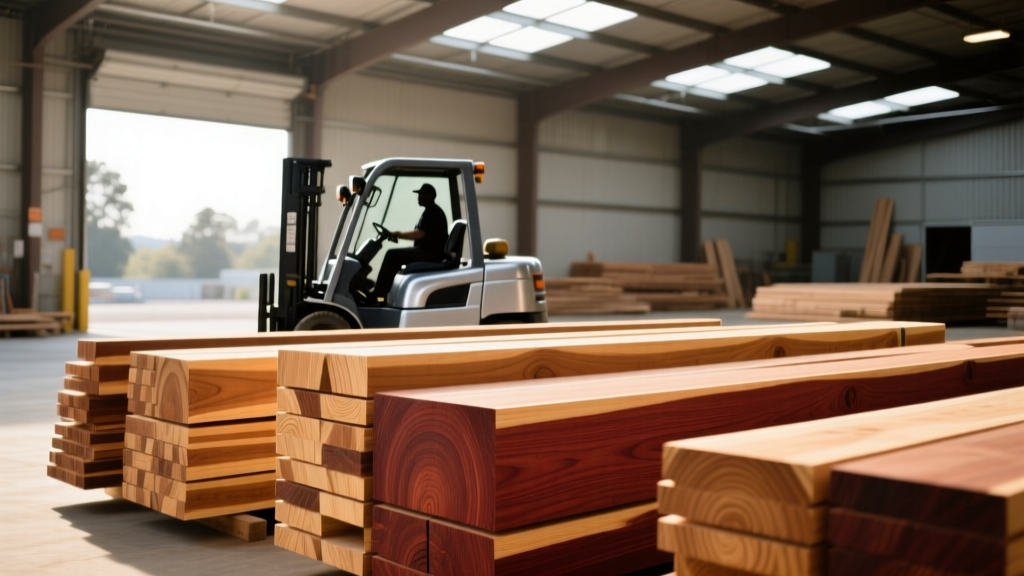
Calculating True Yield and Material Waste
When estimating material costs for a project sourced from Westside Building Materials, novice builders simply multiply the linear footage required by the price per board foot. Professional estimators calculate the true yield. When buying #2 grade framing lumber, you must factor in a cull rate. Even in premium bundles, 5% to 8% of the studs may be unusable due to yard damage, excessive warp, or severe edge wane that prevents proper sheathing nailing.
Furthermore, advanced framing techniques (Optimum Value Engineering), which are increasingly required to meet California's Title 24 energy codes by maximizing cavity insulation, demand exceptionally straight studs. If you are framing 2x6 exterior walls at 24 inches on center, a twisted stud creates a massive thermal bridge and drywall finishing nightmare. For these specific applications, upgrade your purchase order to No. 1 grade or specifically request 'Premium' or 'Machine Stress Rated' (MSR) studs, which have been mechanically tested for stiffness rather than just visually graded.
Strategic Purchasing Framework
- Load-Bearing Headers & Beams: Never compromise. Specify Select Structural DF-L. The cost premium is negligible compared to the risk of deflection.
- Exterior Wall Studs: #2 Grade Hem-F or DF-L is standard, but inspect for twist. Cull rate: ~5%.
- Interior Non-Load-Bearing Partitions: No. 3 or Standard grade is perfectly adequate and saves 15-20% on material costs. Cull rate: ~10%.
- Decking & Fencing: Construction Heart Redwood for ground contact; Construction Common for elevated, well-ventilated deck boards.
By mastering the grading rules, rigorously inspecting stock at the yard, and accounting for local moisture dynamics, builders can maximize the structural performance and aesthetic quality of lumber sourced from Westside Building Materials in Oakland. Always consult the latest grading manuals from the California Redwood Association and WWPA to stay current on mill-specific stamp variations and allowable defect tolerances.
Written by
Marcus ChenMarcus Chen is a licensed structural engineer (PE) and building materials analyst with over 12 years of experience across residential, commercial, and industrial construction. He holds a Master of Science in Civil Engineering from UC Berkeley and spent six years at Thornton Tomasetti before transitioning to independent consulting and technical writing. Marcus specializes in material selection for seismic-prone regions, concrete reinforcement strategies, and lifecycle cost analysis. His work has been cited by the American Concrete Institute (ACI) and the Structural Engineers Association of California (SEAOC). When he is not on a job site or at his desk, you will find him hiking the Sierra Nevada or restoring a 1920s craftsman bungalow in Oakland, CA.
More from Marcus Chen
View all
Construction Cost
How Much Did the Eiffel Tower Cost to Build?
How much did the Eiffel Tower cost to build in 1889? We adjust for inflation and compare its budget to modern skyscraper construction.
Aug 4, 2026

Fire Resistance
What Is a Fire Resistant Material? Testing & Certification Guide
Discover what is a fire resistant material through ASTM and UL testing. Learn how fire ratings, certifications, and assemblies work in construction.
Aug 4, 2026

Construction Cost
How Much Did the Burj Khalifa Cost to Build?
How much did the Burj Khalifa cost to build? We break down the $1.5B project and extract 5 money-saving strategies for your next build.
Jul 30, 2026