What is the Softest Type of Wood? A Janka Hardness Comparison
Discover the softest type of wood for your project. We compare Balsa, Paulownia, Basswood, and Cedar using Janka hardness ratings and structural data.

The Botanical Paradox: Defining Wood Softness
When builders, luthiers, and marine fabricators search for the softest type of wood, they are typically looking for materials with high workability, low density, and specific acoustic or weight-saving properties. However, the term 'softwood' in forestry refers to gymnosperms (conifers), while 'hardwood' refers to angiosperms (deciduous trees). The absolute softest commercial wood available is Balsa, which is botanically classified as a hardwood. Therefore, evaluating the softest type of wood requires relying on empirical mechanical testing rather than botanical categories.
The industry standard for measuring wood hardness is the Janka Hardness Scale. This test measures the pounds-force (lbf) required to embed a 0.444-inch (11.28 mm) steel ball halfway into the wood's grain. A lower Janka rating indicates a softer, more easily dented and machined material. Below, we compare the four softest commercially viable woods, analyzing their structural limits, fastening protocols, and ideal applications.
The Contenders: Comparing the Softest Commercial Woods
Balsa (Ochroma pyramidale) - The Absolute Softest
With a Janka hardness rating of just 70 to 100 lbf, Balsa is universally recognized as the softest type of wood in commercial production. Despite its extreme softness and low density (roughly 7 to 9 lbs/ft³), Balsa possesses an exceptional strength-to-weight ratio. Its cellular structure consists of large, thin-walled parenchyma cells that provide compressive strength while trapping air. In marine construction, end-grain Balsa is heavily utilized as a core material in fiberglass composite hulls, providing immense rigidity at a fraction of the weight of solid foam cores. However, its open-cell structure makes it highly hygroscopic; if the fiberglass skin is breached, Balsa will absorb moisture rapidly, leading to core rot.
Paulownia (Paulownia tomentosa) - The Lightweight Alternative
Paulownia registers at approximately 300 lbf on the Janka scale. Often marketed as the 'aluminum of timbers,' it is significantly harder than Balsa but remains exceptionally light (18 lbs/ft³). Paulownia is prized in the manufacturing of touring skis, snowboards, and surfboards due to its natural vibration-dampening properties and high resistance to moisture warping. Unlike Balsa, Paulownia can be milled into solid structural panels, though it lacks the sheer-load capacity required for architectural framing.
Western Red Cedar (Thuja plicata) - The Softest Exterior Wood
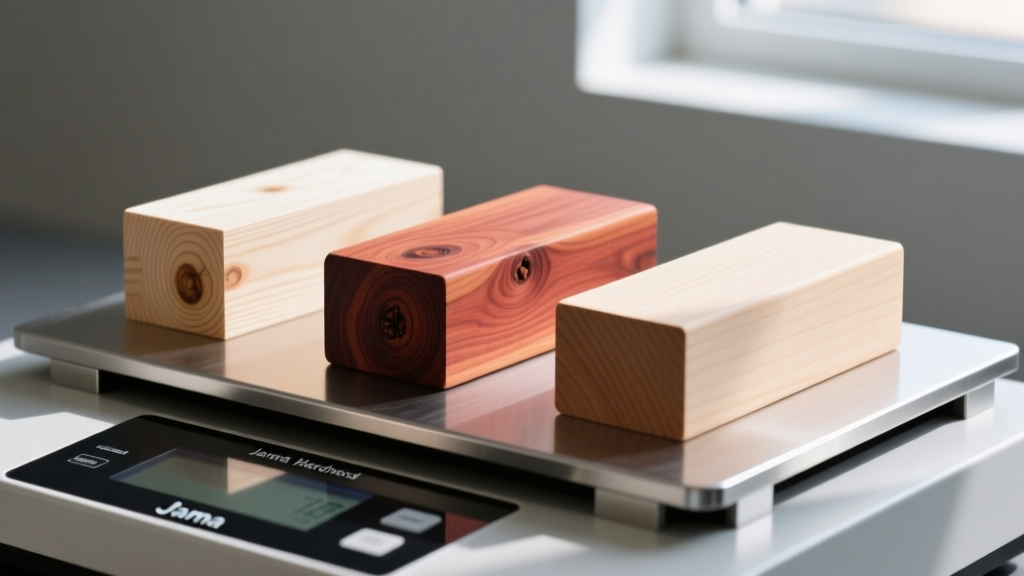
At 350 lbf, Western Red Cedar (WRC) is the softest wood routinely used in exterior architectural applications. Its softness makes it highly susceptible to denting from hail, falling branches, or foot traffic. However, WRC contains natural extractives called thujaplicins, which act as powerful fungicides and decay inhibitors. This allows WRC to be used untreated in exterior siding, fencing, and decking, provided the design accounts for its low surface hardness and high thermal expansion rate.
Basswood (Tilia americana) - The Carver's and CNC Choice
Basswood scores 410 lbf on the Janka scale. It is the softest type of wood that maintains a tight, uniform grain without prominent resin canals or silica deposits. This makes it the premier choice for intricate hand carving, CNC routing, and electric guitar bodies. Basswood machines cleanly with minimal tear-out, but its low density means it strips easily when subjected to mechanical fasteners under tension.
Janka Hardness and Density Comparison Matrix
| Wood Species | Janka Hardness (lbf) | Average Dried Weight (lbs/ft³) | Botanical Class | Primary Commercial Use |
|---|---|---|---|---|
| Balsa | 70 - 100 | 7 - 9 | Hardwood (Angiosperm) | Marine composite cores, RC models |
| Paulownia | 300 | 18 | Hardwood (Angiosperm) | Surfboards, touring skis, light furniture |
| Western Red Cedar | 350 | 23 | Softwood (Gymnosperm) | Exterior siding, decking, saunas |
| Basswood | 410 | 26 | Hardwood (Angiosperm) | CNC routing, musical instruments, carving |
| Eastern White Pine | 380 | 25 | Softwood (Gymnosperm) | Interior trim, pattern making |
Data sourced from The Wood Database and the USDA Forest Products Laboratory Wood Handbook.
Fastening Protocols for Ultra-Soft Woods
The most common failure mode when working with the softest type of wood is fastener pull-out and thread stripping. Standard coarse-thread wood screws or drywall screws will strip the internal fibers of Balsa and Paulownia at torque levels as low as 40 in-lbs. To achieve structural integrity, you must alter your fastening methodology.
Standard PVA wood glues (like Titebond II) rely on penetrating the wood fibers and cross-linking. In ultra-soft, open-celled woods like Balsa, the glue is absorbed too deeply into the cellular structure, starving the joint and resulting in a weak bond. For structural laminations involving Balsa or Paulownia, use a thickened structural epoxy, such as West System 105 Resin with 206 Slow Hardener, mixed with a colloidal silica filler to prevent excessive absorption.
Hardware Solutions for Soft Woods
- Threaded Brass Inserts: For removable hardware in Basswood or Paulownia, drill an undersized pilot hole and install E-Z LOK brass threaded inserts. The external threads bite into the soft wood, while the internal machine threads accept standard bolts without stripping.
- Through-Bolting with Fender Washers: When bolting through Balsa or Cedar, the compressive force of a standard nut will crush the wood fibers. Always use oversized stainless steel fender washers on both the bolt head and the nut to distribute the clamping load over a wider surface area.
- Cyanoacrylate (CA) Thread Locking: If a wood screw must be used in soft wood, drill a pilot hole slightly larger than the screw's root diameter, fill the hole with medium-viscosity CA glue, and drive the screw. The CA hardens the surrounding fibers, creating a permanent, high-strength mechanical lock.
Machining and Finishing Considerations
Soft woods present unique challenges on the workbench. Because the fibers lack rigid lignin structures, they tend to compress and tear rather than shear cleanly when subjected to dull tooling.
CNC Routing and Tooling Geometry
When CNC routing Basswood or Paulownia, standard single-flute end mills often leave a fuzzy finish on the bottom edge of the cut. To achieve a glass-smooth finish, utilize solid carbide V-flute engraving bits or compression spirals. Furthermore, Paulownia contains trace amounts of silica; while low, it will rapidly dull high-speed steel (HSS) cutters. Always use carbide tooling for production runs.
Sanding and Surface Preparation
Sanding ultra-soft woods requires a light touch and specialized abrasives. Standard aluminum oxide sandpaper will quickly clog (load) with the soft wood dust. Use stearated sandpaper (such as 3M Pro Grade) which features a zinc stearate coating that prevents clogging. Never sand soft woods past 220 grit; the fibers will become burnished and polished, preventing stains and finishes from penetrating evenly.
Because soft woods like Basswood and Pine have alternating bands of porous earlywood and dense latewood, they absorb liquid stains unevenly, resulting in severe blotching. Before applying any pigmented stain, seal the surface with a 1-lb cut of dewaxed shellac (a 'wash coat'). This partially seals the porous bands, forcing the subsequent stain to sit closer to the surface and resulting in a uniform, professional color.
Frequently Asked Questions
Is Balsa wood strong enough for structural framing?
No. While Balsa has a high compressive strength-to-weight ratio, its absolute shear and bending strength are far too low for architectural framing. It cannot hold nails or screws under structural loads and lacks the fire-resistance ratings required by building codes. It is strictly used as a core material in composite sandwiches (like fiberglass or carbon fiber) or in non-load-bearing models.
Why does Western Red Cedar dent so easily on decks?
Western Red Cedar's Janka hardness of 350 lbf means it takes very little force to permanently compress the cell walls. High heels, dropped tools, or heavy patio furniture will leave permanent indentations. If you require the rot-resistance of Cedar but need a harder surface, consider Ipe (3,680 lbf) or Cumaru (3,540 lbf), though these tropical hardwoods are significantly more expensive and harder to machine.
Can I use a pocket hole jig on Basswood or Paulownia?
Pocket hole joinery relies on the screw threads biting deeply into the receiving board. In woods softer than 400 lbf, the aggressive threads of standard pocket screws will strip out under the torque of the drill driver, or the clamping force will crush the wood fibers around the pocket. If you must use pocket joinery in Basswood, use coarse-thread screws specifically designed for softwoods, and stop driving the screw the exact moment it seats to avoid over-torqueing.
Written by
David NakamuraDavid Nakamura is a licensed architect (AIA) and construction technology writer focused on sustainable building methods, mass timber engineering, and high-performance building envelopes. He holds a Master of Architecture from the University of Washington and is a certified Passive House Consultant (CPHC). David spent eight years at the Seattle firm Mithun, where he led the design of three LEED Platinum projects, before founding his own practice specializing in net-zero residential design. He serves on the editorial advisory board of GreenBuilder Magazine and has authored peer-reviewed papers on cross-laminated timber (CLT) connections for the Journal of Structural Engineering. In his spare time, David teaches woodworking at Pratt Fine Arts Center and kayaks the Puget Sound.
More from David Nakamura
View all
Construction Cost
Labor Cost to Build a Deck Per Sq Ft: 2026 Installation Guide
Discover the exact labor cost to build a deck per sq ft in 2026. This installation guide breaks down contractor rates, complexity factors, and hidden fees.
Aug 4, 2026

Construction Cost
How Much Does It Cost to Build a 3 Bedroom House? Financing Guide
Learn exactly how much it costs to build a 3 bedroom house and explore 2026 financing options, construction loan types, and budget frameworks for your build.
Aug 4, 2026

Construction Cost
Cost to Build a Tennis Court: 2026 Guide
How much does it cost to build a tennis court in 2026? Breakdowns for asphalt, concrete, and synthetic surfaces plus fencing and lighting.
Jul 30, 2026