Comparing Types of Wood Bows for Curved Architectural Structures
Compare types of wood bows for construction, including glulam arches, steam-bent timber, and LVL. Expert specs, radii limits, and 2026 costs.

Defining Wood Bows in Modern Construction
When architects and structural engineers specify curved timber elements, they are utilizing what the industry refers to as wood bows—structural arches, curved rafters, and bowed beams that introduce sweeping geometry to building envelopes and interior atriums. Unlike standard dimensional lumber, which is restricted to linear spans, types of wood bows are engineered or manipulated to achieve specific radii while maintaining critical load-bearing capacities. Understanding the mechanical differences, manufacturing constraints, and cost variables between these curved timber products is essential for accurate specification and structural integrity in 2026.
Comparing the Primary Types of Wood Bows
The method used to achieve a curve dictates the structural limitations, maximum span, and environmental resilience of the wood bow. Below is a technical breakdown of the four primary categories used in commercial and high-end residential construction.
1. Glulam (Glued Laminated Timber) Bows
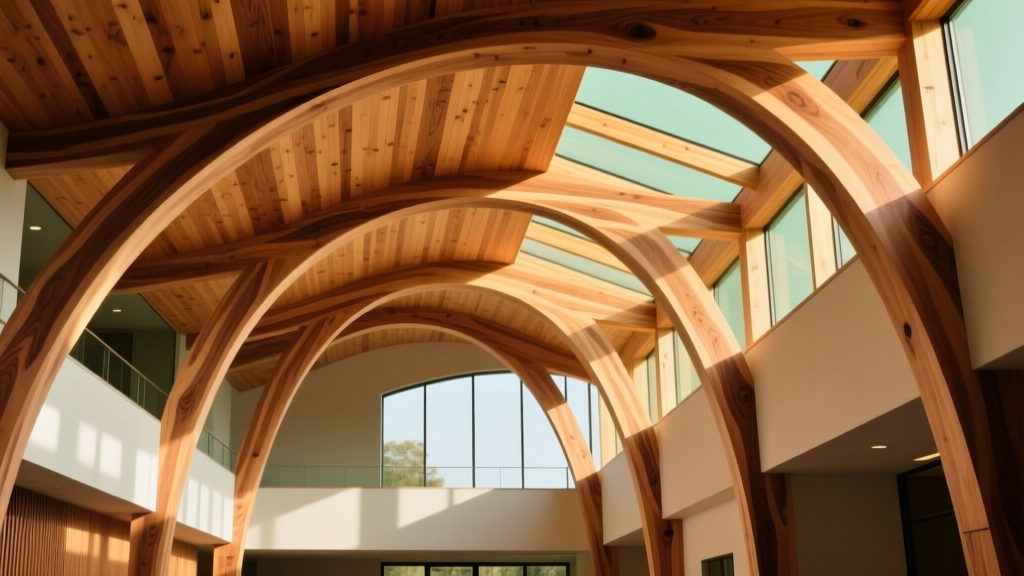
Glulam bows represent the industry standard for long-span curved structural members. Manufactured by bonding layers of dimension lumber with durable, moisture-resistant structural adhesives (typically melamine or polyurethane), glulam can be pressed into massive architectural arches. According to the APA - The Engineered Wood Association, standard 1-inch thick Douglas Fir laminations can be cold-pressed to a minimum radius of 18 feet. For tighter curves, fabricators use 3/8-inch laminations, pushing the minimum radius down to 6 feet. Glulam bows are highly predictable, governed by ANSI A190.1 standards, and can span upwards of 100 feet without intermediate support.
2. Steam-Bent Solid Wood Bows
Steam bending relies on thermal plasticization to alter the cellular structure of solid wood. By exposing timber to steam at 212°F (100°C) for approximately one hour per inch of thickness, the lignin softens, allowing the wood to be clamped to a curved form. Once cooled and dried, the wood retains the bowed shape. White Oak, Ash, and Hickory are preferred due to their favorable interlocking grain and high bending ratios. However, steam-bent wood bows are generally limited to smaller cross-sections (rarely exceeding 6x8 inches) and are more susceptible to checking and cellular rupture if bent past their species-specific failure threshold. The USDA Forest Products Laboratory notes that steam-bent members require careful over-bending (typically 2% to 5%) to account for elastic springback upon release.
3. LVL (Laminated Veneer Lumber) Curved Beams
LVL bows are engineered from ultra-thin rotary-peeled wood veneers (typically 1/8 inch thick) glued under high pressure. Because the grain of each veneer is aligned longitudinally, LVL exhibits exceptional tensile strength and can be cold-pressed into much tighter radii than standard glulam—often as tight as 4 feet—without the risk of tension-perpendicular-to-grain cracking. LVL wood bows are highly dimensionally stable and resist the shrinking and warping that can plague solid timber, making them ideal for exposed interior arches where strict moisture tolerances are required.
4. Kerf-Cut and Bent Plywood Bows
While not used for primary load-bearing structures, kerf-cut solid wood and bent plywood bows are critical for architectural facades, curved interior partition walls, and acoustic ceiling baffles. Kerfing involves cutting a series of closely spaced grooves on the back face of a wood panel, allowing it to flex into a bow. This method is strictly non-structural and is used to achieve complex, compound-curve geometries that would be cost-prohibitive in structural glulam.
Structural Comparison Matrix
| Wood Bow Type | Min. Bending Radius | Max. Structural Span | Primary Species | Best Application |
|---|---|---|---|---|
| Glulam (1" Lams) | 18 feet | 100+ feet | Douglas Fir, Southern Pine | Heavy timber roof arches, gymnasiums |
| Glulam (3/8" Lams) | 6 feet | 60 feet | Douglas Fir, Spruce-Pine-Fir | Curved canopy supports, tight arches |
| Steam-Bent Solid | 3 feet (species dependent) | 20 feet | White Oak, Ash, Hickory | Decorative trusses, marine, furniture |
| LVL Curved | 4 feet | 40 feet | Douglas Fir, Southern Pine | Interior exposed beams, tight radius headers |
Engineering the Curve: Springback and Moisture Dynamics
All types of wood bows exhibit elastic springback—the tendency of the timber to partially return to its original straight form once released from the manufacturing press. In structural glulam, springback typically ranges from 0.5% to 1.5% of the total arc length. Fabricators compensate for this by over-bending the press mold. If you are specifying custom wood bows, always require the fabricator to provide the as-pressed versus as-released dimensional tolerances to ensure field fit-up issues do not occur during steel connection detailing.
Moisture content (MC) is equally critical. Glulam bows are typically manufactured and shipped at an MC of 16%. If installed in a climate-controlled commercial interior where the equilibrium moisture content (EMC) is 8%, the timber will shrink radially and tangentially. In a curved member, this differential shrinkage can induce tension perpendicular to the grain, leading to radial checking (splitting along the laminations). To mitigate this, structural engineers must specify slotted bolt holes in the steel base plates to allow the wood bow to flex and shrink without inducing catastrophic shear stress at the connections.
2026 Cost Breakdown and Procurement
Pricing for curved timber is highly dependent on the complexity of the press setup, the volume of the order, and current resin costs. Below is the estimated 2026 pricing for fabricated wood bows, excluding shipping and crane-setting costs.
| Material Type | Material Cost (per LF) | Fabrication / Press Cost | Total Estimated Cost (per LF) |
|---|---|---|---|
| Standard Glulam Bow (Radius > 18') | $25 - $35 | $20 - $30 | $45 - $65 |
| Tight-Radius Glulam (Radius < 10') | $35 - $50 | $40 - $60 | $75 - $110 |
| LVL Curved Beam | $20 - $30 | $15 - $25 | $35 - $55 |
| Steam-Bent Solid Timber | $40 - $80 | $80 - $150 (Labor intensive) | $120 - $230 |
Specification Checklist for Architects and Builders
To ensure successful integration of wood bows into your building envelope or structural frame, follow this specification checklist:
- Define the Exact Radius: Specify whether the radius is measured to the inside face, outside face, or centerline of the beam. Ambiguity here leads to costly fabrication errors.
- Specify Camber and Tolerances: Long-span glulam bows are often fabricated with intentional upward camber to counteract dead-load deflection. Require the fabricator to stamp the camber line clearly on the timber.
- Detail the Connections: Never use rigid, pinned connections at both ends of a large wood bow. Use a pinned connection at one end and a slotted/roller connection at the other to accommodate thermal expansion and moisture-induced shrinkage.
- Fire Rating Considerations: Heavy timber bows (minimum 5x5 inches) naturally achieve a 1-hour fire rating through the predictable charring rate of wood (approximately 1.5 inches per 45 minutes per WoodWorks design guidelines). Verify local code requirements for exposed curved structural members.
- Finish and Sealer: If the wood bow will be exposed to UV light or high humidity, specify a penetrating oil finish or a breathable polyurethane that will not trap moisture within the laminations, which could lead to delamination over time.
Selecting the correct type of wood bow requires balancing aesthetic curvature with structural reality. While steam-bent solid wood offers unparalleled traditional craftsmanship for tight, decorative curves, engineered solutions like Glulam and LVL provide the predictable, code-compliant strength required for modern, large-scale architectural spans. By understanding the mechanical limits, springback tolerances, and moisture dynamics of these materials, construction professionals can confidently specify curved timber that is both visually striking and structurally enduring.
Written by
Elena RodriguezElena Rodriguez is a civil engineer and technical writer specializing in concrete technology, masonry systems, and ASTM/ACI compliance. She earned her B.S. in Civil Engineering from Texas A&M University and spent a decade at a materials testing laboratory, performing over 2,000 concrete compressive strength tests and masonry prism evaluations. Elena is an ACI-certified Field Testing Technician (Grade I) and a member of ASTM Committee C12 on Natural Building Stone. She currently consults on forensic engineering cases involving concrete failures and moisture intrusion. Based in San Antonio, TX, Elena is a proud member of the Society of Women Engineers (SWE) and coaches her daughter's FIRST Robotics team.
More from Elena Rodriguez
View all
Walls & Panels
Cost Analysis: Light Gauge Steel Framing Advantages and Disadvantages
Evaluate light gauge steel framing advantages and disadvantages through a strict cost analysis lens, comparing material, labor, and lifecycle expenses.
Aug 4, 2026

Walls & Panels
Gypsum Board Types: Exact Specifications, Thickness & Dimensions
Compare standard, Type X, and moisture-resistant gypsum board types. Get exact specifications, thicknesses, dimensions, and ASTM standards for your project.
Aug 4, 2026

Fire Resistance
Best Fire-Resistant Outdoor Decking Materials: 2026 Buyer Guide
Discover the best fire-resistant outdoor decking materials for 2026. Compare Class A PVC, aluminum, and hardwood options for WUI compliance and safety.
Aug 4, 2026