Which Butcher Block Type of Wood Handles Structural Loads Best?
Discover which butcher block type of wood offers the highest structural load capacity, shear strength, and deflection resistance for heavy-duty builds.

The Misconception: Butcher Block as a Structural Element
When most builders and architects evaluate materials for countertops or cutting surfaces, they focus on aesthetics, food safety, and surface hardness. However, in heavy-duty commercial kitchens, industrial woodworking shops, and modern architectural millwork, thick butcher block slabs (typically 1.5 to 3 inches thick) are routinely subjected to significant structural loads. In these scenarios, selecting the correct butcher block type of wood is not a matter of visual preference; it is an engineering decision governed by modulus of rupture (MOR), modulus of elasticity (MOE), and shear strength along the glue lines.
Using standard dimensional lumber framing tables for butcher block will yield inaccurate results. Butcher block is an engineered composite of solid wood strips, meaning its structural integrity relies as much on the adhesive bond and grain orientation as it does on the base timber species. This guide breaks down the mechanical properties of the most common butcher block woods to help you specify materials for load-bearing workbenches, cantilevered shelving, and heavy architectural spans.
Mechanical Properties: Evaluating the Butcher Block Type of Wood
To determine how a butcher block slab will behave under a load, we must look beyond the Janka hardness scale. While Janka measures resistance to surface indentation (critical for cutting and abrasion), it tells us very little about bending strength or stiffness. For structural applications, MOR (the maximum stress the wood can withstand before rupturing) and MOE (the wood's stiffness or resistance to elastic deflection) are the governing metrics.
| Wood Species | Janka Hardness (lbf) | MOR (psi) | MOE (10^6 psi) | Density (lbs/ft³) | Best Structural Use |
|---|---|---|---|---|---|
| Hard Maple (Sugar) | 1,450 | 15,800 | 1.83 | 44.0 | Heavy shop benches, high-load spans |
| Black Walnut | 1,010 | 14,600 | 1.68 | 38.0 | Aesthetic cantilevers, moderate loads |
| Teak | 1,070 | 14,600 | 1.55 | 41.0 | High-moisture environments, marine |
| Acacia | 1,750 - 2,200 | 13,000 (avg) | 1.45 | 45.0 | Short-span heavy point loads |
| Strand-Woven Bamboo | 3,000+ | 18,500+ | 2.10+ | 50.0 | Maximum stiffness, long spans |
As the data indicates, Hard Maple remains the undisputed gold standard for traditional timber butcher block due to its exceptional balance of high MOR and high MOE. While Acacia is harder on the surface, its interlocked grain and lower MOE make it more prone to deflection and unpredictable movement under sustained loads. Strand-woven bamboo, technically a grass but categorized commercially alongside butcher block, offers superior stiffness but requires entirely different fastening and machining protocols.
Edge-Grain vs. End-Grain: Structural Implications
The structural capacity of a butcher block slab is entirely dictated by its grain orientation. You cannot treat all butcher block configurations equally when calculating load limits.
End-grain-up butcher block (where the growth rings face the ceiling) is exceptional for heavy chopping and impact absorption. However, it has virtually zero structural spanning capability. Under a bending load, the short vertical wood fibers act like a stack of unglued pencils, leading to catastrophic shear failure along the glue lines. Never use end-grain-up butcher block for cantilevered surfaces, unsupported shelving, or spanning workbenches.
Edge-Grain (Quarter-Sawn/Strip): This is the only viable configuration for structural applications. The continuous longitudinal fibers run the length of the slab, allowing the wood to act as a unified beam. Edge-grain Hard Maple provides maximum resistance to downward deflection. Face-Grain (Flat-Sawn): While stronger than end-grain, wide face-grain strips are highly susceptible to cupping and tangential shrinkage. In environments with fluctuating humidity, face-grain slabs will warp, compromising the structural connection to the steel or timber base.
Real-World Structural Applications & Span Limits
Heavy-Duty Workbenches and Shop Tables
For industrial workbenches supporting heavy machinery, vises, and dynamic impact loads, a 1.75-inch to 2.25-inch thick edge-grain Hard Maple slab is the standard. According to the Forest Products Laboratory Wood Handbook, a 1.75-inch thick Hard Maple beam can safely span 28 inches between steel supports while maintaining a deflection limit of L/360 under a uniform load of 100 lbs per square foot. If your bench requires a 36-inch clear span without an intermediate cross-brace, you must increase the slab thickness to a minimum of 2.5 inches or reinforce the underside with a steel C-channel.
Cantilevered Architectural Shelving
When specifying floating butcher block shelves anchored into wall studs, the primary failure mode is not the wood breaking, but the internal shear stress tearing the wood fibers apart at the anchor point. Black Walnut, while beautiful, has a lower shear strength parallel to the grain compared to Hard Maple. For cantilevered shelves extending more than 12 inches from the wall, use Hard Maple or strand-woven bamboo, and anchor using 1/2-inch steel rods epoxied into deep, precision-drilled holes rather than relying on standard L-brackets.
Fastening, Joinery, and Adhesive Selection
The glue lines in a butcher block slab represent its structural weak point. Standard aliphatic resin (yellow wood glue) used in cheap, imported butcher block degrades under sustained shear stress and high humidity. For structural applications, verify the manufacturer's adhesive specifications:
- PVA Type III (e.g., Titebond III): Acceptable for interior, climate-controlled workbenches. Offers roughly 4,000 psi shear strength but lacks gap-filling properties.
- PUR (Polyurethane Reactive): The industry standard for high-end structural butcher block. PUR adhesives offer superior moisture resistance and maintain bond integrity under dynamic vibration (critical for shop tables with planers or lathes).
- Structural Epoxy: Required if the butcher block features integrated metal inlays or is being bonded to non-porous substrates like steel base frames.
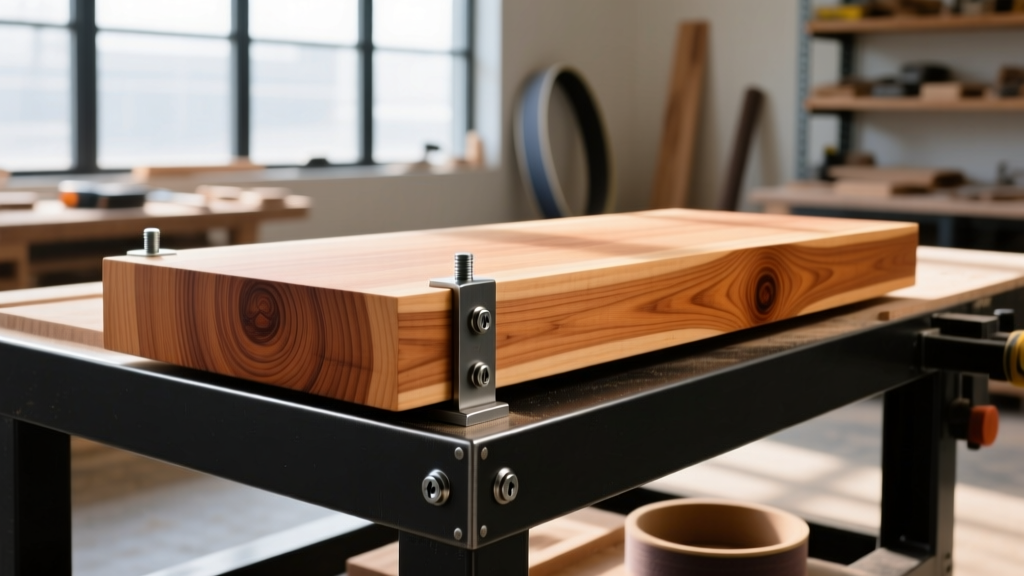
When fastening the slab to a base, never drive wood screws directly into the end-grain or edge-grain of the butcher block. The withdrawal resistance is too low, and seasonal expansion will snap the screws. Instead, use 3/8"-16 brass or steel threaded inserts (such as E-Z Lok) installed from the underside, paired with machine bolts. This allows the solid wood to expand and contract across its width without cracking the slab or compromising the structural connection.
Moisture-Induced Deflection and Long-Term Creep
Wood is a hygroscopic material, and structural deflection is not just a product of immediate weight; it is also a product of time and moisture. "Creep" refers to the gradual, permanent deformation of a material under sustained mechanical stress. In butcher block, creep is accelerated by moisture cycling.
If a 1.5-inch Walnut butcher block countertop is installed over a dishwasher or commercial steam oven without a proper vapor barrier, the bottom of the slab will absorb ambient moisture and expand, while the sealed top remains stable. This differential moisture content (MC) creates internal tension that will physically bow the slab upward, pulling structural fasteners out of the base cabinetry. To mitigate this in structural installations, always seal the underside of the butcher block with a high-solids epoxy or a dedicated moisture-catalyzed urethane to balance the vapor exchange rate with the top surface.
Expert Verdict: Selecting Your Material
If your project requires a butcher block type of wood that will serve as a true structural element—spanning distances, bearing heavy point loads, or resisting dynamic vibration—Black Walnut and Teak should be relegated to aesthetic, fully supported applications. Hard Maple remains the most reliable, predictable, and structurally sound timber for heavy-duty edge-grain slabs. For projects demanding maximum stiffness with minimal thickness, strand-woven bamboo provides unmatched MOE, provided you adapt your machining and fastening strategies to accommodate its extreme density and abrasive silica content. Always specify edge-grain orientation, verify PUR adhesive usage with your millwork supplier, and engineer your steel supports based on the specific MOE of the chosen species.
Written by
Priya KapoorPriya Kapoor is a real estate market analyst and construction economics researcher with expertise in housing affordability, development feasibility, and infrastructure investment. She holds a Master of Regional Planning from Cornell University and previously worked as a senior analyst at CBRE's Investment Properties group, where she modeled returns for $4B in mixed-use development pipelines. Priya now runs an independent research practice advising developers, municipalities, and REITs on construction cost forecasting and market timing. She publishes the quarterly "BuildMat Market Pulse" report tracking material price indices across 12 commodity categories. Based in Austin, TX, Priya serves on the board of Habitat for Humanity Austin and is a marathon runner.
More from Priya Kapoor
View all
Construction Cost
Cost to Build a 1600 Sq Ft Home in 2026: Full Breakdown
Accurate 2026 cost to build a 1600 sq ft home—material, labor, and regional pricing breakdowns included. Plan your budget with real-time estimates.
Aug 11, 2026

Wood & Lumber
Name the Types of Wood for Pressure Treatment and Preservation
Learn how to name the types of wood best suited for pressure treatment. Compare species treatability, chemical retention levels, and 2026 preservation costs.
Aug 4, 2026

Stone & Masonry
Stone Veneer Suppliers Lindenhurst: 2026 Cost Analysis
Analyze 2026 stone veneer costs in Lindenhurst, NY. Compare local supplier pricing, delivery fees, and Suffolk County installation labor rates.
Aug 4, 2026