Preserving Different Types of Wood Planks: A Treatment Guide
Discover the best treatment and preservation methods for different types of wood planks, from softwoods to tropical hardwoods, to prevent rot and decay.

The Science of Wood Preservation: Matching Biology to Chemistry
The longevity of exterior and structural timber relies entirely on the intersection of species biology and chemical preservation. Untreated wood planks are susceptible to three primary degradation vectors: fungal decay (rot), ultraviolet (UV) photodegradation, and wood-destroying insects (termites and carpenter ants). Selecting the correct preservation method requires understanding the cellular structure and natural extractives inherent to specific types of wood planks.
Modern preservation has moved far beyond the legacy Chromated Copper Arsenate (CCA) treatments of the early 2000s. Today, the industry relies on micronized copper azole (MCA), alkaline copper quaternary (ACQ), and advanced thermal modification. According to the Environmental Protection Agency (EPA), modern copper-based preservatives offer robust fungal resistance with significantly lower environmental toxicity profiles, provided they are applied to the correct wood species and use-case.
The Preservation Matrix: Types of Wood Planks vs. Treatment Protocols
Not all planks accept treatment equally. The permeability of the sapwood and heartwood dictates whether a plank can be pressure-treated or requires surface-level preservation. Below is a decision matrix for matching wood species to their optimal preservation strategy.
| Wood Plank Category | Natural Heartwood Durability | Primary Preservation Method | Expected Maintenance Cycle |
|---|---|---|---|
| Southern Yellow Pine (SYP) | Low (Highly permeable sapwood) | MCA or ACQ Pressure Treatment (UC4A/UC4B) | N/A (Lifetime structural) |
| Western Red Cedar | Moderate to High | Penetrating Alkyd-Oil Stain with UV Blockers | 3 to 5 Years |
| White Oak / European Oak | High (Tyloses block liquid penetration) | Film-Forming Polyurethane or Epoxy Sealer | 5 to 7 Years |
| Ipe / Cumaru (Tropical Hardwoods) | Very High (Dense, oily extractives) | Solvent-Based Penetrating UV-Inhibiting Oil | 1 to 2 Years |
| Douglas Fir | Moderate (Heartwood resists penetration) | Borate Diffusion or Surface Film Coatings | 3 to 5 Years |
Deep-Dive Treatment Protocols by Wood Species
1. Softwood Planks: Pine, Spruce, and Fir
Softwoods dominate structural framing and exterior decking due to their rapid growth and high permeability. Southern Yellow Pine is the industry standard for pressure treatment because its sapwood readily absorbs liquid preservatives under high atmospheric pressure.
For non-pressure-treated softwoods like Cedar and Redwood, the natural extractives (thujaplicins in cedar) provide moderate fungal resistance. However, these extractives are water-soluble and will leach out over time. Preservation requires a penetrating alkyd-oil stain that contains a mildewcide (such as IPBC - 3-Iodo-2-propynyl butyl carbamate) to prevent the extractives from feeding surface mold.
2. Hardwood Planks: Oak, Ash, and Maple
Hardwoods present a unique preservation challenge. White Oak, for instance, contains tyloses—balloon-like cellular outgrowths that make the heartwood virtually impermeable to liquids. Attempting to pressure-treat or deeply stain white oak planks will result in surface pooling and uneven absorption.
Instead, hardwood preservation relies on film-forming finishes or specialized end-grain sealing. For exterior hardwood architectural elements, apply a two-part marine-grade epoxy primer followed by an aliphatic polyurethane topcoat. This encapsulates the wood, blocking moisture ingress while providing a high-build UV shield. Crucially, all end-grains of hardwood planks must be sealed with a dedicated wax-based end-sealer (like Anchorseal) immediately after cutting to prevent radial checking and moisture wicking.
3. Tropical and Exotic Hardwoods: Ipe, Teak, and Mahogany
Tropical hardwoods possess extreme density (often exceeding 60 lbs/ft³) and high concentrations of natural oils and resins. These oils make them naturally immune to rot and insects, but they actively repel water-based finishes and cause adhesion failure in standard polyurethanes.
To preserve the color of tropical planks (preventing the natural silvering caused by UV oxidation), use a solvent-based, trans-oxide pigmented penetrating oil. These oils are low-viscosity, allowing them to bypass the natural surface oils and penetrate the dense cellular structure. Avoid film-forming finishes on Ipe or Cumaru; the wood's natural movement and oily surface will cause films to peel within a single season.
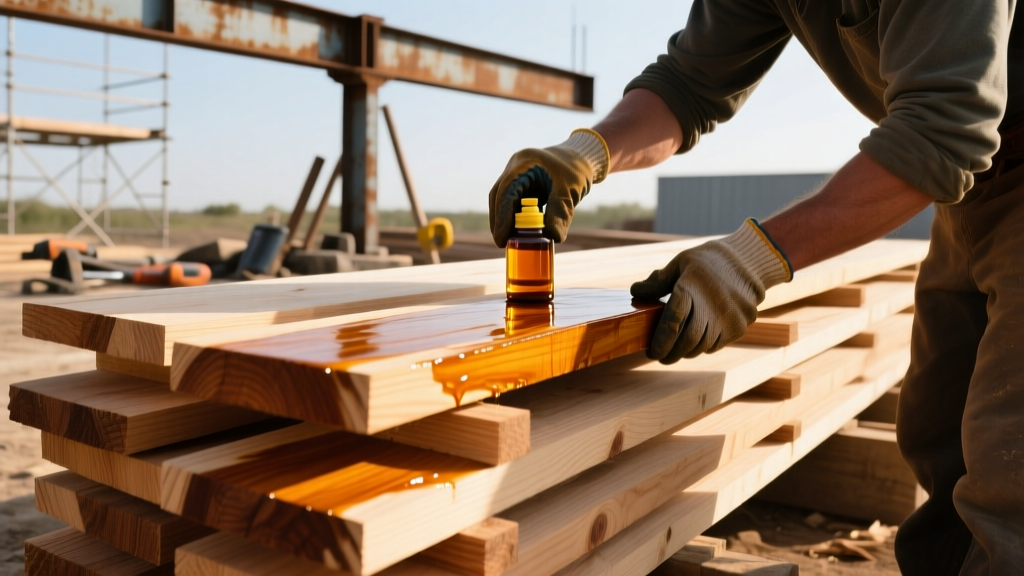
Advanced Preservation Technologies: Thermal and Chemical Modification
For projects requiring high durability without chemical biocides, the market has shifted toward modified wood planks:
- Thermally Modified Timber (TMT): Wood is baked in an oxygen-deprived kiln at 400°F–450°F. This process caramelizes the hemicellulose (the food source for fungi) and alters the cellular structure to reduce water absorption by up to 50%. TMT planks require no chemical preservatives but become brittle, requiring specialized carbide-tipped tooling for installation.
- Acetylated Wood (e.g., Accoya): Radiata pine is reacted with acetic anhydride, which binds to the wood's free hydroxyl groups. This reduces the wood's equilibrium moisture content (EMC) to roughly 3-5%, making it dimensionally stable and virtually rot-proof. Acetylated planks carry 50-year above-ground warranties and can be coated with standard water-based acrylics.
Step-by-Step Surface Preparation & Application
The most advanced preservative will fail if applied to improperly prepared wood. Follow this strict preparation protocol for exterior wood plank finishing:
- Moisture Verification: Use a pin-type moisture meter. Wood must be below 15% moisture content (MC) before applying film-forming finishes, and below 19% MC for penetrating oils. Applying finishes over wet wood traps moisture, guaranteeing sub-film fungal growth.
- Mechanical Abrasion: Sand bare wood to 80-grit for penetrating oils, or 100-120 grit for film-forming sealers. Never sand exterior wood past 120-grit; burnished wood fibers close the cellular pores, preventing preservative penetration.
- Extractive Bleed Mitigation: If painting Cedar or Redwood planks, wash the surface with a TSP (Trisodium Phosphate) solution and apply a stain-blocking alkyd primer. Failure to do so will result in tannin bleed, manifesting as brown stains through the topcoat within weeks.
- Application Environment: Apply treatments when ambient temperatures are between 50°F and 85°F, and avoid direct midday sunlight, which causes the carrier solvents to flash off before the active biocides can penetrate the wood matrix.
Troubleshooting Common Treatment Failures
Symptom: Alligatoring and Peeling of Clear Sealers
Cause: Application of a non-flexible, interior-grade polyurethane to exterior planks, or application over wood with >20% MC. UV radiation degrades the lignin just beneath the clear film, causing the finish to lose its anchor and peel.
Fix: Strip the failed film using a sodium hydroxide-based chemical stripper, neutralize with a mild acid wash (oxalic acid), and switch to a pigmented, flexible penetrating oil. Clear exterior finishes require annual reapplication; pigmented finishes last 3x longer.
Symptom: Black Mildew Stains on Cedar/Redwood
Cause: Use of raw linseed oil or natural oil blends that lack synthetic mildewcides. The natural oils act as a food source for surface mold spores.
Fix: Clean with a diluted oxygen bleach solution (sodium percarbonate) to kill the spores without damaging the wood fibers. Recoat with an alkyd-based or synthetic oil formulation containing IPBC or zinc pyrithione.
Symptom: Fastener Corrosion and Streaking
Cause: Using standard galvanized fasteners with modern ACQ or MCA pressure-treated planks. The high copper content in the preservative acts as a cathode, rapidly corroding standard zinc galvanization.
Fix: Exclusively use hot-dipped galvanized (ASTM A153) or stainless steel (Type 304 or 316) fasteners and joist hangers when fastening copper-treated wood planks.
Final Specifications for Long-Term Durability
Preserving wood is not a one-size-fits-all endeavor. By aligning the specific biological traits of your chosen types of wood planks with the correct chemical or physical treatment, you can extend the service life of exterior timber from a mere 5 years to over 50 years. Always consult the USDA Forest Products Laboratory Wood Handbook for species-specific gravity and shrinkage data before finalizing your preservation and fastening schedules.
Written by
Elena RodriguezElena Rodriguez is a civil engineer and technical writer specializing in concrete technology, masonry systems, and ASTM/ACI compliance. She earned her B.S. in Civil Engineering from Texas A&M University and spent a decade at a materials testing laboratory, performing over 2,000 concrete compressive strength tests and masonry prism evaluations. Elena is an ACI-certified Field Testing Technician (Grade I) and a member of ASTM Committee C12 on Natural Building Stone. She currently consults on forensic engineering cases involving concrete failures and moisture intrusion. Based in San Antonio, TX, Elena is a proud member of the Society of Women Engineers (SWE) and coaches her daughter's FIRST Robotics team.
More from Elena Rodriguez
View all
Walls & Panels
Cost Analysis: Light Gauge Steel Framing Advantages and Disadvantages
Evaluate light gauge steel framing advantages and disadvantages through a strict cost analysis lens, comparing material, labor, and lifecycle expenses.
Aug 4, 2026

Walls & Panels
Gypsum Board Types: Exact Specifications, Thickness & Dimensions
Compare standard, Type X, and moisture-resistant gypsum board types. Get exact specifications, thicknesses, dimensions, and ASTM standards for your project.
Aug 4, 2026

Fire Resistance
Best Fire-Resistant Outdoor Decking Materials: 2026 Buyer Guide
Discover the best fire-resistant outdoor decking materials for 2026. Compare Class A PVC, aluminum, and hardwood options for WUI compliance and safety.
Aug 4, 2026