Best Types of Wood Mulch for Soil Preservation and Termite Defense
Compare the best types of wood mulch for soil preservation, moisture retention, and termite defense. Learn decay rates, C:N ratios, and application depths.

The Biological Interface: Carbon-to-Nitrogen Ratios and Decay Kinetics
Wood mulch is not merely a cosmetic landscape finish; it is an active biological and chemical interface that dictates soil microbiology, moisture retention, and structural vulnerability. When evaluating the various types of wood mulch from a preservation standpoint, the most critical metric is the Carbon-to-Nitrogen (C:N) ratio. Microbes require nitrogen to break down carbon-rich wood. If the mulch's C:N ratio exceeds 30:1, soil bacteria will scavenge nitrogen from the surrounding topsoil, causing localized nitrogen immobilization that starves shallow-rooted plants.
Understanding the decay rate of different wood species allows you to align your mulch choice with your maintenance schedule and soil preservation goals. Fast-decaying mulches build topsoil rapidly but require annual replenishment, while highly preserved heartwoods can last for years but contribute little to immediate soil biology.
| Mulch Type | C:N Ratio | Estimated Lifespan | Nitrogen Immobilization Risk |
|---|---|---|---|
| Aged Hardwood Bark | 100:1 to 150:1 | 1–2 Years | Moderate (Mitigated by aging) |
| Fresh Arborist Wood Chips | 400:1 to 600:1 | 2–3 Years | High (Requires soil N supplementation) |
| Pine Bark Nuggets | 400:1 to 500:1 | 3–4 Years | Low (Decays too slowly to tie up N) |
| Cedar / Cypress Heartwood | 300:1 to 450:1 | 4–6 Years | Low (Natural oils inhibit microbial decay) |
Natural Preservatives: Allelopathy and Pest Resistance
Certain tree species produce secondary metabolites—extractives like tannins, terpenes, and phenols—that act as natural wood preservatives. These compounds defend the living tree against fungal rot and insect herbivory, and they persist long after the wood is chipped into mulch.
Cedar and Cypress: The Biological Repellents
Western Red Cedar contains thujone, while Bald Cypress contains cypressene. Both are potent natural fungicides and insect repellents. From a preservation perspective, cedar and cypress mulches are exceptional for resisting decay and deterring foraging insects like carpenter ants and certain termite species. However, these same volatile oils can exhibit allelopathic effects, inhibiting seed germination and stunting the growth of sensitive annuals and shallow-rooted perennials. Reserve cedar and cypress mulches for established shrub beds, tree rings, and pathways rather than active vegetable gardens or annual flower beds.
Black Walnut: The Juglone Hazard
Black walnut (Juglans nigra) wood and bark contain juglone, a highly toxic naphthoquinone. Even when aged, walnut mulch can leach juglone into the soil, causing rapid wilting and death in juglone-sensitive plants, including tomatoes, potatoes, azaleas, and hydrangeas. Never use unidentified arborist chips near sensitive garden beds if walnut trees were processed in the batch.
Structural Preservation: The Mulch-Foundation-Termite Triangle
The most severe risk associated with improper wood mulch application is structural compromise via subterranean termites (including the highly destructive Formosan subterranean termite). Mulch does not inherently attract termites from distant colonies; rather, it provides the precise microclimate—high moisture and moderate temperature modulation—that existing soil-dwelling colonies require to forage above ground without desiccating.
According to entomological research on mulching and termite foraging behavior, a thick layer of wood mulch resting against wooden siding or structural piers bridges the physical and chemical termiticide barriers applied to the foundation. To preserve structural timber and prevent moisture-induced rot, landscaping professionals must adhere to strict clearance protocols.
The 6/12 Foundation Preservation Rule
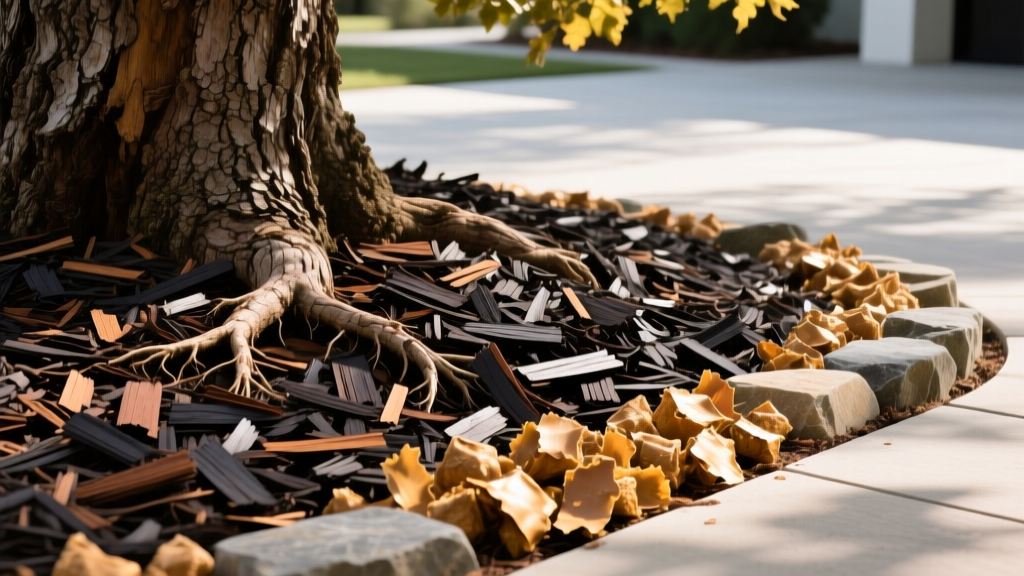
- Vertical Clearance (6 Inches): Maintain a minimum 6-inch gap between the top of the mulch layer and the bottom of the wooden siding, brick weep holes, or structural framing. This prevents splash-back of soil-borne fungi and denies termites a concealed bridge into the wall cavity.
- Horizontal Clearance (12 Inches): Establish a 12-inch mulch-free perimeter directly against the foundation. Use inorganic materials in this zone, such as crushed gravel, river rock, or bare soil treated with a non-repellent termiticide. Gravel preserves drainage and creates a dry, hostile environment for termite tunneling.
Recycled and Treated Wood Mulch: Chemical Leaching Risks
The proliferation of colored mulches (often dyed black or red) has introduced a complex variable to soil preservation: the presence of recycled Construction and Demolition (C&D) timber. While modern pressure-treated lumber utilizes Alkaline Copper Quaternary (ACQ) or Copper Azole (CA), older structures demolished today still contain Chromated Copper Arsenate (CCA).
When CCA-treated wood is inadvertently chipped into commercial mulch supplies, arsenic, chromium, and copper can leach into the soil profile. The EPA guidelines on wood preservatives highlight the persistent toxicity of heavy metals in soil environments. Even if the mulch is certified as ACQ-only, the elevated copper levels can accumulate to phytotoxic concentrations in poorly drained, acidic soils, devastating earthworm populations and mycorrhizal fungal networks. For edible gardens, rain gardens, or playgrounds, strictly specify virgin, untreated, undyed hardwood or softwood mulch.
Application Matrices: Depth and Moisture Preservation
The physical geometry of the mulch dictates its gas exchange properties and moisture preservation capabilities. Applying the wrong type of wood mulch at the incorrect depth leads to anaerobic soil conditions, root suffocation, and the proliferation of artillery fungus (Sphaerobolus stellatus), which shoots tar-like spores onto adjacent siding and windows.
Research from Penn State Extension on moisture conservation emphasizes that mulch depth must be inversely proportional to the material's particle density and matting potential.
Shredded Hardwood (Fines and Double-Shred)
- Target Depth: 2 to 3 inches maximum.
- Preservation Profile: Excellent for moisture retention and weed suppression due to its interlocking, mat-forming nature. However, if applied thicker than 3 inches, it forms an impermeable crust that sheds water and blocks oxygen diffusion to the root zone. Must be fluffed annually to prevent anaerobic souring.
- Best Application: Sloped beds (resists washing), perennial borders, and high-traffic landscape areas.
Pine Bark Nuggets (Mini and Large)
- Target Depth: 3 to 4 inches.
- Preservation Profile: High porosity allows for excellent gas exchange and water infiltration. Because they do not mat, they eliminate the risk of anaerobic souring. However, their lightweight, buoyant nature makes them highly susceptible to displacement during heavy rainfall or irrigation.
- Best Application: Flat, established shrub beds, acid-loving plant zones (azaleas, rhododendrons), and areas with low surface water runoff.
Coarse Arborist Wood Chips (Raw, Unaged)
- Target Depth: 4 to 6 inches.
- Preservation Profile: The irregular, chunky structure prevents matting entirely, allowing maximum airflow while slowly moderating soil temperature extremes. As noted in the C:N table, raw chips will tie up surface nitrogen; therefore, apply a high-nitrogen organic fertilizer (like blood meal or feather meal) to the soil surface before laying the chips.
- Best Application: Large tree rings, woodland restoration areas, utility pathways, and heavy clay soils requiring long-term structural amendment.
Purchasing and Quality Verification
When sourcing types of wood mulch for large-scale preservation projects in 2026, verify the material's origin. Request a certificate of origin from the supplier to ensure the batch is free from C&D debris and invasive species like the Emerald Ash Borer or Asian Longhorned Beetle, which can survive in improperly composted, unaged wood chips. Expect to pay between $35 and $45 per cubic yard for bulk shredded hardwood, $50 to $65 for cypress, and $60 to $80 for premium cedar, excluding delivery fees. Investing in premium, species-specific mulch reduces long-term maintenance costs and protects both your soil biology and your structural foundation.
Written by
Elena RodriguezElena Rodriguez is a civil engineer and technical writer specializing in concrete technology, masonry systems, and ASTM/ACI compliance. She earned her B.S. in Civil Engineering from Texas A&M University and spent a decade at a materials testing laboratory, performing over 2,000 concrete compressive strength tests and masonry prism evaluations. Elena is an ACI-certified Field Testing Technician (Grade I) and a member of ASTM Committee C12 on Natural Building Stone. She currently consults on forensic engineering cases involving concrete failures and moisture intrusion. Based in San Antonio, TX, Elena is a proud member of the Society of Women Engineers (SWE) and coaches her daughter's FIRST Robotics team.
More from Elena Rodriguez
View all
Walls & Panels
Cost Analysis: Light Gauge Steel Framing Advantages and Disadvantages
Evaluate light gauge steel framing advantages and disadvantages through a strict cost analysis lens, comparing material, labor, and lifecycle expenses.
Aug 4, 2026

Walls & Panels
Gypsum Board Types: Exact Specifications, Thickness & Dimensions
Compare standard, Type X, and moisture-resistant gypsum board types. Get exact specifications, thicknesses, dimensions, and ASTM standards for your project.
Aug 4, 2026

Fire Resistance
Best Fire-Resistant Outdoor Decking Materials: 2026 Buyer Guide
Discover the best fire-resistant outdoor decking materials for 2026. Compare Class A PVC, aluminum, and hardwood options for WUI compliance and safety.
Aug 4, 2026