Lowe's Lumber Performance Ratings & Grade Specifications Guide
Master Lowe's lumber performance ratings, grade stamps, and moisture specs. Learn to decode structural stamps and select the right framing and trim boards.
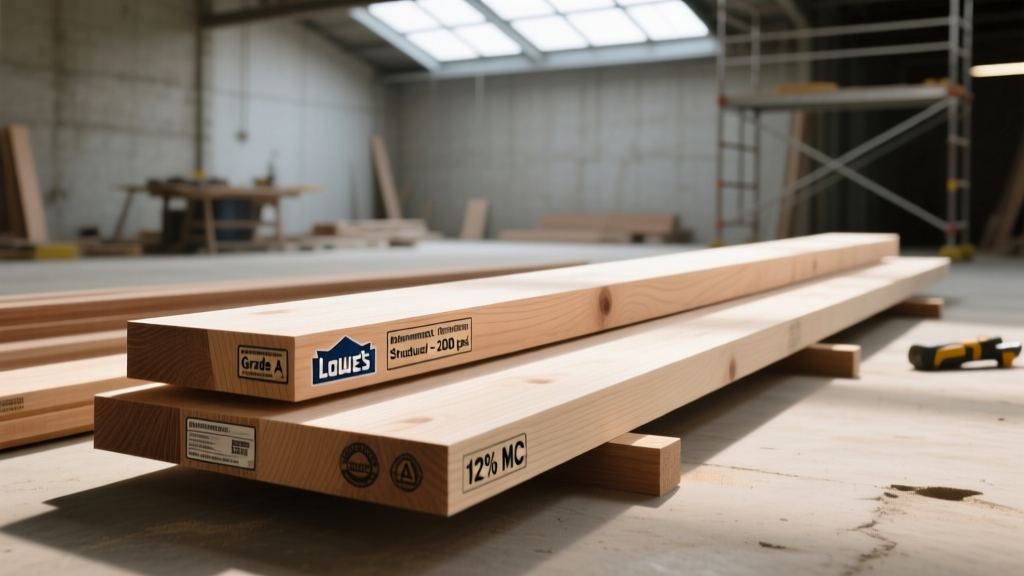
Decoding Structural Performance in Lowe's Lumber Inventory
When sourcing framing and finish materials for residential or light commercial construction, understanding the exact performance ratings of Lowe's lumber is critical for structural integrity, code compliance, and minimizing callbacks. While the big-box retailer offers a vast selection of dimensional lumber, engineered wood, and appearance boards, the true value lies in reading the grade stamps and understanding the underlying mechanical properties. This guide breaks down the technical specifications, moisture content thresholds, and span ratings you need to evaluate when selecting Lowes lumber for your 2026 building projects.
Anatomy of the Grade Stamp: What the Ink Tells You
Every piece of structural dimensional lumber sold at Lowe's carries a grade stamp. This stamp is not merely a manufacturer's logo; it is a legally binding certification of the board's structural capacity, verified by an independent grading agency. Misinterpreting this stamp is a primary cause of failed framing inspections.
The 5 Pillars of a Lumber Grade Stamp
- Certification Agency: Identifies the rules under which the lumber was graded. Common agencies found at Lowe's include SPIB (Southern Pine Inspection Bureau), WWPA (Western Wood Products Association), and WCLIB (West Coast Lumber Inspection Bureau).
- Species Identification: Abbreviations like SYP (Southern Yellow Pine), SPF (Spruce-Pine-Fir), or DF-L (Douglas Fir-Larch). This dictates the baseline engineering values.
- Structural Grade: The load-bearing classification, such as No. 1, No. 2, Stud, or Construction.
- Mill Identification: A unique number or name identifying the specific manufacturing mill, crucial for tracing material defects or recalls.
- Moisture Content (MC) Condition: Indicates the moisture level at the time of surfacing (e.g., S-DRY, MC15, KD).
For structural framing, the Southern Pine Inspection Bureau (SPIB) and WWPA grading rules govern the allowable design values. A #2 grade SYP board from Lowe's will have significantly higher bending strength than a #2 grade SPF board, even though both carry a "No. 2" designation.
Moisture Content Specifications and Dimensional Stability
Moisture content (MC) at the time of purchase directly dictates how the lumber will behave once installed in a climate-controlled environment or exposed to the elements. Lowe's typically stocks three distinct moisture categories for dimensional lumber, each with specific performance implications.
| Stamp Designation | Max Moisture Content | Typical Lowe's Product | Performance & Application Notes |
|---|---|---|---|
| S-DRY | ≤ 19% | Standard Green/SYP Framing | Prone to shrinkage and twisting as it acclimates to interior HVAC. Must be installed with the "crown" facing up to mitigate sagging as it dries. |
| MC15 | ≤ 15% | Premium KD Framing | Reduced shrinkage compared to S-DRY. Ideal for load-bearing walls where drywall cracking is a major concern. |
| KD (Kiln-Dried) | ≤ 15% (Often 8-12%) | Appearance Boards, Trim, MDF-core | Dimensionally stable. Required for interior finish carpentry, cabinetry, and trim to prevent joint separation. |
| PT (Pressure Treated) | 35% - 75% (Wet) | ProWood / Ground Contact Decking | Extremely high initial MC. Will shrink significantly in width. Deck boards must be butted tight during installation; framing requires hot-dipped galvanized fasteners. |
Warning: The S-DRY Drywall Callback
Installing S-DRY (Surface Dry, up to 19% MC) SYP floor joists or wall plates in a winter-heated home will cause the wood to drop to 8-10% MC. This 9% moisture loss results in roughly 0.5 inches of vertical shrinkage per 10 feet of stacked lumber, leading to severe drywall cracks and nail pops. Always specify MC15 or KD framing for interior conditioned spaces.
Structural Span Ratings: SYP vs. SPF at Lowe's
Lowe's regional inventory heavily dictates the species you will encounter. Southern and Eastern stores predominantly stock Southern Yellow Pine (SYP), while Northern and Western locations lean toward Spruce-Pine-Fir (SPF) or Hem-Fir. The structural performance gap between these species is substantial and must be factored into your span calculations according to the American Wood Council (AWC) Span Tables.
Key Engineering Properties: Fb and E
- Fb (Fiber Stress in Bending): Measures the wood's resistance to breaking under load.
- E (Modulus of Elasticity): Measures stiffness, or how much the board will deflect (bounce) under weight.
| Species / Grade | Fb (psi) | E (psi) | Max Span (2x10 @ 16" O.C., 40 psf Live Load) |
|---|---|---|---|
| No. 2 SYP | 1,100 | 1,700,000 | 18' 6" |
| No. 2 SPF | 875 | 1,300,000 | 16' 2" |
| No. 2 Hem-Fir | 850 | 1,300,000 | 15' 9" |
As the data illustrates, a #2 SYP joist from Lowe's can span over two feet further than a #2 SPF joist of the exact same dimension. If you are building in a region where Lowe's only stocks SPF, you may need to reduce your joist spacing from 16" on-center to 12" on-center to achieve the same floor stiffness and prevent bouncy floors.
Appearance Grades vs. Structural Grades: Avoiding Costly Mistakes
Lowe's separates its lumber into structural framing categories and appearance/finish categories. A common and dangerous mistake made by DIYers and novice builders is assuming that a high-priced, beautiful appearance board possesses high structural strength.
Critical Failure Mode: The Appearance Board Trap
Lowe's sells "Select" and "Premium" pine boards (often 1x4, 1x6, or 1x8) that are visually flawless, knot-free, and kiln-dried. However, these are graded for appearance, not structural load. They lack the structural grade stamp required by building codes for load-bearing applications. Never use Lowe's Select appearance boards as structural rafters, joists, or headers, regardless of how thick or stiff they feel in the aisle.
Decision Matrix: Specifying Lowe's Lumber by Application
To streamline your material takeoffs and ensure code compliance, use this decision matrix when ordering from the Lowe's pro desk or navigating the aisles.
- Exterior Deck Framing (Ground Contact): Specify 2x6 or 2x8 UC4A (Ground Contact) Pressure-Treated SYP. Look for the ProWood or Severe Weather brand tags indicating 0.60 pcf retention for posts in concrete.
- Exterior Deck Framing (Above Ground): Specify 2x8 UC3B (Above Ground) Pressure-Treated. Lower chemical retention reduces corrosion risk to fasteners while protecting against rain and humidity.
- Interior Load-Bearing Walls: Specify #2 or better KD/MC15 SPF or SYP. Ensure the stamp reads "STUD" or "NO. 2". Avoid "Utility" or "Economy" grades for load-bearing walls.
- Interior Non-Load-Bearing Partition Walls: "STUD" grade is acceptable and cost-effective. S-DRY is permissible here if the home will not be immediately heated and dried in.
- Floor Joists (Conditioned Space): Specify #2 MC15 or KD SYP. The lower moisture content prevents the floor system from shrinking and causing subfloor squeaks as the home's HVAC system dries the air.
- Interior Trim and Millwork: Specify KD Select or Premium Radiata/Ponderosa Pine. Ensure the boards are stored flat in the home for 72 hours prior to installation to acclimate to the specific indoor humidity.
Fastener Compatibility Note
When utilizing Lowe's pressure-treated lumber, the high copper content in modern preservatives (like Micronized Copper Azole) will rapidly corrode standard zinc-plated nails and screws. You must pair PT lumber with hot-dipped galvanized (HDG) fasteners meeting ASTM A153 standards, or specialized polymer-coated structural screws designed specifically for treated lumber.
Summary: Verifying Specs on the Job Site
Relying solely on the bin tags at the store is insufficient. The bin tag indicates what the store intends to stock, but mixed bundles are common in high-volume lumber yards. Always verify the physical grade stamp on a statistically significant sample of the bundle (at least 10%) before accepting a Lowe's lumber delivery on your job site. Confirm the species matches your engineered span tables, verify the moisture designation aligns with your installation environment, and reject any boards with excessive wane, bow, or twist that exceed the tolerances outlined in the Western Wood Products Association grading manuals. Precision in material specification at the point of purchase prevents catastrophic structural failures and costly rework in the field.