Cost Guide to All Types of Woods for Construction in 2026
Analyze the 2026 costs and structural value of all types of woods. Compare softwood, hardwood, and engineered lumber pricing for optimal building ROI.

The 2026 Lumber Market: Pricing and Value Baselines
Evaluating all types of woods for construction requires moving beyond simple per-board-foot pricing to understand total installed cost, structural lifespan, and long-term return on investment. As the lumber market stabilizes in 2026 following years of supply chain volatility, builders and architects are recalibrating their material schedules. The National Association of Home Builders (NAHB) notes that while baseline dimensional lumber prices have normalized, premium hardwoods and advanced engineered timbers continue to see price appreciation driven by sustainable forestry mandates and high commercial demand.
This cost analysis breaks down the financial and structural realities of softwoods, hardwoods, and engineered wood products, providing exact pricing metrics and value frameworks for residential and commercial projects.
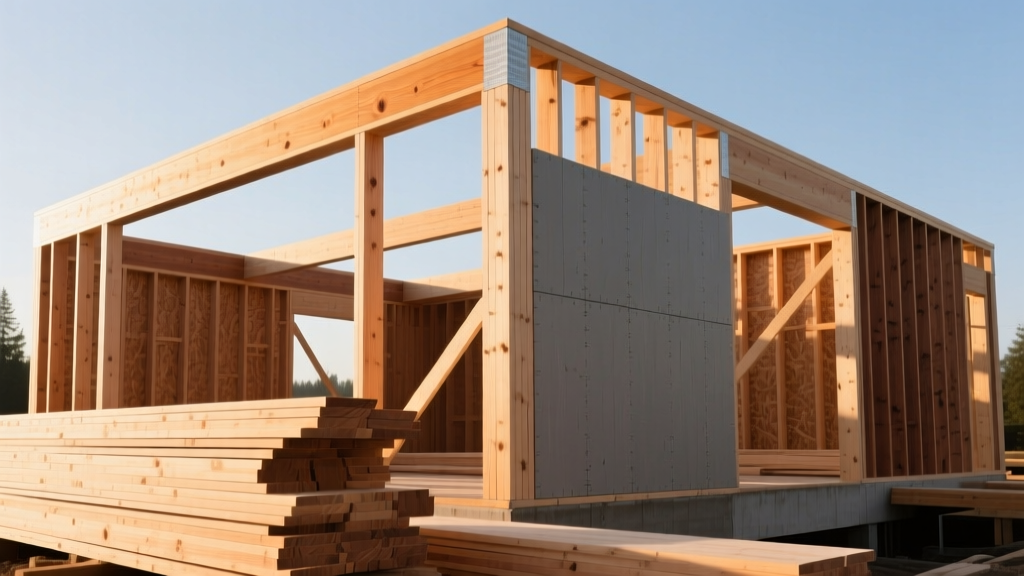
Dimensional Softwoods: Structural Framing Economics
Softwoods remain the backbone of North American light-frame construction. When calculating the value of dimensional softwoods, the primary metric is the cost-to-strength ratio, specifically evaluating the modulus of elasticity (E) and extreme fiber in bending (Fb) relative to the purchase price.
Spruce-Pine-Fir (SPF) vs. Douglas Fir-Larch
SPF is the default choice for standard wall framing due to its low cost and adequate structural properties for standard load-bearing walls. In 2026, #2 grade SPF 2x4 studs average $3.80 to $4.50 per linear foot (LF). However, for high-load applications like roof rafters or floor joists spanning over 14 feet, Douglas Fir-Larch provides superior structural value.
Southern Yellow Pine (SYP) and Pressure Treatment
SYP is prized for its high density and exceptional nail-holding capacity. It is also the primary species used for pressure-treated lumber. Standard ground-contact (UC4A) treated SYP 4x4 posts cost between $8.50 and $10.00 per LF. The value here lies in longevity; properly graded and treated SYP resists fungal decay and termite damage for 40+ years, eliminating the replacement costs associated with untreated wood in sill plates and exterior decks.
Hardwoods: Calculating Finish and Longevity ROI
Hardwoods are rarely used for structural framing in modern construction; their value is realized in interior finishes, flooring, and high-wear architectural millwork. The cost analysis of hardwoods must factor in the Janka hardness rating, which dictates the material's resistance to denting and wear over decades of use.
| Wood Species | Avg. Cost (per sq. ft. unfinished) | Janka Hardness (lbf) | Best Application & Value Proposition |
|---|---|---|---|
| Red Oak | $5.50 - $7.00 | 1,290 | Standard flooring; excellent stain absorption and high availability. |
| Hard Maple | $7.50 - $9.50 | 1,450 | High-traffic commercial floors; superior dent resistance. |
| Black Walnut | $12.00 - $16.00 | 1,010 | Luxury millwork and cabinetry; high aesthetic ROI for resale. |
| Hickory | $8.00 - $10.50 | 1,820 | Rustic flooring; highest domestic hardness for extreme wear zones. |
According to the USDA Forest Products Laboratory, the cellular structure of ring-porous hardwoods like Oak makes them highly dimensionally stable when quarter-sawn, though this milling technique adds a 30% to 45% premium to the base material cost. For high-end residential builds, specifying quarter-sawn White Oak for cabinetry and trim yields a measurable increase in property appraisal values that frequently exceeds the initial material premium.
Engineered Wood: The Commercial and Multi-Family Standard
Engineered wood products (EWPs) represent the highest technological leap in timber construction. By reconstituting wood fibers, veneers, or strands with structural adhesives, EWPs eliminate natural defects like knots and slope-of-grain, resulting in highly predictable engineering values.
LVL and Glulam Beams
Laminated Veneer Lumber (LVL) and Glued-Laminated Timber (Glulam) have largely replaced solid-sawn beams and steel I-beams in residential and light-commercial headers. A standard 1.75E grade LVL beam (11.875 inches deep) costs approximately $14.00 to $18.00 per LF. While this is more expensive than a comparable built-up 2x12 dimensional lumber header, LVL guarantees zero shrinkage, warping, or crowning, eliminating the costly drywall crack callbacks that plague traditional framing.
Cross-Laminated Timber (CLT)
CLT is revolutionizing mid-rise commercial construction. Consisting of alternating layers of dimension lumber glued at 90-degree angles, CLT panels act as massive structural diaphragms. In 2026, CLT panels average $14.00 to $19.00 per square foot of surface area. APA – The Engineered Wood Association highlights that while the raw material cost of CLT is higher than concrete, the total installed cost is often 15% to 20% lower due to drastically reduced crane time, smaller foundation requirements, and the elimination of secondary framing and drywall trades.
Hidden Cost Multipliers: Grading, Moisture, and Treatment
When budgeting for all types of woods, failing to account for grading and moisture content specifications leads to severe cost overruns. The stamp on a piece of lumber dictates its structural capacity and its physical behavior post-installation.
- Moisture Content (MC): Standard S-DRY (Surfaced Dry, max 19% MC) lumber is cheaper upfront but will shrink as it acclimates to interior conditioned spaces, causing drywall pops and squeaky floors. Specifying MC-15 (max 15% MC) or KD-15 (Kiln Dried) lumber adds $0.15 to $0.30 per LF but saves thousands in interior finishing callbacks.
- Grade Upgrades: Upgrading from #2 Common to Select Structural dimensional lumber increases material costs by 25% to 40%. However, Select Structural allows engineers to reduce the total board footage required in high-wind or seismic zones, often resulting in a net-zero cost difference when factoring in reduced labor and fastener requirements.
- Preservative Treatments: Standard Alkaline Copper Quaternary (ACQ) treatment is cost-effective but highly corrosive to standard fasteners. Specifying lumber treated with Micronized Copper Azole (MCA) costs roughly 10% more but allows the use of standard hot-dipped galvanized fasteners, avoiding the massive premium required for stainless steel hardware.
Decision Framework: Matching Wood Species to Project Budgets
Selecting the optimal wood requires aligning the material's inherent properties with the project's financial and structural constraints. Use this framework to guide material scheduling:
- Standard Residential Framing: Default to #2 Grade SPF. It provides the lowest cost-per-stud while meeting all International Residential Code (IRC) requirements for standard load paths. Reserve Douglas Fir strictly for high-load ridges and long-span rafters.
- Moisture-Prone Envelopes: Specify SYP treated with MCA for sill plates, deck joists, and exterior trim. The slight material premium prevents catastrophic structural rot and fastener corrosion.
- High-Visibility Interior Finishes: Allocate budget to quarter-sawn White Oak or Hard Maple for flooring and millwork. The high Janka hardness and dimensional stability protect the aesthetic investment over decades of use.
- Long-Span and Multi-Family Structures: Mandate LVL for all headers and Glulam for primary columns. The elimination of natural wood defects ensures predictable structural performance and reduces the risk of framing failures during the building's lifecycle.
Optimizing lumber costs in 2026 is not about finding the cheapest board at the yard; it is about engineering the material schedule so that every dollar spent on wood directly contributes to structural integrity, reduced labor time, or long-term durability.
Written by
David NakamuraDavid Nakamura is a licensed architect (AIA) and construction technology writer focused on sustainable building methods, mass timber engineering, and high-performance building envelopes. He holds a Master of Architecture from the University of Washington and is a certified Passive House Consultant (CPHC). David spent eight years at the Seattle firm Mithun, where he led the design of three LEED Platinum projects, before founding his own practice specializing in net-zero residential design. He serves on the editorial advisory board of GreenBuilder Magazine and has authored peer-reviewed papers on cross-laminated timber (CLT) connections for the Journal of Structural Engineering. In his spare time, David teaches woodworking at Pratt Fine Arts Center and kayaks the Puget Sound.
More from David Nakamura
View all
Construction Cost
Labor Cost to Build a Deck Per Sq Ft: 2026 Installation Guide
Discover the exact labor cost to build a deck per sq ft in 2026. This installation guide breaks down contractor rates, complexity factors, and hidden fees.
Aug 4, 2026

Construction Cost
How Much Does It Cost to Build a 3 Bedroom House? Financing Guide
Learn exactly how much it costs to build a 3 bedroom house and explore 2026 financing options, construction loan types, and budget frameworks for your build.
Aug 4, 2026

Construction Cost
Cost to Build a Tennis Court: 2026 Guide
How much does it cost to build a tennis court in 2026? Breakdowns for asphalt, concrete, and synthetic surfaces plus fencing and lighting.
Jul 30, 2026