What Type of Brush for Staining Wood on Exposed Structural Timber
Discover what type of brush for staining wood on exposed structural timber. Expert guide on bristle materials, sizing, and glulam application techniques.

The Unique Challenge of Staining Structural Timber
When architects and contractors ask what type of brush for staining wood on large-scale structural members, the answer requires moving beyond standard residential trim advice. Exposed structural timber—such as Douglas fir glulam beams, Southern Yellow Pine heavy timber posts, and cross-laminated timber (CLT) ceiling panels—presents a unique set of physical and chemical challenges. Unlike milled 1x4 trim, structural members feature massive surface areas, deep growth rings, and often a mix of planed and rough-sawn textures.
According to the FPL Wood Handbook, the porous nature of structural softwoods means they absorb penetrating stains at vastly different rates across the flat grain versus the end grain. A brush that works perfectly on a furniture piece will fail catastrophically on a 40-foot glulam beam, leaving lap marks, shedding bristles in rough-sawn pockets, or failing to push stain deep into the timber's cellular structure. Selecting the correct application tool is critical for achieving uniform UV protection and moisture management in modern mass timber construction.
Decoding Bristle Materials: Synthetic vs. Natural
The primary decision when determining what type of brush for staining wood in structural applications comes down to the chemistry of your stain. In 2026, stringent VOC regulations have accelerated the development of high-solids waterborne acrylics, though traditional penetrating alkyd-oils remain prevalent for deep-timber protection.
| Bristle Type | Best Stain Chemistry | Structural Timber Use Case | Drawbacks |
|---|---|---|---|
| Natural (China Bristle) | Oil-based, Alkyd, Linseed | Rough-sawn heavy timber posts; deep-penetrating exterior applications. | Absorbs water and goes limp; unusable with waterborne stains. |
| Synthetic (Nylon/Polyester) | Waterborne Acrylic, Hybrid | Planed glulam beams; interior mass timber ceilings; fast-drying formulas. | Can push waterborne stains too thin if not properly flagged. |
| Blended (Natural/Synthetic) | Universal, Oil-Modified | Mixed-finish projects where crews switch between oil and water bases. | Jack-of-all-trades; lacks the extreme capacity of pure China bristle. |
For oil-based penetrating stains on rough-sawn structural timber, 100% White China Bristle is mandatory. The natural microscopic scales on animal hair hold up to 40% more stain than synthetic alternatives, releasing it slowly as the brush is dragged across the wood. This reservoir effect is vital when staining vertical 8x8 timber posts, reducing the need to constantly reload the brush while working at height on scaffolding.
Conversely, if you are applying a low-VOC waterborne acrylic to a planed Douglas fir glulam beam, a Nylon/Polyester synthetic blend is required. Natural bristles act like sponges in water-based carriers, swelling and losing their snap. Synthetic filaments maintain their stiffness, allowing the applicator to push the stain into the timber's summerwood (latewood) bands without the brush collapsing.
Sizing and Shape: Matching the Brush to the Structural Member
Structural timber dimensions dictate brush geometry. Standard 2-inch brushes are entirely inadequate for the broad faces of engineered wood products. The APA (The Engineered Wood Association) notes that standard glulam beam widths range from 3-1/8 inches to 10-3/4 inches. To maintain a wet edge and prevent lap marks, your brush width must cover a significant portion of the beam's face in a single stroke.
The Structural Brush Matrix
- 4-Inch to 5-Inch Flat Block Brush: The workhorse for broad glulam faces and CLT panel edges. Provides maximum stain reservoir and ensures uniform pressure across wide growth rings.
- 6-Inch Block Brush or Stain Pad: Reserved for massive timber fascias and continuous horizontal beams. Requires two-handed operation but cuts application time in half on 12-inch wide members.
- 2.5-Inch Angled Sash Brush: Strictly for detail work. Used for cutting in around steel connection plates, coating the interior of mortise pockets, and sealing complex timber-framing joinery.
Warning: The Mortise and Tenon Trap
Never use a large block brush to apply stain inside structural mortise pockets or around steel shear plates. The dense bristle pack will trap excess stain in the end-grain recesses. As the timber dries and shifts under structural loads, this trapped, un-wiped stain will weep out, creating dark, unsightly bleed marks on the finished beam. Always switch to a 2-inch angled brush for connection zones, and immediately wipe excess with a lint-free rag.
Application Techniques for Long-Span Glulam Beams
Staining a continuous 45-foot glulam beam requires rigorous technique to avoid overlap marks. Because structural stains are designed to penetrate rather than sit on the surface, drying times can be deceptive.
- Pre-Wet the End Grain: Structural beam ends are essentially bundles of open straws. Apply a 50/50 mix of stain and appropriate thinner to the end grain 15 minutes before staining the long grain. This partial sealing prevents the end grain from absorbing 10x the normal amount of pigment, which causes permanent blackening.
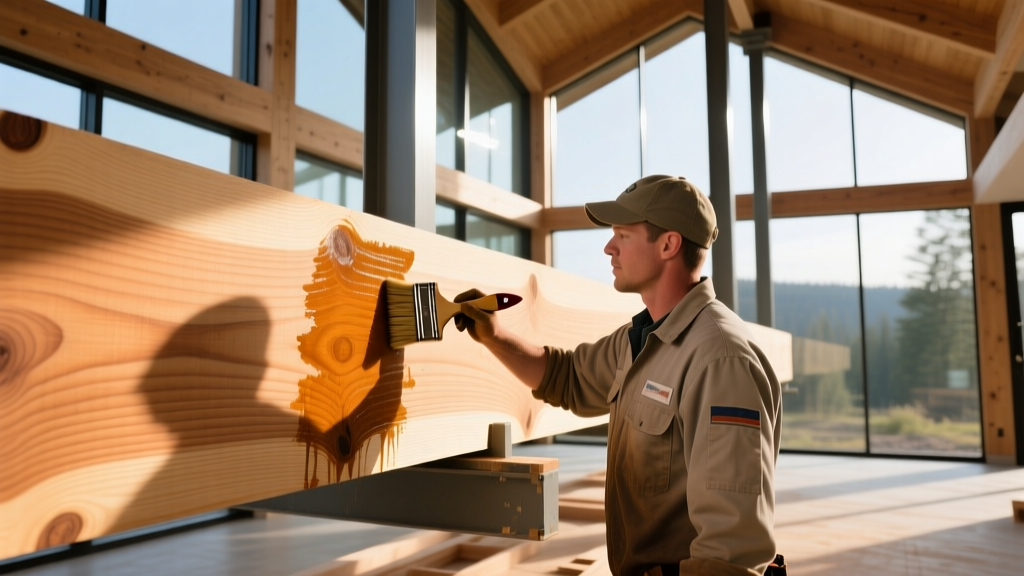
- Establish the Wet Edge: Work in continuous 8-foot sections. Always start your brush stroke an inch behind the wet edge and pull forward into the dry wood. Never stop a stroke in the middle of a beam span; always terminate at a structural joint or connection plate.
- Back-Brushing: After laying down a heavy coat with a 5-inch block brush, immediately follow with a dry, clean 4-inch synthetic brush to even out the film thickness and push the stain into the checking (natural cracks) of the timber.
- Manage the Drip Rail: On horizontal beams, stain will inevitably pool on the bottom edge. Assign a secondary crew member with a 2-inch sash brush to run the bottom edge and catch drips before they cure into hard, glossy icicles.
Common Failure Modes in Heavy Timber Staining
Understanding why applications fail helps clarify what type of brush for staining wood you should avoid. Here are the most frequent structural timber staining failures:
- Bristle Shedding in Checks: Cheap synthetic brushes with cut (unflagged) tips will catch on the micro-splinters inside timber checks and natural knots. The bristles snap off and become permanently embedded in the drying stain. Solution: Only use premium brushes with laser-split (flagged) tips that glide over rough textures.
- Chatter Marks: Using a brush that is too stiff for the stain's viscosity causes the bristles to skip across the dense latewood bands of Douglas fir, leaving alternating light and dark streaks. Solution: Match brush stiffness to stain viscosity. Thinner waterborne stains require softer, more flexible nylon filaments.
- Resin Bleed-Through: Structural pine and fir contain high levels of pitch. If a brush generates too much friction heat during aggressive application, it can draw pitch to the surface, ruining the stain finish. Solution: Use a lighter touch and allow the brush's reservoir to do the work, rather than scrubbing the timber.
2026 Product Recommendations for Structural Projects
For commercial and high-end residential mass timber projects, investing in professional-grade application tools yields a massive return in labor savings and finish quality. Here are the top-tier brushes specified by timber finishing contractors in 2026:
- Purdy Pro-Extra 4-Inch Flat ($38 - $44): The industry standard for waterborne and hybrid structural stains. Features a copper-infused ferrule to prevent rust in high-humidity timber frames and laser-split Chimney Sweep filaments that hold massive amounts of material without dripping.
- Wooster PRO 6-Inch Block Brush ($48 - $55): Ideal for broad CLT panels and oversized glulam beams. The 6-inch footprint covers a standard 5-1/8 inch glulam face in a single pass, virtually eliminating lap marks on long spans.
- Shur-Line 5.5-Inch Premium Stain Pad ($22 - $28): While not a traditional brush, this pad is heavily favored for the flat, vertical webs of structural I-joists and the smooth sides of planed timber. The foam-and-fleece surface applies a perfectly even, streak-free coat of penetrating oil without the risk of bristle shedding.
- Linzer 2.5-Inch China Bristle Angle ($14 - $18): The dedicated detail brush for oil-based applications on heavy timber joinery, tenons, and steel connection interfaces.
Selecting the correct brush for structural timber is not merely an aesthetic choice; it directly impacts the longevity of the wood's moisture barrier and the structural integrity of the finish. By matching the bristle material to the stain chemistry and scaling the brush geometry to the timber's dimensions, contractors can achieve flawless, durable finishes on the most demanding architectural wood structures.
Written by
Priya KapoorPriya Kapoor is a real estate market analyst and construction economics researcher with expertise in housing affordability, development feasibility, and infrastructure investment. She holds a Master of Regional Planning from Cornell University and previously worked as a senior analyst at CBRE's Investment Properties group, where she modeled returns for $4B in mixed-use development pipelines. Priya now runs an independent research practice advising developers, municipalities, and REITs on construction cost forecasting and market timing. She publishes the quarterly "BuildMat Market Pulse" report tracking material price indices across 12 commodity categories. Based in Austin, TX, Priya serves on the board of Habitat for Humanity Austin and is a marathon runner.
More from Priya Kapoor
View all
Construction Cost
Cost to Build a 1600 Sq Ft Home in 2026: Full Breakdown
Accurate 2026 cost to build a 1600 sq ft home—material, labor, and regional pricing breakdowns included. Plan your budget with real-time estimates.
Aug 11, 2026

Wood & Lumber
Name the Types of Wood for Pressure Treatment and Preservation
Learn how to name the types of wood best suited for pressure treatment. Compare species treatability, chemical retention levels, and 2026 preservation costs.
Aug 4, 2026

Stone & Masonry
Stone Veneer Suppliers Lindenhurst: 2026 Cost Analysis
Analyze 2026 stone veneer costs in Lindenhurst, NY. Compare local supplier pricing, delivery fees, and Suffolk County installation labor rates.
Aug 4, 2026