Best Types of Wood for Cutting Boards: 2026 Cost Guide
Compare the best types of wood for cutting boards by cost, Janka hardness, and lifespan. Find the highest-value lumber for your kitchen in 2026.

The Material Science of Cutting Surfaces
When evaluating the types of wood for cutting boards, the fundamental challenge is balancing two opposing physical forces: knife-edge retention and surface durability. A cutting board is a sacrificial tool. If the wood is too hard, it will blunt your chef's knife; if it is too soft, it will score deeply, creating anaerobic trenches where bacteria thrive.
The industry metric for this balance is the Janka hardness scale, which measures the force (in pounds-force, or lbf) required to embed a steel ball into the wood. According to The Wood Database, the optimal Janka sweet spot for cutting boards lies between 900 lbf and 1,500 lbf. Woods below this range (like Pine or Fir) are structurally inadequate, while woods above it (like Hickory or Ipe) will destroy microscopic knife edges. However, hardness is only one variable in the cost-value equation. Grain porosity, natural oil content, and milling costs drastically alter the long-term ROI of your lumber purchase.
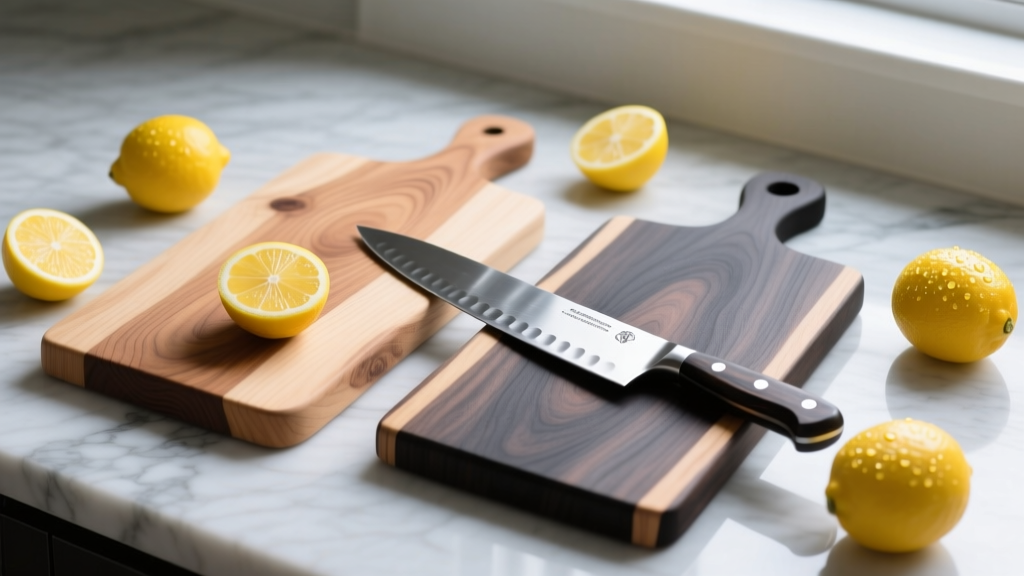
2026 Lumber Cost & Value Matrix
Pricing for domestic and exotic hardwoods has stabilized in 2026, though import tariffs continue to affect tropical species. The table below analyzes the most common cutting board woods based on Surfaced 4 Sides (S4S) board foot pricing, Janka hardness, and structural viability.
| Wood Species | Janka Hardness | Avg Cost (S4S / BF) | Grain Type | Value Rating |
|---|---|---|---|---|
| Hard Maple (Sugar) | 1,450 lbf | $7.00 - $9.50 | Closed / Fine | ★★★★★ |
| Black Walnut | 1,010 lbf | $13.00 - $17.00 | Closed / Medium | ★★★★☆ |
| Cherry (American) | 950 lbf | $9.00 - $12.00 | Closed / Fine | ★★★★☆ |
| Teak (Burmese) | 1,070 lbf | $28.00 - $36.00 | Closed / Oily | ★★★☆☆ |
| Acacia (Asian) | 1,500 - 2,300 lbf | $4.50 - $7.00 | Closed / Variable | ★★★☆☆ |
Species Breakdown: ROI and Performance
Hard Maple: The Undisputed Benchmark
Hard Maple (Acer saccharum) remains the gold standard for commercial and residential cutting boards. Its tight, closed grain prevents moisture and food particles from penetrating the surface, a critical factor for food safety. At 1,450 lbf, it is hard enough to resist deep knife scarring but yields just enough to protect high-carbon steel edges. From a cost perspective, it offers the highest yield per board foot with minimal waste, making it the most economical choice for large, end-grain butcher blocks.
Black Walnut: The Premium Aesthetic
Walnut is prized for its rich, dark chocolate heartwood. At 1,010 lbf, it is noticeably softer than maple, meaning it is exceptionally gentle on expensive Japanese gyutos and custom-forged knives. However, walnut is more prone to denting from heavy cleaver work. The cost premium (roughly double that of maple) is driven by aesthetic demand rather than structural superiority. Pro Tip: Use walnut as an accent wood in edge-grain stripes rather than a solid slab to reduce material costs by 40% while maintaining visual contrast.
Teak: The Low-Maintenance Outlier
Teak (Tectona grandis) contains high levels of natural silica and oils, making it incredibly resistant to water absorption and warping. This drastically reduces the maintenance cost (oiling frequency). However, there is a hidden trade-off: silica is an abrasive. Despite a moderate Janka rating of 1,070 lbf, the microscopic silica deposits in teak will dull knives significantly faster than maple or walnut. Furthermore, at $30+ per board foot, the initial capital outlay is difficult to justify unless you prioritize zero-maintenance over knife longevity.
Red Oak has large, open pores that act like microscopic straws, drawing meat juices and bacteria deep into the board. Even with heavy mineral oiling, Red Oak is fundamentally unsafe for raw meat preparation. Always stick to closed-grain hardwoods.
Construction Methods and Their Cost Multipliers
The species you choose is only half the equation. The orientation of the wood grain dictates both the manufacturing cost and the lifespan of the board. According to the USDA Forest Products Laboratory Wood Handbook, wood movement and dimensional stability vary wildly depending on grain orientation.
- Face-Grain (Flat-Sawn): The cheapest to produce. Wide planks are glued side-by-side. Drawback: Prone to severe warping and cupping as the board absorbs moisture unevenly. Not recommended for thick, heavy-duty boards.
- Edge-Grain (Quarter-Sawn): Strips are turned on their sides and glued. Offers excellent stability and moderate cost. This is the standard for high-quality, long rectangular carving boards.
- End-Grain: The most expensive construction method. Blocks are arranged so the cut ends face up. This requires 3x more glue joints, extensive planing, and generates high waste. Value Add: End-grain acts like a brush, allowing knife edges to slip between wood fibers rather than severing them, resulting in a 'self-healing' surface that lasts decades.
Hidden Costs: Glues, Finishes, and Hardware
When calculating the true cost of a cutting board build, material pricing is just the baseline. You must factor in the consumables required to make the board food-safe and structurally sound.
The Adhesive Requirement
Standard PVA wood glues (like Titebond II) are water-resistant but will eventually delaminate under repeated washing and soaking. You must use a Type I waterproof, FDA-approved indirect food-contact adhesive. Titebond III Ultimate is the industry standard, costing roughly $12 to $15 per 16oz bottle. While more expensive than standard glue, it prevents catastrophic joint failure, protecting your lumber investment.
Finishing Economics
Avoid 'drying' oils like raw linseed or standard tung oil, which require metallic driers to cure and can go rancid if not fully polymerized. The most cost-effective and food-safe finish is a mixture of food-grade mineral oil and beeswax. A 16oz bottle of mineral oil costs under $10 and will maintain a heavy-use board for over a year. Apply it monthly to end-grain boards, and quarterly to edge-grain boards.
Decision Matrix: Which Wood Should You Buy?
Use this framework to select the right lumber based on your specific culinary habits and budget constraints.
| User Profile | Recommended Wood | Recommended Build | Estimated Material Cost (18'x12' Board) |
|---|---|---|---|
| The Professional Chef (Prioritizes knife edge retention above all) | Black Walnut or Cherry | End-Grain (1.5' thick) | $65 - $85 |
| The Heavy Prep Cook (Chops dense root veggies, uses cleavers) | Hard Maple | Edge-Grain (1.25' thick) | $30 - $45 |
| The Low-Maintenance User (Hates oiling, leaves board on counter) | Teak | Edge-Grain (1' thick) | $90 - $120 |
| The Budget Builder (Needs a large surface area for cheap) | Acacia or Hard Maple | Face-Grain (0.75' thick) | $15 - $25 |
Sourcing Lumber: S4S vs. Rough Sawn
If you are milling the board yourself, buying rough-sawn lumber from a local sawyer will cut your base material costs by 30% to 50%. However, rough lumber requires a jointer and a thickness planer to achieve the precise, parallel dimensions needed for airtight glue joints. If you lack these tools, the cost of S4S (Surfaced 4 Sides) lumber from a specialized hardwood dealer is justified. S4S lumber ensures that your clamping pressure is distributed evenly, preventing the microscopic gaps that lead to bacterial ingress and glue-line failure.
Ultimately, the highest value in cutting board construction comes from pairing a closed-grain domestic hardwood (like Hard Maple) with an end-grain orientation and a Type I waterproof adhesive. While the initial labor and material cost is higher than a big-box store bamboo alternative, a properly maintained maple board will easily outlast a decade of daily culinary abuse, making it the most economically sound choice for serious kitchens.
Written by
James ThorntonJames Thornton is a construction industry veteran with 25 years of hands-on experience in wood framing, lumber grading, and residential building codes. He started as a framing carpenter in rural Oregon, earned his ICC Residential Building Inspector certification, and eventually became a senior plan reviewer for the City of Portland Bureau of Development Services. James holds a B.S. in Wood Science & Technology from Oregon State University and is a certified lumber grader through the West Coast Lumber Inspection Bureau (WCLIB). He has inspected over 3,000 residential construction sites and authored the city's internal guide on advanced framing techniques (2x6 at 24" O.C.). James lives in Bend, OR, where he builds custom timber-frame cabins and competes in lumberjack sports.
More from James Thornton
View all
Insulation
Best Home Insulation Materials: Complete 2026 Guide
Compare top home insulation materials for 2026. Find R-values, installed costs per square foot, and best uses for fiberglass, spray foam, and mineral wool.
Aug 4, 2026

Sustainable Building
Certify Your Green Building Material for LEED and WELL
Step-by-step guide to certifying a green building material for LEED v5 and WELL v2. Master EPDs, HPDs, and VOC limits for 2026 project specifications.
Aug 4, 2026

Stone & Masonry
Veneer Stacked Stone Panels: Interior Design & Style Showcase
Discover how veneer stacked stone panels transform interiors. Explore modern design profiles, material pairings, and technical installation specs.
Aug 4, 2026