Types of Grain in Wood Compared: Structure and Aesthetics
Compare types of grain in wood for structural integrity and aesthetics. Expert guide on straight, spiral, interlocked, and wavy grain patterns.

The Anatomy of Wood Grain: Alignment vs. Figure
In architectural woodworking and structural timber framing, the term 'grain' is frequently misused to describe surface patterns. True wood grain refers to the longitudinal alignment of the wood's cellular structure (tracheids and fibers) relative to the trunk's vertical axis. The visual pattern on the surface—cathedrals, birdseye, or ribbon stripes—is technically the 'figure,' which is a byproduct of how the grain is intersected by the saw blade. Understanding the distinct types of grain in wood is critical for predicting dimensional stability, structural load capacity, and machining behavior. A misidentification of grain direction can lead to catastrophic structural shear failure in load-bearing joists or severe tear-out in custom millwork.
Straight Grain vs. Spiral Grain: The Structural Divide
The orientation of wood cells dictates how a board will behave under compressive, tensile, and shear stresses. The two most foundational grain classifications in structural engineering are straight and spiral grain.
Straight Grain: The Engineering Baseline
Straight grain occurs when the longitudinal cells run perfectly parallel to the vertical axis of the tree. This alignment provides maximum tensile strength and predictable shrinkage. In structural framing, species like Douglas Fir and Southern Yellow Pine (SYP) are prized for their predominantly straight grain. According to the American Wood Council (AWC), visually graded structural lumber relies heavily on straight grain to achieve its published allowable stress design (ASD) values. When cells are parallel to the load, the wood's modulus of elasticity (MOE) remains at its peak.
Spiral Grain: The Hidden Structural Hazard
Spiral grain occurs when cells wrap around the trunk in a helical pattern as the tree grows. This is highly prevalent in fast-growing plantation species like Radiata Pine and certain hardwoods like Sweetgum. In structural grading, spiral grain is measured as the 'slope of grain.' A slope of 1 in 12 (meaning the grain deviates 1 inch from the vertical axis over 12 inches of length) is the maximum allowable limit for high-grade structural joists. Exceeding this slope drastically reduces the wood's bending strength and increases the likelihood of severe twisting (wind) during the kiln-drying process.
Interlocked and Wavy Grain: Durability and Aesthetics
While straight and spiral grains dictate structural framing, interlocked and wavy grains dominate the hardwood, decking, and fine furniture markets.
Interlocked Grain: The Exterior Durability King
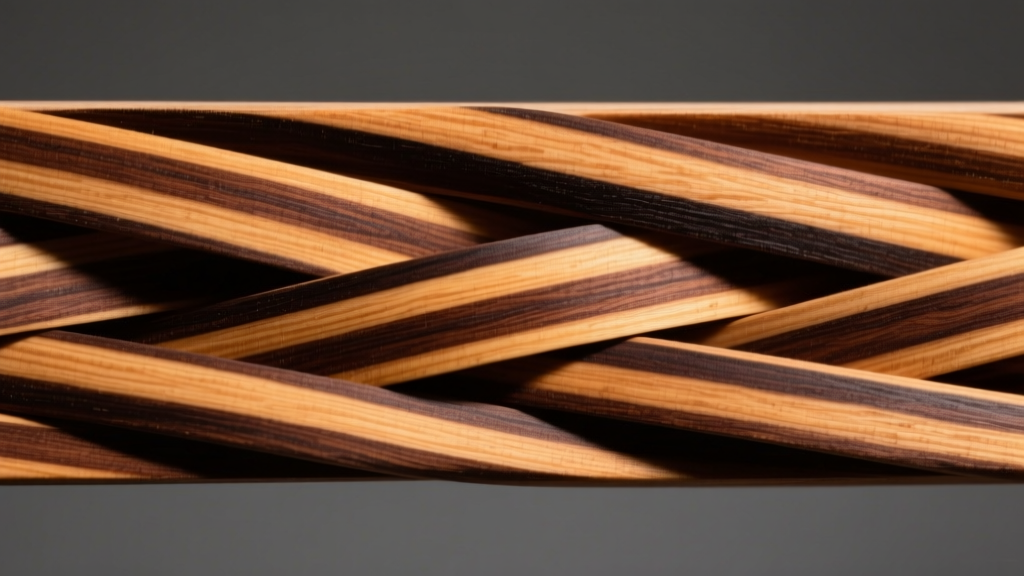
Interlocked grain occurs when the tree alternates the direction of its spiral growth annually or bi-annually—wrapping clockwise for a few years, then counter-clockwise. This creates a highly dense, interwoven cellular matrix. Species exhibiting heavy interlocked grain include Ipe, Cumaru, Sapele, and African Mahogany.
From a structural standpoint, interlocked grain provides immense resistance to shear forces and checking (surface splitting), making it the premier choice for exterior decking and marine applications. However, it is notoriously difficult to machine. Standard straight-knife planer heads will violently tear out the alternating fibers. Professional millworks processing interlocked Sapele or Ipe must use helical cutterheads (such as the Byrd Shelix) with carbide inserts angled at 15 to 20 degrees to shear the fibers cleanly rather than chopping them.
Wavy and Curly Grain: The Aesthetic Premium
Wavy, curly, or fiddleback grain is a genetic mutation or a reaction to environmental compression, causing the fibers to undulate in a three-dimensional wave. Hard Maple, Black Walnut, and Koa are famous for this trait. While visually stunning—creating a chatoyant, 3D optical illusion when finished—wavy grain is structurally compromised. The undulating fibers create short-grain sections that are brittle and prone to snapping under tension. Consequently, wavy grain lumber is strictly reserved for veneers, musical instrument backs, and non-structural decorative panels.
Comparative Matrix: Grain Types, Stability, and Cost
The following matrix compares the primary grain types across critical performance metrics, utilizing 2026 market averages for North American lumber yards.
| Grain Type | Representative Species | T/R Shrinkage Ratio | Machinability | Primary Application | Est. Cost (BF) |
|---|---|---|---|---|---|
| Straight | Douglas Fir, Sitka Spruce | 1.5 - 1.8 (Highly Stable) | Excellent | Structural framing, joists | $4.50 - $6.00 |
| Spiral | Radiata Pine, Sweetgum | 2.2+ (Prone to warping) | Good (if dried properly) | Pallets, non-structural | $2.00 - $3.50 |
| Interlocked | Ipe, Sapele, Mahogany | 1.3 - 1.6 (Exceptional) | Poor (Requires helical heads) | Decking, marine, exterior | $12.00 - $18.00 |
| Wavy/Curly | Hard Maple, Black Walnut | 2.0+ (Unpredictable) | Difficult (High tear-out risk) | Veneer, instruments, decor | $22.00 - $45.00+ |
Milling Cuts: How Sawyers Manipulate Grain Presentation
The way a log is sliced at the sawmill determines how the natural grain is exposed on the board face. The National Hardwood Lumber Association (NHLA) grading rules account for these cuts, as they directly impact the board's stability and yield.
- Plain Sawn (Flat Sawn): The log is sliced tangentially to the growth rings. This produces the classic 'cathedral' figure. While it yields the most lumber per log (making it the most cost-effective), plain sawn boards have a high tangential shrinkage rate, making them prone to cupping across their width.
- Quarter Sawn): The log is first quartered, then sliced perpendicular to the growth rings. This exposes the straight grain and, in species like White Oak, reveals the medullary rays (ray fleck). Quarter sawn lumber shrinks primarily in thickness rather than width, offering superior dimensional stability for wide plank flooring and cabinet doors.
- Rift Sawn: Similar to quarter sawn, but the cuts are made at a strict 30 to 60-degree angle to the growth rings to completely eliminate the medullary ray fleck. This produces a perfectly uniform, tight straight-grain 'pin stripe' look. It generates the highest amount of waste and commands a 30% to 50% premium over plain sawn lumber.
Expert Selection Framework: Matching Grain to Application
Specifying the correct grain type requires balancing structural engineering limits with aesthetic and budgetary constraints. Use this decision framework for your next project:
- For Load-Bearing Framing (Headers, Joists, Rafters): Specify visually graded No. 2 or better Douglas Fir-Larch or Southern Pine. Inspect the board edges for a slope of grain no steeper than 1:12. Avoid boards with large knots that disrupt the straight grain flow, as these create localized shear planes.
- For Exterior Decking and Cladding: Specify interlocked grain tropical hardwoods (Ipe, Garapa) or thermally modified straight-grain Ash. The interlocked cellular structure prevents the deep checking that plagues straight-grain exterior woods when exposed to UV and moisture cycling.
- For Wide Plank Flooring (over radiant heat): Specify quarter sawn White Oak or Rift Sawn Hard Maple. The low Tangential/Radial (T/R) shrinkage ratio of quarter sawn grain ensures the boards will not gap or cup when the radiant heat system dries out the winter air.
- For High-End Millwork and Cabinetry: Utilize plain sawn Walnut for warm, varied cathedrals, but ensure the moisture content is acclimated to exactly 6-8% before machining to mitigate post-installation movement.
Sourcing and Grading Standards
When procuring lumber based on grain characteristics, rely on established grading agencies rather than visual guesswork. For structural softwoods, ensure the stamp includes the grading agency mark (e.g., WWPA, SPIB) and the moisture content at the time of surfacing (S-DRY for 19% or less, MC-15 for 15% or less). For hardwoods, NHLA grades (FAS, Select, No. 1 Common) dictate the percentage of clear, straight-grain cutting yield, but they do not strictly penalize wavy or interlocked grain unless it compromises the structural integrity of the clear face. Always request physical samples or high-resolution end-grain photos from your supplier when sourcing premium interlocked or quarter sawn stock to verify the cellular alignment before committing to a full unit purchase.
Written by
Marcus ChenMarcus Chen is a licensed structural engineer (PE) and building materials analyst with over 12 years of experience across residential, commercial, and industrial construction. He holds a Master of Science in Civil Engineering from UC Berkeley and spent six years at Thornton Tomasetti before transitioning to independent consulting and technical writing. Marcus specializes in material selection for seismic-prone regions, concrete reinforcement strategies, and lifecycle cost analysis. His work has been cited by the American Concrete Institute (ACI) and the Structural Engineers Association of California (SEAOC). When he is not on a job site or at his desk, you will find him hiking the Sierra Nevada or restoring a 1920s craftsman bungalow in Oakland, CA.
More from Marcus Chen
View all
Construction Cost
How Much Did the Eiffel Tower Cost to Build?
How much did the Eiffel Tower cost to build in 1889? We adjust for inflation and compare its budget to modern skyscraper construction.
Aug 4, 2026

Fire Resistance
What Is a Fire Resistant Material? Testing & Certification Guide
Discover what is a fire resistant material through ASTM and UL testing. Learn how fire ratings, certifications, and assemblies work in construction.
Aug 4, 2026

Construction Cost
How Much Did the Burj Khalifa Cost to Build?
How much did the Burj Khalifa cost to build? We break down the $1.5B project and extract 5 money-saving strategies for your next build.
Jul 30, 2026