The Hardness of Wood Types: Cost and Lifespan ROI Guide
Analyze the hardness of wood types against material and installation costs to find the optimal Janka rating for maximum flooring ROI and lifespan.
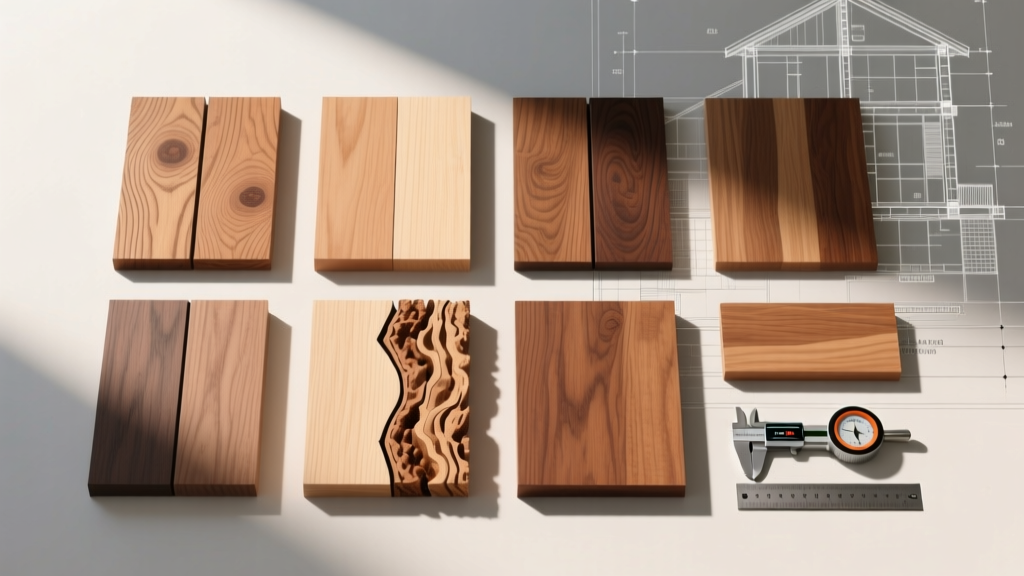
The Economics of the Janka Hardness Scale
When evaluating the hardness of wood types for flooring and structural applications, the Janka hardness test—which measures the force required to embed a 0.444-inch steel ball halfway into the wood—serves as the industry baseline. However, treating the Janka rating purely as a measure of dent resistance misses the broader financial picture. The hardness of wood types directly dictates material yield, installation labor, tooling depreciation, and long-term refinishing viability. In 2026, with skilled flooring labor averaging $65 to $95 per hour, selecting a wood species based solely on its raw hardness rating without factoring in installation friction is a primary driver of budget overruns.
Ultra-hard exotic species like Brazilian Walnut (Ipe) or Cumaru boast Janka ratings exceeding 3,500 lbf (pounds-force), but they carry a hidden installation premium of 30% to 45% compared to domestic species. Conversely, softer woods like Eastern White Pine (380 lbf) offer low upfront material costs but incur high lifecycle replacement costs in high-traffic zones. Finding the optimal return on investment (ROI) requires mapping the Janka rating against both the initial capital expenditure and the 20-year lifecycle cost.
Hardness vs. Cost: 2026 Market Data Matrix
The following table breaks down common flooring species by their Janka hardness, current 2026 material costs per square foot, and the associated installation multipliers. The 'Effective 20-Year Cost' factors in one mid-life sanding and refinishing cycle for solid hardwoods.
| Wood Species | Janka Rating (lbf) | Material Cost (per sq ft) | Install Multiplier | Effective 20-Yr Cost (per sq ft) |
|---|---|---|---|---|
| Black Cherry | 950 | $8.50 - $11.00 | 1.0x (Standard) | $22.00 - $26.00 |
| Red Oak | 1,290 | $5.50 - $8.00 | 1.0x (Standard) | $16.00 - $20.00 |
| White Oak | 1,360 | $7.00 - $10.50 | 1.0x (Standard) | $18.50 - $24.00 |
| Hard Maple | 1,450 | $7.50 - $11.00 | 1.1x (Slight blade wear) | $20.00 - $25.00 |
| Hickory | 1,820 | $6.50 - $9.50 | 1.25x (Pre-drilling/fasteners) | $19.00 - $24.00 |
| Brazilian Cherry | 2,350 | $10.00 - $14.00 | 1.4x (High tooling cost) | $28.00 - $35.00 |
| Brazilian Walnut (Ipe) | 3,680 | $13.00 - $18.00 | 1.6x (Extensive prep) | $38.00 - $48.00 |
Note: Material costs reflect select-and-better grades for solid 3/4-inch tongue-and-groove planking. Installation multipliers apply to professional nail-down methods on wood subfloors.
The ROI 'Sweet Spot': 1,200 to 1,500 lbf
The Optimal Hardness Zone
For 85% of residential and light-commercial applications, the highest ROI is found in species with a Janka rating between 1,200 and 1,500 lbf. This range—anchored by Red Oak (1,290), White Oak (1,360), and Hard Maple (1,450)—provides sufficient dent resistance to withstand dropped utensils, pet claws, and standard foot traffic without crossing the threshold where wood density begins to severely penalize installation labor and tooling costs. According to the Wood Database, woods in this bracket also exhibit optimal dimensional stability, reducing the likelihood of seasonal gapping or cupping that plagues denser exotics.
Hidden Installation Costs of Ultra-Hard Species
Specifying woods with a Janka rating above 2,000 lbf introduces compounding friction costs during installation. Contractors price these jobs higher not out of preference, but due to measurable physical constraints:
Tooling and Blade Depreciation
Cutting Ipe, Cumaru, or Strand-Woven Bamboo (which can exceed 3,000 lbf) destroys standard steel and standard-carbide saw blades. Installers must use specialized high-density carbide-tipped blades, which cost between $80 and $130 each. While a standard blade might yield 1,200 linear feet of clean cuts in Red Oak, it may dull after just 250 linear feet in Brazilian Walnut. This blade cost is invariably passed to the consumer, adding roughly $0.40 to $0.75 per square foot to the project.
Fastener Deflection and 'Shiners'
Pneumatic flooring nailers and staplers rely on the kinetic force to drive 16-gauge or 18-gauge cleats through the tongue of the board. In woods exceeding 2,200 lbf, the fastener often deflects, bends, or fails to seat fully, resulting in a 'shiner' (a nail head protruding above the wood surface). To prevent this, installers must pre-drill pilot holes for the first and last three rows, and often throughout the field for exceptionally dense species. Pre-drilling adds an average of 1.5 to 2.5 labor hours per 100 square feet, inflating the installation budget by $1.50 to $2.50 per square foot.
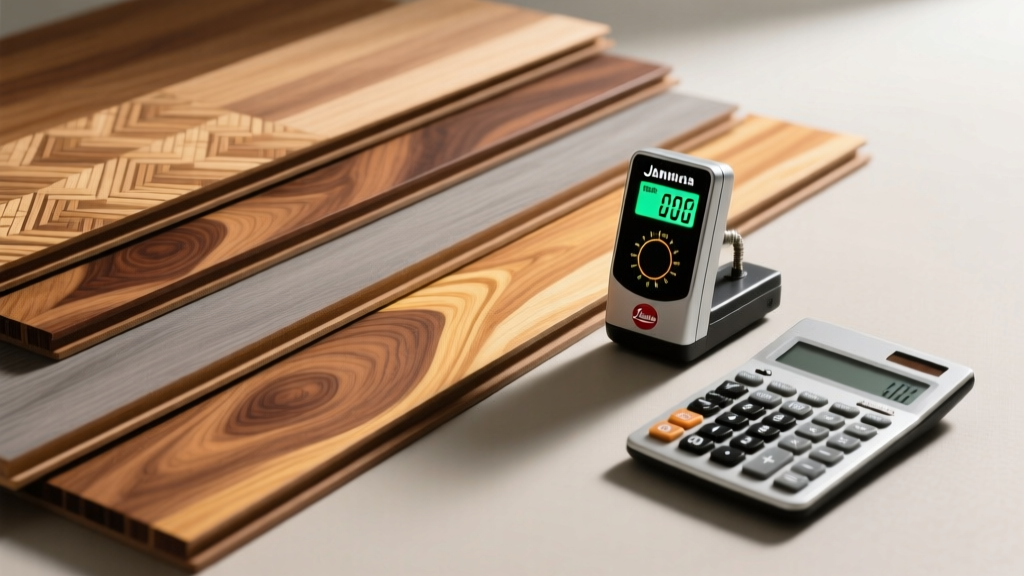
Engineered vs. Solid Hardwood: The Hardness Illusion
When analyzing the hardness of wood types in the modern market, engineered hardwood complicates the value equation. An engineered plank features a real hardwood wear layer (typically 2mm to 6mm thick) bonded to a plywood or HDF core. The Janka rating of the wear layer dictates surface dent resistance, but the structural hardness is governed by the core.
From a cost-value perspective, a 4mm White Oak wear layer over a multi-ply Baltic birch core offers superior dimensional stability compared to solid White Oak, particularly in below-grade or radiant-heat installations. However, the refinishing ROI drops significantly. A solid 3/4-inch White Oak floor (1,360 lbf) can be sanded and refinished 6 to 8 times over a 60-year lifespan. A 2mm engineered wear layer can only be refinished once, if at all. If the surface is severely gouged, the entire plank must be replaced. Therefore, if selecting a softer wood like Black Walnut (1,010 lbf) in an engineered format, the inability to easily sand out deep dents makes the long-term ROI highly unfavorable compared to a harder species or a solid plank.
Decision Matrix: Matching Hardness to Application
Use this framework to align the hardness of wood types with specific environmental demands and budget constraints:
- Low-Traffic / Formal Areas (Bedrooms, Dining Rooms): Target 800 - 1,100 lbf. Black Cherry, Black Walnut, and Teak. These species offer rich coloration and excellent workability. The lower hardness is acceptable here, and the premium material cost is justified by the aesthetic value rather than structural durability.
- High-Traffic Residential (Hallways, Kitchens, Living Rooms): Target 1,200 - 1,500 lbf. White Oak, Red Oak, Ash, and Hard Maple. This is the highest ROI category. These woods absorb standard impacts, take stains evenly, and require no specialized installation tooling.
- Heavy Abuse / Large Dogs / Commercial Lobbies: Target 1,600 - 2,000 lbf. Hickory, Pecan, and Jarrah. Hickory provides the absolute best hardness-to-cost ratio on the market. It is domestically sourced, keeping material costs low, while offering a Janka rating of 1,820 lbf that easily resists large canine claws and heavy rolling loads.
- Exterior / High-Moisture Transitions: Target 2,500+ lbf. Ipe, Cumaru, and Tigerwood. For exterior decking or interior-exterior transition zones where moisture and physical abuse are extreme, the high material and installation costs of these exotics are justified by their natural rot resistance and extreme density, which prevents water infiltration.
Moisture Content, Density, and Long-Term Value
A critical, often overlooked factor in the cost analysis of wood hardness is the relationship between density and moisture movement. The USDA Forest Products Laboratory notes that while denser, harder woods generally exhibit lower overall volumetric shrinkage, they generate significantly higher internal swelling and shrinking forces.
'Denser woods exert more force against fasteners and adjacent boards during seasonal humidity fluctuations. If an ultra-hard wood is installed without proper acclimation to the site's Equilibrium Moisture Content (EMC), the resulting expansion pressure can cause subfloor delamination or fastener failure.'
This means that for woods exceeding 2,000 lbf, the acclimation period prior to installation must be strictly monitored. While a standard Red Oak floor might acclimate to a home's HVAC environment in 5 to 7 days, dense exotics may require 14 to 21 days of on-site acclimation with the HVAC system running. This extended timeline delays project completion and increases general contractor overhead costs. Furthermore, if the National Wood Flooring Association (NWFA) guidelines for moisture testing are bypassed to save time, the resulting cupping or crowning in dense woods is nearly impossible to sand flat without removing massive amounts of the wear layer, effectively destroying the floor's lifecycle value.
Final Value Assessment
Maximizing ROI when evaluating the hardness of wood types requires abandoning the misconception that 'harder is always better.' For interior applications, the financial penalty of installing ultra-hard exotics—driven by tooling wear, extended acclimation, and complex fastening—rarely yields a proportional increase in functional lifespan. By targeting the 1,200 to 1,500 lbf sweet spot, or utilizing Hickory for high-abuse zones, builders and homeowners secure optimal dent resistance while maintaining standard installation costs and preserving the floor's long-term refinishing viability.
Written by
David NakamuraDavid Nakamura is a licensed architect (AIA) and construction technology writer focused on sustainable building methods, mass timber engineering, and high-performance building envelopes. He holds a Master of Architecture from the University of Washington and is a certified Passive House Consultant (CPHC). David spent eight years at the Seattle firm Mithun, where he led the design of three LEED Platinum projects, before founding his own practice specializing in net-zero residential design. He serves on the editorial advisory board of GreenBuilder Magazine and has authored peer-reviewed papers on cross-laminated timber (CLT) connections for the Journal of Structural Engineering. In his spare time, David teaches woodworking at Pratt Fine Arts Center and kayaks the Puget Sound.
More from David Nakamura
View all
Construction Cost
Labor Cost to Build a Deck Per Sq Ft: 2026 Installation Guide
Discover the exact labor cost to build a deck per sq ft in 2026. This installation guide breaks down contractor rates, complexity factors, and hidden fees.
Aug 4, 2026

Construction Cost
How Much Does It Cost to Build a 3 Bedroom House? Financing Guide
Learn exactly how much it costs to build a 3 bedroom house and explore 2026 financing options, construction loan types, and budget frameworks for your build.
Aug 4, 2026

Construction Cost
Cost to Build a Tennis Court: 2026 Guide
How much does it cost to build a tennis court in 2026? Breakdowns for asphalt, concrete, and synthetic surfaces plus fencing and lighting.
Jul 30, 2026