Types of Wood in Africa: A Grade and Quality Guide for Builders
Master the grading, moisture standards, and machining profiles for types of wood in Africa. A technical guide for builders specifying imported hardwoods.

The Technical Reality of Grading African Timber
Specifying types of wood in Africa for commercial, structural, or high-end residential projects requires navigating a complex matrix of botanical variations, milling standards, and international compliance frameworks. Unlike domestic North American or European softwoods graded strictly by structural stress values, imported African hardwoods are primarily evaluated through visual grading rules (adapted from NHLA standards), dimensional stability metrics, and specific gravity. As of 2026, stricter enforcement of the US Lacey Act and EU Timber Regulation (EUTR) means that quality grading must be inextricably linked to verifiable chain-of-custody documentation.
Core Quality Metrics: Hardness, Density, and Silica
Evaluating the physical properties of African species is the first step in quality control. The presence of silica and the degree of interlocked grain dictate both the structural longevity and the machining requirements on the job site. Below is a technical comparison of the most heavily imported African hardwoods.
| Species | Janka Hardness (lbf) | Specific Gravity | Silica Content | Primary Application |
|---|---|---|---|---|
| Iroko (Milicia excelsa) | 1,260 | 0.58 | High | Exterior cladding, marine, flooring |
| Sapele (Entandrophragma cylindricum) | 1,410 | 0.50 | None | Interior millwork, cabinetry, veneers |
| Wenge (Millettia laurentii) | 1,930 | 0.68 | Low | Heavy-duty flooring, structural accents |
| Opepe (Nauclea diderrichii) | 1,630 | 0.63 | High | Heavy marine construction, piling |
Species-Specific Grading and Machining Profiles
Iroko: The High-Silica Teak Alternative
Iroko is frequently specified as a cost-effective substitute for Burmese Teak in exterior applications. However, quality grading must account for its high silica content. According to data compiled by The Wood Database, Iroko's silica rapidly blunts standard high-speed steel (HSS) tooling. When inspecting milled Iroko profiles on-site, look for micro-tearout or burnished edges—these are telltale signs that the mill used dull blades, which compromises the wood's natural weather resistance by opening the end-grain pores to moisture ingress.
Sapele: Managing Interlocked Grain
Sapele is prized for its distinctive ribbon-stripe figure when quarter-sawn. The primary quality defect in Sapele lumber is tearout caused by its highly interlocked grain. Top-tier FAS (First and Seconds) grade Sapele should be specified as 'Quarter-Sawn Only' for architectural millwork to maximize dimensional stability. Flat-sawn Sapele is prone to severe cupping if moisture levels fluctuate post-installation.
Wenge: Structural Density and Splinter Hazards
With a Janka rating of 1,930 lbf, Wenge is exceptionally hard and heavy. Quality control for Wenge flooring or structural beams must focus on end-checking (splitting at the board ends). Because Wenge is highly brittle, boards shorter than 6 feet are often downgraded to #1 Common or utility grade due to the high waste factor during installation. Pre-drilling is mandatory; attempting to blind-nail Wenge without pre-drilling will result in shattered tongues and compromised structural integrity.
Moisture Content and Trans-Oceanic Kiln Standards
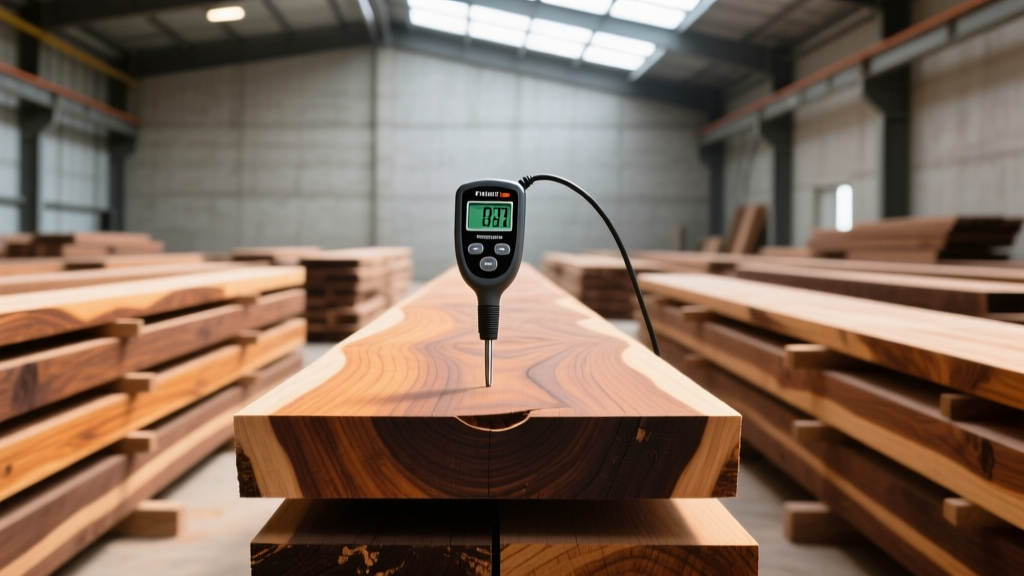
African lumber is typically kiln-dried (KD) at the origin mill to a moisture content (MC) of 10-12%. However, the journey from West or Central African ports to North American or European job sites introduces severe moisture risks. 'Container rain'—condensation forming inside shipping containers due to diurnal temperature shifts over the ocean—can artificially spike the surface MC of the top layers of lumber bundles by 4% to 8%.
Upon delivery, builders must use a pin-type moisture meter (calibrated for high-density tropical hardwoods) to test the core of the boards, not just the surface. For interior climate-controlled environments, the lumber must acclimate to an Equilibrium Moisture Content (EMC) of 6-8% before installation. If the core MC reads above 12%, the lumber must be stickered and acclimated in the installation environment for a minimum of 14 to 21 days.
Visual Grading: NHLA Adaptations for Imports
While African mills use NHLA terminology (FAS, Selects, #1 Common), the application of these rules differs slightly from domestic hardwoods. In domestic grading, FAS requires a minimum clear-face cutting yield of 83.3% and restricts the amount of sapwood. In African export grading, 'FAS' often permits a higher percentage of sapwood unless explicitly restricted. To ensure you receive heartwood-only material—which contains the natural oils and extractives required for rot resistance—architects and procurement managers must explicitly write 'FAS, Heartwood Only, Minimum 90/10 Heart-to-Sap Ratio' on the specification sheet.
Procurement Framework: Specifying African Lumber
To eliminate ambiguity and ensure job-site readiness, use this exact specification sequence when ordering types of wood in Africa for your projects:
- Botanical Name & Origin: Specify the exact scientific name (e.g., Entandrophragma cylindricum) rather than trade names, which can vary by region.
- Grade & Sapwood Restriction: Define the visual grade (e.g., FAS) and mandate heartwood percentages.
- Milling & Grain Orientation: Specify Quarter-Sawn, Rift-Sawn, or Flat-Sawn based on the species' stability profile.
- Moisture Content at Time of Loading: Mandate KD to 10-12% MC, verified by a third-party inspector at the port of origin.
- Packaging Protocol: Require foil-wrapped bundles with silica gel desiccant packs inside the shipping container to prevent transit-related moisture spikes.
- Chain of Custody: Require FSC-CoC certification numbers on all commercial invoices to satisfy USDA APHIS Lacey Act requirements.
Written by
Marcus ChenMarcus Chen is a licensed structural engineer (PE) and building materials analyst with over 12 years of experience across residential, commercial, and industrial construction. He holds a Master of Science in Civil Engineering from UC Berkeley and spent six years at Thornton Tomasetti before transitioning to independent consulting and technical writing. Marcus specializes in material selection for seismic-prone regions, concrete reinforcement strategies, and lifecycle cost analysis. His work has been cited by the American Concrete Institute (ACI) and the Structural Engineers Association of California (SEAOC). When he is not on a job site or at his desk, you will find him hiking the Sierra Nevada or restoring a 1920s craftsman bungalow in Oakland, CA.
More from Marcus Chen
View all
Construction Cost
How Much Did the Eiffel Tower Cost to Build?
How much did the Eiffel Tower cost to build in 1889? We adjust for inflation and compare its budget to modern skyscraper construction.
Aug 4, 2026

Fire Resistance
What Is a Fire Resistant Material? Testing & Certification Guide
Discover what is a fire resistant material through ASTM and UL testing. Learn how fire ratings, certifications, and assemblies work in construction.
Aug 4, 2026

Construction Cost
How Much Did the Burj Khalifa Cost to Build?
How much did the Burj Khalifa cost to build? We break down the $1.5B project and extract 5 money-saving strategies for your next build.
Jul 30, 2026