Selecting a Type of Wood for Heavy Timber Construction
Learn how to select a type of wood for heavy timber construction using our 2026 structural, fire, and durability decision framework.
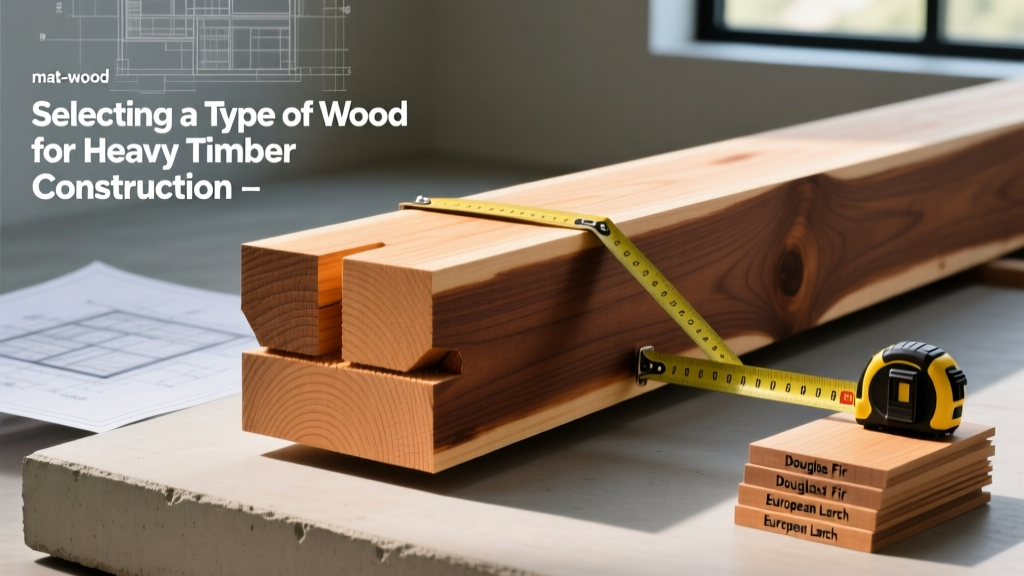
The Heavy Timber Selection Matrix
When architects and structural engineers must select a type of wood for heavy timber construction, the decision extends far beyond aesthetic grain patterns. Heavy timber (Type IV construction) relies on the mass of the wood itself to provide structural integrity, fire resistance, and long-term durability. The selection process requires a rigorous evaluation of four distinct pillars: structural capacity, environmental durability, fire performance, and current market supply chains.
Step 1: Structural Capacity (MOE and Fb Ratings)
The foundation of any timber selection framework is the National Design Specification (NDS) for Wood Construction, published by the American Wood Council (AWC). For heavy timber framing (members 5x5 inches or larger), designers rely heavily on two mechanical properties: Allowable Bending Stress (Fb) and Modulus of Elasticity (MOE).
Fb dictates the maximum load the beam can bear before rupturing, while MOE measures the material's stiffness. In commercial atriums or long-span residential great rooms, a high MOE is critical to prevent visible sagging and to mitigate floor vibrations. Douglas Fir-Larch (DF-L) consistently dominates this category, offering the highest stiffness-to-weight ratio among readily available North American softwoods.
| Species / Grade | Fb (psi) | MOE (10^6 psi) | Density (pcf) |
|---|---|---|---|
| Douglas Fir-Larch (Select Structural) | 1,500 | 1.9 | 34 |
| Southern Pine (No. 1) | 1,350 | 1.8 | 36 |
| Hem-Fir (Select Structural) | 1,400 | 1.6 | 28 |
| White Oak (Select Structural) | 1,300 | 1.78 | 47 |
Step 2: Environmental Durability and Decay Resistance
Heavy timber elements exposed to the exterior, or situated in high-humidity interior environments like natatoriums or indoor agricultural facilities, require careful species selection to prevent fungal decay. The USDA Forest Products Laboratory categorizes heartwood decay resistance into three classes: highly resistant, resistant, and slightly/non-resistant.
Heartwood vs. Sapwood Treatments
A critical specification error occurs when designers assume a species' natural decay resistance applies to the entire timber. Natural durability is almost exclusively found in the heartwood. Large-dimension timbers (e.g., 10x10 or 12x12) inevitably contain a high percentage of sapwood, which is susceptible to rot regardless of the species. If utilizing Western Red Cedar or Douglas Fir in damp conditions, the specification must explicitly mandate 'All Heartwood' grading, which commands a 30% to 45% premium and requires extended lead times.
Alternatively, specifying Southern Yellow Pine (SYP) allows for deep pressure treatment with preservatives like Copper Azole (CA-C) or Alkaline Copper Quaternary (ACQ). SYP's porous sapwood accepts treatment deeply, making it the most reliable choice for sill plates, exterior colonnades, or marine-adjacent structures.
Step 3: Fire Performance and Char Rate Calculations
Heavy timber achieves its fire rating not through chemical retardants, but through mass. When exposed to fire, the outer layer of wood chars, creating an insulating barrier that protects the unburned core. According to guidelines detailed by WoodWorks, the nominal char rate for sawn heavy timber is 1.5 inches per hour.
NDS Char Layer Calculation: To achieve a 2-hour fire rating, a structural beam must possess an additional 3.0 inches of sacrificial wood on all exposed sides beyond what is required for structural loading. A beam calculated to need a 6x10 cross-section for gravity loads must be sized up to a 12x16 to maintain structural integrity after two hours of charring.
Denser species like White Oak and Southern Pine char slightly slower than lighter species like Hem-Fir, but the NDS standardizes the 1.5 in/hr rate for simplicity in sawn lumber design. For exposed interior applications where minimizing the initial cross-section is architecturally desired, designers often turn to concealed intumescent coatings or specify structural glued laminated timber (glulam), which utilizes a 1.2 in/hr char rate for its outer laminations.
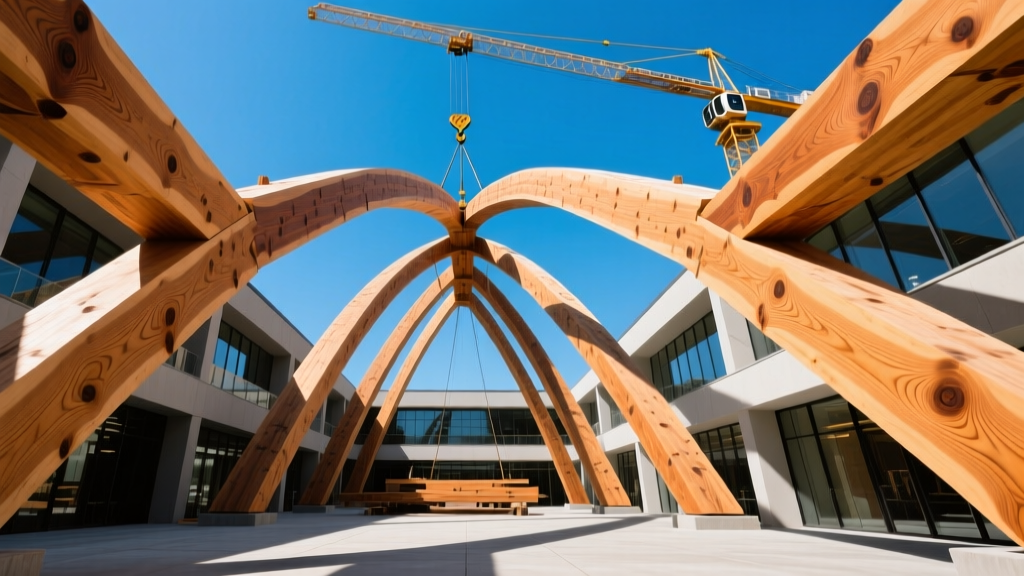
Step 4: 2026 Market Pricing and Lead Time Realities
The theoretical ideal species often collides with supply chain realities. In 2026, the heavy timber market is characterized by regional monopolies and strict grading bottlenecks. Sawn timbers larger than 8x8 require specialized mills and extended kiln-drying schedules to reach the MC15 (Moisture Content 15%) standard required to prevent severe checking and twisting post-installation.
| Species (8x8 #1 Structural) | Avg. Cost / Board Foot (2026) | Typical Lead Time | Fastener Requirement |
|---|---|---|---|
| Douglas Fir-Larch | $6.50 - $8.20 | 4 - 6 Weeks | HDG or 304 SS |
| Southern Yellow Pine | $4.50 - $5.80 | 2 - 4 Weeks | HDG or 316 SS (if treated) |
| Hem-Fir | $5.20 - $6.80 | 3 - 5 Weeks | Standard Galvanized |
| White Oak | $11.00 - $14.50 | 8 - 12 Weeks | 316 SS (Mandatory) |
Note on Fasteners: White Oak contains high levels of tannic acid, which rapidly corrodes standard galvanized and even 304 stainless steel hardware, leading to unsightly black weeping stains and structural connection failure. 316 stainless steel is non-negotiable for White Oak timber connections.
Applied Decision Tree: Matching Species to Scenario
Use the following framework to finalize your heavy timber specification based on the primary constraint of your project:
- Scenario A: Long-Span Commercial Roof Beams (Deflection Governed)
- Priority: Maximum MOE and lightweight handling.
- Selection: Douglas Fir-Larch (Select Structural). Its 1.9x10^6 psi MOE minimizes beam depth, preserving interior volume.
- Scenario B: Exterior Canopy or Marine Boardwalk
- Priority: Deep preservative penetration and rot resistance.
- Selection: Southern Yellow Pine, pressure-treated to 0.60 pcf retention (UC4B or UC4C category). Avoid untreated cedar, which cannot be reliably pressure-treated to the core in large dimensions.
- Scenario C: High-End Architectural Feature (Exposed Interior Atrium)
- Priority: Aesthetic consistency, minimal checking, and tight grain.
- Selection: Free-of-Heart (FOHC) Douglas Fir or premium White Oak. Specify kiln-dried (MC15) and mandate a mill-applied penetrating oil finish prior to shipping to stabilize moisture exchange.
- Scenario D: Budget-Constrained Industrial Retrofit
- Priority: Cost-efficiency and rapid availability.
- Selection: Hem-Fir or #2 Grade Southern Pine. Hem-Fir offers excellent workability and lower weight, making it ideal for retrofits where crane capacity or existing foundation loads are restricted.
By systematically filtering your project requirements through structural mechanics, environmental exposure, fire code char calculations, and current market logistics, you eliminate guesswork and ensure the selected timber performs flawlessly over its multi-decade lifespan.
Written by
Elena RodriguezElena Rodriguez is a civil engineer and technical writer specializing in concrete technology, masonry systems, and ASTM/ACI compliance. She earned her B.S. in Civil Engineering from Texas A&M University and spent a decade at a materials testing laboratory, performing over 2,000 concrete compressive strength tests and masonry prism evaluations. Elena is an ACI-certified Field Testing Technician (Grade I) and a member of ASTM Committee C12 on Natural Building Stone. She currently consults on forensic engineering cases involving concrete failures and moisture intrusion. Based in San Antonio, TX, Elena is a proud member of the Society of Women Engineers (SWE) and coaches her daughter's FIRST Robotics team.
More from Elena Rodriguez
View all
Walls & Panels
Cost Analysis: Light Gauge Steel Framing Advantages and Disadvantages
Evaluate light gauge steel framing advantages and disadvantages through a strict cost analysis lens, comparing material, labor, and lifecycle expenses.
Aug 4, 2026

Walls & Panels
Gypsum Board Types: Exact Specifications, Thickness & Dimensions
Compare standard, Type X, and moisture-resistant gypsum board types. Get exact specifications, thicknesses, dimensions, and ASTM standards for your project.
Aug 4, 2026

Fire Resistance
Best Fire-Resistant Outdoor Decking Materials: 2026 Buyer Guide
Discover the best fire-resistant outdoor decking materials for 2026. Compare Class A PVC, aluminum, and hardwood options for WUI compliance and safety.
Aug 4, 2026