Installation Best Practices for All Types of Door Wood
Master the installation of solid wood doors. Learn species-specific acclimation, fastener specs, and clearance tolerances for mahogany, oak, and pine.

The Physics of Wood: Why Species Dictates Installation
Installing a solid wood door is not a one-size-fits-all process. The cellular structure of the timber dictates how it reacts to environmental humidity, structural loads, and fastener stress. When evaluating the various types of door wood, installers must account for tangential and radial shrinkage rates. According to the USDA Forest Products Laboratory Wood Handbook, hardwoods like White Oak exhibit significantly higher volumetric shrinkage (up to 10.5%) compared to stable tropical hardwoods like Genuine Mahogany (approx. 4.1%).
If you hang a White Oak door using the same clearances and fasteners intended for a lightweight Pine door, you risk seasonal binding, hinge tear-out, and finish failure. Proper installation requires adjusting your acclimation timeline, fastener gauge, and gap tolerances to the specific species you are hanging.
Moisture enters the end grain of wood up to 50 times faster than the face grain. Before any door is hung, all six sides (top, bottom, and four edges) must be sealed with a high-quality polyurethane, spar varnish, or penetrating oil. If the top and bottom rails are left unsealed, the door will absorb ambient moisture unevenly, causing the stiles to bow and the bottom rail to rot. This is the leading cause of warranty voids across all premium wood door manufacturers.
Acclimation Protocols by Wood Density
Acclimation is the process of allowing the door's moisture content (MC) to reach equilibrium with the interior environment. Skipping this step guarantees seasonal warping. The target MC for interior doors in climate-controlled homes is typically 6% to 8%, while exterior doors may target 10% to 12% depending on the regional equilibrium moisture content (EMC).
| Wood Species | Density (lbs/ft³) | Target Interior MC | Min. Acclimation Time | Required Ambient RH |
|---|---|---|---|---|
| Genuine Mahogany | 32 - 37 | 6% - 8% | 48 Hours | 35% - 50% |
| White Oak | 47 - 56 | 6% - 9% | 72 Hours | 30% - 50% |
| Douglas Fir | 32 - 34 | 8% - 11% | 48 Hours | 35% - 55% |
| Eastern White Pine | 25 - 28 | 8% - 12% | 72 Hours | 35% - 55% |
Pro Tip: Always verify moisture content using a pin-type moisture meter (such as a Delmhorst or Wagner) driven into the end grain or an inconspicuous edge. Surface scanning meters are inaccurate on dense, finished hardwoods.
Hinge and Fastener Specifications for Heavy Hardwoods
The weight of the door wood directly dictates hinge sizing and screw gauges. A standard 1-3/4" thick hollow-core door weighs roughly 40 lbs, but a solid 2-1/4" Mahogany exterior door can exceed 180 lbs. Standard 3.5" residential hinges will deform and sag under this load within months.
Hinge Sizing Matrix
- 1-3/4" Interior Softwood (Pine/Fir): 3.5" x 3.5" radius or square corner hinges (3 per door).
- 1-3/4" Interior Hardwood (Oak/Maple): 4" x 4" ball-bearing hinges (3 per door).
- 2-1/4" Exterior Hardwood (Mahogany/Walnut): 4.5" x 4.5" or 5" x 5" heavy-duty ball-bearing hinges (minimum 3, ideally 4 for doors over 84" tall).
Fastener Penetration and Pre-Drilling
For the top hinge—which bears the majority of the tensile load—you must use at least one 3-inch structural wood screw (typically #10 or #12 gauge) that penetrates through the hinge, the jamb, the shims, the drywall, and bites at least 1.5 inches into the structural jack stud.
When working with dense hardwoods like White Oak or Hickory, driving a 3-inch screw directly through the hinge leaf will cause the screw head to snap or the hinge to bind. You must pre-drill a clearance hole (matching the screw's shank diameter) through the hinge leaf and jamb, and a smaller pilot hole (matching the screw's root diameter) into the framing stud.
Step-by-Step Hanging: Adjusting for Wood Movement
The Window and Door Manufacturers Association (WDMA) outlines strict clearance tolerances in their I.S. 1-A standard to accommodate seasonal wood expansion. Failing to leave adequate gaps will result in the door binding against the jamb during high-humidity summer months.
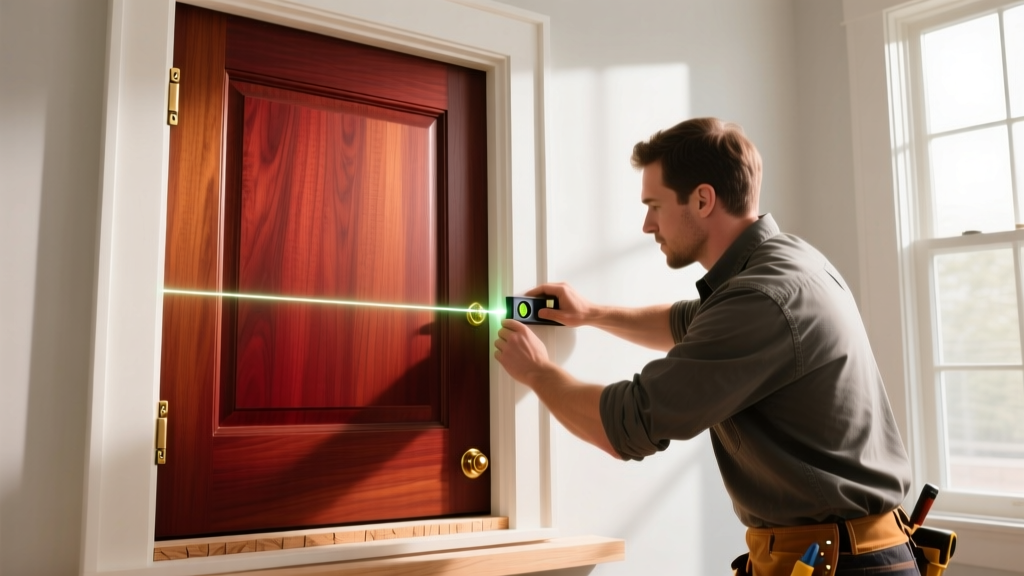
- Verify Rough Opening: Ensure the rough opening is plumb, level, and square. The jamb should be 1/2" to 3/4" wider and taller than the actual door slab.
- Set the Jamb: Install the door frame using composite shims (never wood shims, which compress and rot). Place shims at every hinge location and at the strike plate location to prevent the jamb from bowing inward when the door latches.
- Establish Clearances: Maintain a strict 1/8" (3.2mm) gap at the top and both side jambs. For the bottom, leave 3/8" to 1/2" for interior doors over hard flooring, or up to 3/4" for exterior doors requiring a weather sweep.
- Hang the Slab: Start with the top hinge. Insert the 3-inch structural screw first to pull the jamb tight to the framing. Verify the 1/8" reveal on the hinge side before securing the middle and bottom hinges.
- Adjust the Strike: Close the door and mark the strike plate location. The gap on the lock side must remain a uniform 1/8" from top to bottom. If the gap tapers, adjust the shims behind the hinges, not the strike plate.
Troubleshooting Wood-Specific Installation Failures
Different types of door wood present unique chemical and structural challenges during and after installation. Recognizing these edge cases separates master carpenters from general handymen.
White Oak, Western Red Cedar, and Teak contain high levels of tannic acid. If you use standard zinc-plated or galvanized steel screws, hinges, or nails, any introduction of moisture will trigger a chemical reaction. This creates iron tannate, resulting in permanent, deep black stains radiating from the fastener holes. Solution: You must exclusively use 304 or 316 stainless steel, or silicon bronze fasteners and hardware when installing these specific wood species.
Managing Softwood Denting and Compression
Pine and Douglas Fir are highly susceptible to compression damage. If a installer uses a steel hammer directly on the jamb or over-tightens the hinge screws, the wood fibers will crush, leaving permanent depressions. Always use a wooden mallet or a scrap block of MDF when tapping the jamb into place. When tightening hinge screws on softwoods, use a hand screwdriver for the final three turns rather than an impact driver to prevent stripping the pilot holes and crushing the wood around the hinge leaf.
Addressing Mahogany and Teak Oils
Tropical hardwoods like Mahogany and Teak naturally exude oils and resins, especially when exposed to direct sunlight or interior heat sources. If you attempt to paint or apply a water-based polyurethane over these woods without proper preparation, the finish will peel or fail to cure. Before applying any topcoat, wipe the bare wood down with lacquer thinner or naphtha to remove surface oils, then apply a shellac-based primer (such as Zinsser B-I-N) to lock in the resins before painting.
Final Inspection and Hardware Integration
Once the door is hung, the installation is only as strong as the hardware integration. For solid wood doors, mortised locksets are mandatory. Bored cylindrical locksets remove too much cross-sectional wood from the stile, creating a weak point that can split under the torque of a heavy door closing.
According to the Architectural Woodwork Institute (AWI), premium architectural wood doors require a minimum stile width of 4 inches to properly accommodate a standard mortise lock body without compromising the structural integrity of the stile. Always drill the knob bore and latch bore from both sides of the door, meeting in the middle, to prevent the exit-side wood from blowing out and splintering. By aligning your installation techniques with the specific biological properties of the door wood, you ensure a plumb, stable, and historically durable entryway.
Written by
David NakamuraDavid Nakamura is a licensed architect (AIA) and construction technology writer focused on sustainable building methods, mass timber engineering, and high-performance building envelopes. He holds a Master of Architecture from the University of Washington and is a certified Passive House Consultant (CPHC). David spent eight years at the Seattle firm Mithun, where he led the design of three LEED Platinum projects, before founding his own practice specializing in net-zero residential design. He serves on the editorial advisory board of GreenBuilder Magazine and has authored peer-reviewed papers on cross-laminated timber (CLT) connections for the Journal of Structural Engineering. In his spare time, David teaches woodworking at Pratt Fine Arts Center and kayaks the Puget Sound.
More from David Nakamura
View all
Construction Cost
Labor Cost to Build a Deck Per Sq Ft: 2026 Installation Guide
Discover the exact labor cost to build a deck per sq ft in 2026. This installation guide breaks down contractor rates, complexity factors, and hidden fees.
Aug 4, 2026

Construction Cost
How Much Does It Cost to Build a 3 Bedroom House? Financing Guide
Learn exactly how much it costs to build a 3 bedroom house and explore 2026 financing options, construction loan types, and budget frameworks for your build.
Aug 4, 2026

Construction Cost
Cost to Build a Tennis Court: 2026 Guide
How much does it cost to build a tennis court in 2026? Breakdowns for asphalt, concrete, and synthetic surfaces plus fencing and lighting.
Jul 30, 2026