Hardwood Floor Cleaning Specs: pH, Moisture, and Finish Limits
Technical specifications for hardwood floor cleaning, including pH limits, moisture thresholds, and equipment ratings for polyurethane and oil finishes.
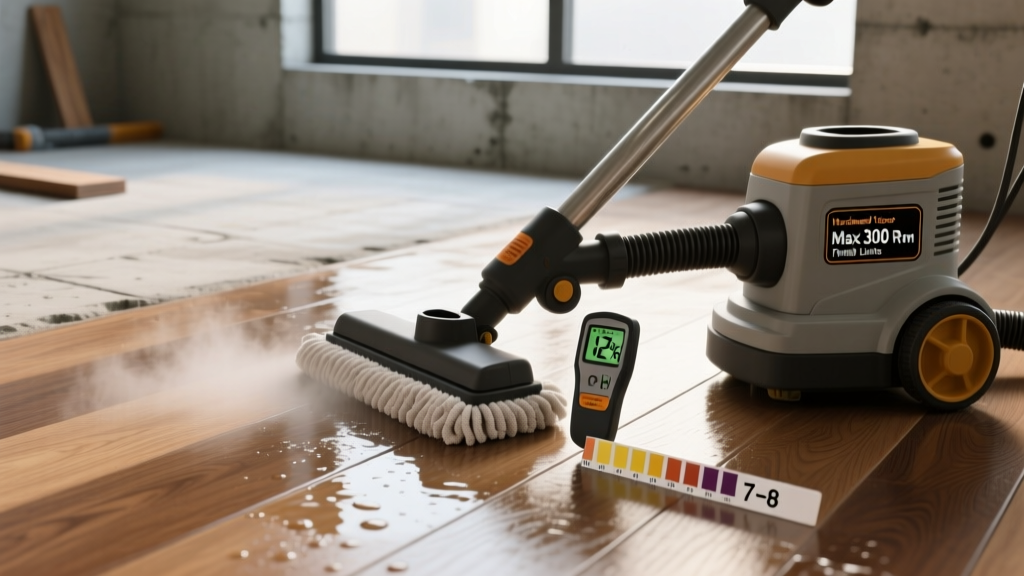
The Chemistry of Surface Interaction
Hardwood floor cleaning is not merely a janitorial task; it is a controlled chemical and mechanical interaction with the floor's wear layer. Specifying the wrong cleaning parameters can lead to catastrophic finish failure, cellular wood swelling, and irreversible surface hazing. Professional facility managers and flooring contractors must adhere to strict performance ratings regarding pH, surfactant chemistry, moisture dwell time, and mechanical abrasion to preserve the integrity of both site-finished and factory-prefinished wood systems.
pH Thresholds and Surfactant Behavior
The pH scale dictates the chemical stability of the floor finish. Most commercial hardwood floor cleaners are formulated to be neutral or slightly alkaline, but the acceptable range shifts dramatically based on the specific finish chemistry.
- Waterborne Polyurethane (e.g., Bona Traffic HD, Basic Coatings StreetShoe): Require a pH between 7.0 and 8.5. Cleaners with a pH above 9.0 will initiate saponification, breaking down the urethane cross-links and causing permanent dulling.
- Penetrating Hardwax Oils (e.g., Rubio Monocoat 2C, Osmo Polyx-Oil): Require a strict pH of 7.0 to 7.5. These finishes rely on capillary action within the wood pores. Anionic surfactants found in high-pH alkaline cleaners leave a microscopic soap scum residue that clogs these pores, preventing future maintenance coats from bonding.
- Aluminum Oxide (Factory Prefinished): Tolerate a wider pH range (6.5 to 9.0) due to the extreme chemical resistance of the ceramic bead coating, but acidic cleaners (pH < 6.0) will degrade the acrylic grout lines between beveled edges.
Moisture Dynamics and Dwell Time Specifications
Wood is hygroscopic. The hemicellulose and amorphous cellulose within the wood cell walls readily absorb free water. When specifying cleaning protocols for autoscrubbers or manual damp-mopping, the primary metric to control is surface dwell time and residual moisture volume.
Cellular Absorption Limits
According to the USDA Forest Products Laboratory Wood Handbook, wood begins to exhibit dimensional swelling when its Moisture Content (MC) exceeds the fiber saturation point, but surface checking and micro-cupping can occur with localized MC spikes of just 2% to 3% above the ambient equilibrium. Therefore, cleaning specifications must ensure that surface moisture does not penetrate the finish micro-fissures.
| Equipment Type | Max Residual Moisture | Max Dwell Time | Required Vacuum/Suction Spec |
|---|---|---|---|
| Manual Damp Mop (Flatbed) | < 1.5 oz / sq ft | < 120 seconds | N/A (Relies on evaporation) |
| Commercial Autoscrubber | < 0.5 oz / sq ft | < 15 seconds | Min. 150 CFM vacuum motor |
| Spray-and-Mop System | < 2.0 oz / sq ft | < 60 seconds | N/A (Requires immediate dry-pass) |
For commercial autoscrubbers operating on hardwood, the squeegee assembly must be calibrated to leave the floor visually dry within 3 seconds of the vacuum head passing. Any visible water trail indicates insufficient vacuum lift or worn squeegee blades, which will inevitably lead to edge-cupping over a 6-month cycle.
Mechanical Performance: Pad and Microfiber Ratings
The mechanical action of the cleaning medium must remove particulate soil without micro-scratching the wear layer. The National Wood Flooring Association (NWFA) strictly advises against the use of traditional string mops, which push abrasive grit across the floor and hold excessive water. Instead, specifications must dictate precise microfiber metrics and pad color codes.
Microfiber GSM and Blend Specifications
Not all microfiber is engineered for hardwood. The performance rating of a microfiber pad is determined by its weight (Grams per Square Meter, or GSM) and its fiber split ratio.
- Dry Dusting (300 - 400 GSM): Requires a minimum 80/20 polyester/polyamide blend. The electrostatic charge generated by the polyester captures silica dust (which has a Mohs hardness of 7, harder than most aluminum oxide finishes) without scratching.
- Damp Mopping (500 - 600 GSM): Requires a higher polyamide content for superior capillary water retention. A 500+ GSM pad holds the cleaning solution within the fiber core, preventing free water from pooling on the floor surface while the pad glides.
Abrasive Pad Color Codes for Scrubbing
When mechanical agitation is required for localized stain removal, operators must adhere to the standardized floor pad color code. Using the wrong pad will instantly void the manufacturer's warranty.
- White Pad (Non-Abrasive): Safe for all polyurethane and hardwax oil finishes. Used for light scuff mark removal.
- Blue Pad (Light Scrub): Use with extreme caution. Only approved for high-build commercial waterborne urethanes. Will permanently dull hardwax oils and satin/matte factory finishes.
- Black/Brown/Green Pads: STRICTLY PROHIBITED. These contain aggressive synthetic abrasives designed for VCT stripping and will strip the finish down to bare wood.
Finish-Specific Cleaning Matrices
To ensure compliance and prevent cross-contamination of maintenance protocols, facility managers should implement the following specification matrix based on the installed finish type. Data regarding chemical compatibility is supported by technical data sheets from leading manufacturers like Bona Professional Systems and independent testing labs.
| Finish Type | Target pH | Water Quality Req. | Approved Mechanical Pad | Prohibited Chemicals |
|---|---|---|---|---|
| Site-Applied Waterborne Poly | 7.0 - 8.5 | Tap or Softened | 500 GSM Microfiber, White Pad | Ammonia, Bleach, Oil Soaps |
| Hardwax Oil (Penetrating) | 7.0 - 7.5 | Distilled or Deionized | 500 GSM Microfiber Only | Anionic surfactants, Waxes |
| UV-Cured Aluminum Oxide | 6.5 - 9.0 | Tap (if < 7 GPG) | 400 GSM Microfiber, White Pad | Acrylic polishes, Steam |
"The most common cause of premature finish degradation in commercial hardwood installations is not foot traffic, but the cumulative effect of high-alkaline cleaning residues and hard water mineral deposits acting as an abrasive slurry underfoot."
— Commercial Flooring Systems Engineering Report
Diagnostic Troubleshooting for Cleaning-Induced Failures
When a hardwood floor exhibits visual defects, it is critical to determine if the failure is intrinsic to the wood or induced by improper cleaning specifications. Use the following diagnostic matrix to identify and correct cleaning-related anomalies.
Symptom-to-Spec Resolution
- Symptom: Cloudy, white hazing in high-traffic corridors.
Cause: Hard water mineral deposits (calcium carbonate) left behind by high-evaporation spray mopping, or high-pH cleaner residue.
Spec Fix: Switch to a pH-neutral cleaner formulated with chelating agents. Use distilled water in autoscrubber tanks. Perform a one-time neutralization pass using 2 oz of white vinegar per gallon of distilled water, followed by a pure water rinse. - Symptom: Finish feels tacky or attracts dirt immediately after cleaning.
Cause: Use of traditional "oil soaps" or acrylic-based polish cleaners on a polyurethane surface. These products do not penetrate urethane; they sit on top and remain semi-liquid.
Spec Fix: Cease use of oil soaps immediately. Degrease the floor using a specialized polyurethane remover or isopropyl alcohol solution (mixed at 1:4 ratio with water) applied via 500 GSM microfiber. - Symptom: Micro-cupping at the board edges (boards raised on the sides, lower in the middle).
Cause: Excessive moisture dwell time from string mopping or leaking autoscrubber squeegees, causing the bottom of the board to remain dry while the top edge expands.
Spec Fix: Recalibrate autoscrubber vacuum motors to >150 CFM. Mandate flatbed microfiber mopping with a strict <120-second dwell time limit. Monitor ambient RH to ensure it remains between 35% and 55%. - Symptom: Patchy, uneven sheen (glossy spots on a matte floor).
Cause: Incomplete removal of spray cleaner before it dries, resulting in localized surfactant buildup that alters the light refraction of the matte flattening agents (silica) in the finish.
Spec Fix: Implement a two-step mopping protocol: Step 1 applies the cleaning solution; Step 2 follows immediately with a dry, 400 GSM microfiber pad to physically remove the suspended soil and liquid before evaporation occurs.
By treating hardwood floor cleaning as a precise materials science protocol rather than a general custodial chore, facility managers can extend the lifecycle of commercial wood floors by 5 to 10 years, delaying the need for expensive, disruptive mechanical sanding and refinishing.