Types of Wood Color: Evaluating Lumber Grade and Quality
Discover how types of wood color impact lumber grading. Learn NHLA sapwood allowances, extractive science, and procurement specs for hardwood buyers.

The Science Behind Wood Coloration and Grading
When evaluating the types of wood color in a lumber yard, buyers must look beyond basic aesthetics. Wood color is a fundamental grading metric that dictates structural integrity, workability, and price per board foot. The visual variations in hardwood and softwood lumber are driven by biological functions and chemical extractives, which directly influence how grading agencies classify the material.
At a cellular level, wood color is divided into two distinct zones: the heartwood and the sapwood. According to the USDA Forest Products Laboratory Wood Handbook, sapwood is the living, outer portion of the tree responsible for transporting water and nutrients. It is typically pale, porous, and lacks the chemical extractives that provide natural rot resistance. Heartwood, the inner core, is biologically dead and filled with extractives—tannins, resins, oils, and quinones—that give species like Black Walnut and Eastern Red Cedar their rich, dark hues.
How Types of Wood Color Dictate Lumber Grades
The National Hardwood Lumber Association (NHLA) establishes the grading rules for North American hardwoods. While structural defects like knots and wane are primary grading factors, color specifications act as strict secondary modifiers. In standard grading, color itself is not a defect unless a specific 'color grade' is invoked by the buyer or the species' inherent grading rules.
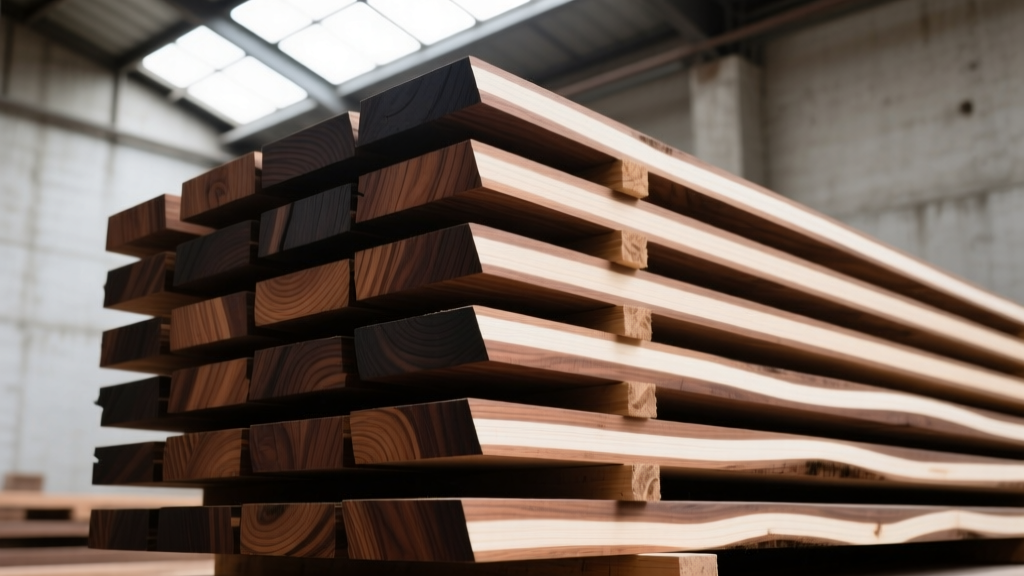
For species where the heartwood is the prized commodity (e.g., Walnut, Cherry), the presence of white sapwood is penalized. Conversely, for species where the sapwood is preferred (e.g., Hard Maple, Ash), the darker heartwood is treated as a visual defect. Understanding these inversely related color preferences is critical for accurate procurement and yield calculation.
| Species | Heartwood Color | Sapwood Color | NHLA Color Grade Allowances (FAS) | Typically Steamed? |
|---|---|---|---|---|
| Black Walnut | Dark Chocolate Brown | Pale Yellow/White | 10% sapwood on poor face; 30% on good face | Yes |
| Hard Maple | Reddish-Brown | Creamy White | White Maple grade requires 100% sapwood on one face | No (Ruins white color) |
| American Cherry | Pinkish-Tan to Red-Brown | Pale Pink/White | No strict NHLA color limits, but market demands blended | Sometimes |
| White Oak | Light to Medium Brown | White/Light Tan | Sapwood is generally accepted; no strict color deductions | No |
Sapwood Limitations by Species and Grade
The most common point of friction between lumber buyers and suppliers involves sapwood allowances. Because the types of wood color vary so wildly by species, the NHLA has written species-specific exceptions into their standard grading rulebook. Misunderstanding these exceptions leads to massive yield losses in the milling room.
Calculating Sapwood Deductions in FAS Walnut
Black Walnut is the premier example of color-based grading. The market demands dark brown heartwood. However, a living walnut tree produces a thick band of white sapwood. To prevent excessive waste, the NHLA allows specific sapwood tolerances for Walnut graded as FAS (Firsts and Seconds).
Under standard NHLA rules, an FAS Walnut board permits up to 10% sapwood on the poor face, and up to 30% on the good face. Let us apply this to a real-world yield calculation:
- Board Dimensions: 12 feet long (144 inches) by 6 inches wide.
- Total Surface Area: 864 square inches.
- 10% Allowance (Poor Face): 86.4 square inches of sapwood permitted.
If the white sapwood runs the entire 6-inch width of the board, it can extend exactly 14.4 inches down the length of the board (86.4 / 6 = 14.4) before the board is downgraded from FAS to Select or #1 Common. If your cut-list requires 10-foot clear rip cuts, a board with a 15-inch sapwood tail is useless to you, despite technically meeting the FAS color grade. This is why specifying 'heartwood only' or '90/90' (90% heartwood on both faces) is a necessary procurement step for high-end cabinetry.
Environmental Factors: Oxidation, UV, and Kiln Drying
The types of wood color you see in a rough-sawn stack will not match the final finished product. Wood is a reactive, photosensitive material. According to research detailed by The Wood Database, the extractives in heartwood are highly susceptible to photo-oxidation when exposed to ultraviolet light.
"American Black Cherry is notorious for its color shift. Freshly milled cherry is a pale, almost yellowish-pink. Within six months of UV exposure, it oxidizes into a deep, rich reddish-brown. Applying a UV-inhibitive clear coat immediately after milling will permanently lock in the pale color, resulting in a severe aesthetic mismatch if replacement boards are required later."
Kiln drying also fundamentally alters wood color. Steaming is a process where lumber is placed in a high-humidity environment at temperatures between 180°F and 212°F before the actual drying cycle begins. This process forces the water-soluble dark extractives from the Walnut or Cherry heartwood to bleed into the pale sapwood, creating a uniform, blended color. While steaming maximizes yield by eliminating the stark white sapwood contrast, it slightly mutes the overall vibrancy of the heartwood. Buyers must explicitly choose between 'steamed and blended' or 'unsteamed / natural contrast' based on their design requirements.
Procurement Framework: Specifying Color in Purchase Orders
Relying on generic grade names like 'FAS' or '#1 Common' is insufficient when color is a critical design element. Lumber buyers and architects must use precise terminology in their purchase orders to ensure the delivered types of wood color match the project specifications. Use the following checklist to eliminate color-related yield surprises:
- Define the Face: Specify if color requirements apply to one face (1F) or both faces (2F). Standard grading only guarantees the 'poor face' meets the minimum clear-cutting requirements.
- Specify Steaming Status: For Walnut and Cherry, explicitly write 'Steamed and Blended' or 'Unsteamed / Natural'. Do not leave this to the supplier's discretion.
- Invoke Custom Color Grades: For Hard Maple, do not just order 'FAS'. Order 'FAS White Maple' or specify '90% white sapwood on the good face' to ensure you receive the creamy white material required for modern millwork.
- Account for Oxidation: For exotic species like Purpleheart or Padauk, which transition from vibrant purple/red to muddy brown under UV light, specify that the supplier must provide wood treated with a UV-inhibitor if the material is being stored outdoors or in a glass-walled staging area prior to installation.
- Request Physical Samples: Color charts are notoriously inaccurate due to monitor calibration and print variances. Always require a physical, sanded, and clear-coated sample board signed off by the architect before the full bundle is shipped.
By treating wood color as a quantifiable grading metric rather than a subjective visual trait, procurement teams can drastically reduce material waste, prevent jobsite delays, and ensure the final architectural millwork matches the original design intent.
Written by
David NakamuraDavid Nakamura is a licensed architect (AIA) and construction technology writer focused on sustainable building methods, mass timber engineering, and high-performance building envelopes. He holds a Master of Architecture from the University of Washington and is a certified Passive House Consultant (CPHC). David spent eight years at the Seattle firm Mithun, where he led the design of three LEED Platinum projects, before founding his own practice specializing in net-zero residential design. He serves on the editorial advisory board of GreenBuilder Magazine and has authored peer-reviewed papers on cross-laminated timber (CLT) connections for the Journal of Structural Engineering. In his spare time, David teaches woodworking at Pratt Fine Arts Center and kayaks the Puget Sound.
More from David Nakamura
View all
Construction Cost
Labor Cost to Build a Deck Per Sq Ft: 2026 Installation Guide
Discover the exact labor cost to build a deck per sq ft in 2026. This installation guide breaks down contractor rates, complexity factors, and hidden fees.
Aug 4, 2026

Construction Cost
How Much Does It Cost to Build a 3 Bedroom House? Financing Guide
Learn exactly how much it costs to build a 3 bedroom house and explore 2026 financing options, construction loan types, and budget frameworks for your build.
Aug 4, 2026

Construction Cost
Cost to Build a Tennis Court: 2026 Guide
How much does it cost to build a tennis court in 2026? Breakdowns for asphalt, concrete, and synthetic surfaces plus fencing and lighting.
Jul 30, 2026