Green Lumber Deep Dive: Roseburg Douglas Fir vs Canfor SYP Specs
Compare Roseburg Douglas Fir and Canfor SYP green lumber product lines. Explore moisture specs, grading stamps, shrinkage, and structural framing uses.
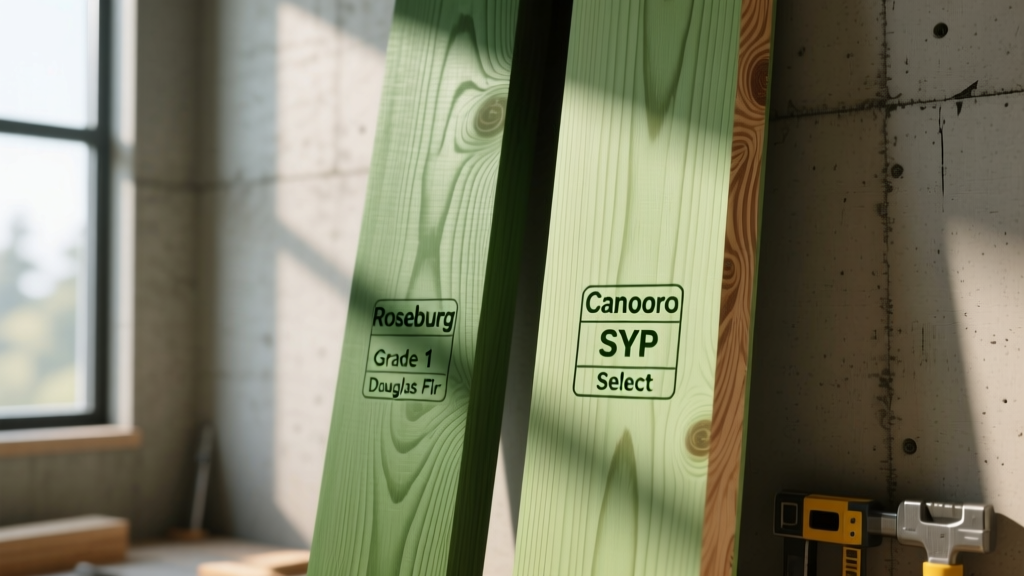
The Mechanics of Green Lumber: Moisture, Grading, and Stamps
In structural timber, heavy industrial construction, and timber framing, specifying unseasoned wood requires a precise understanding of moisture dynamics and species-specific shrinkage. Green lumber is defined by the American Wood Council as wood with a moisture content (MC) exceeding 19%. At the mill, it is stamped S-GRN (Surface Green) or marked with MC > 19%. While kiln-dried (KD) lumber dominates light-frame residential construction, green lumber remains a critical, cost-effective material for heavy timber structures, agricultural buildings, marine pilings, and industrial crane mats.
Because green lumber bypasses the energy-intensive kiln drying process, it is typically priced 15% to 25% lower per MBF (Thousand Board Feet) than its KD equivalents. However, this upfront savings is offset by higher freight costs—water weight can increase shipping mass by 20% to 30%—and the mandatory engineering allowances for post-installation shrinkage. According to the USDA Forest Products Laboratory Wood Handbook, wood only begins to shrink once it drops below the fiber saturation point (typically around 30% MC). Therefore, a timber installed at 45% MC will not experience dimensional changes until it dries below this threshold.
Brand Deep Dive: Roseburg Forest Products (Douglas Fir)
Roseburg Forest Products is a premier supplier of West Coast softwoods, and their Industrial Douglas Fir and Heavy Timber product lines are industry standards for green lumber in the Pacific Northwest and beyond. Douglas Fir (DF) is prized for its high strength-to-weight ratio and superior dimensional stability compared to many other softwoods.
Product Line Specifics and Grading Protocols
Roseburg’s green DF timbers are typically available in rough-sawn and S4S (Surfaced Four Sides) profiles, ranging from 6x6 up to 12x12 cross-sections, with lengths up to 40 feet for specialized heavy timber orders. Grading is governed by the West Coast Lumber Inspection Bureau (WCLIB) and the Western Wood Products Association (WWPA). When ordering Roseburg green timbers, structural engineers must specify the grade based on the intended load:
- Select Structural: Highest stiffness and bending strength. Reserved for primary load-bearing beams and trusses where deflection limits are strict.
- No. 1: Excellent for general heavy framing, timber roof purlins, and post-and-beam columns. Allows minimal wane and tight, sound knots.
- No. 2: The workhorse grade for agricultural buildings, temporary shoring, and non-critical structural blocking.
Douglas Fir shrinks approximately 4.8% radially and 7.6% tangentially from green to oven-dry. In practical field terms, a 12x12 green DF timber installed at 40% MC and allowed to dry to an interior equilibrium of 12% MC will shrink to roughly 11.25 x 11.25 inches. Timber framers must oversize mortise and tenon joints by 1/16' to 1/8' and use slotted holes for steel tension ties to accommodate this inevitable movement.
Brand Deep Dive: Canfor Southern Yellow Pine (SYP)
Canfor’s Southern Yellow Pine product lines dominate the industrial, pallet, and marine sectors in the Southern United States. SYP is fundamentally different from Douglas Fir; it is denser, heavier, and possesses a higher specific gravity (averaging 0.55 at 12% MC), making it exceptionally resistant to wear and impact. Canfor’s Industrial SYP and Marine & Treating Stock lines are frequently shipped green for specific downstream applications.
Industrial and Marine Applications
For pallet manufacturers and industrial blocking, Canfor’s green SYP provides the necessary sheer strength to withstand forklift impacts and heavy static loads. Because pallets are often used in humid environments or outdoors, the high initial moisture content of green SYP is less of a structural liability and more of a functional baseline.
In marine applications, Canfor’s green SYP is the preferred stock for pressure-treated pilings and retaining walls. The cellular structure of green SYP, combined with its high permeability, allows for deep penetration of preservatives like Creosote or Chromated Copper Arsenate (CCA). However, because the wood is unseasoned, mills must employ mechanical incising—piercing the wood surface with thousands of tiny needles—to ensure the preservative reaches the core before the wood is driven into saltwater environments.
Head-to-Head Specification Matrix
When deciding between West Coast Douglas Fir and Southern Yellow Pine for a green lumber application, structural engineers and procurement managers must weigh density, shrinkage, and end-use requirements. The following matrix compares the baseline specifications for Roseburg DF and Canfor SYP green product lines.
| Feature | Roseburg Douglas Fir (Green) | Canfor Southern Yellow Pine (Green) |
|---|---|---|
| Primary Species | Coastal / Inland Douglas Fir | Loblolly / Longleaf / Slash Pine |
| Moisture Content at Mill | 35% - 50% | 40% - 60% |
| Typical Dimensions | 6x6 to 12x12 (Timbers) | 2x4 to 8x8 (Pallets, Blocking, Pilings) |
| Tangential Shrinkage | 7.6% (Green to Oven-Dry) | 7.8% (Green to Oven-Dry) |
| Density (Green Weight) | ~55 lbs/ft³ | ~62 lbs/ft³ |
| Primary Applications | Timber Framing, Heavy Roof Purlins, Bridges | Pallets, Crane Mats, Marine Pilings, Shoring |
Critical Installation Protocols for Unseasoned Timber
Designing with green lumber requires strict adherence to the National Design Specification (NDS) for Wood Construction. The NDS mandates that structural calculations for S-GRN lumber must be based on the net dressed dimensions (the size the wood will shrink to), not the green rough-sawn dimensions. Beyond structural math, the physical installation of green lumber introduces severe corrosion and connection challenges.
Never use standard G90 galvanized hardware, zinc-plated screws, or aluminum connectors with green lumber. The high moisture content acts as an electrolyte, and the natural wood acids (particularly in Douglas Fir and Oak) accelerate galvanic corrosion. You must specify ASTM A153 Class D hot-dipped galvanized (HDG) hardware or Type 316 Stainless Steel for all structural connections. For engineered connectors, utilize heavy-duty coatings like Simpson Strong-Tie ZMAX (G185) or equivalent.
Fastening and Joint Detailing
Because green lumber shrinks primarily across the grain (radially and tangentially) and very little longitudinally, vertical columns will maintain their height while horizontal girders and plates will shrink in depth. If a steel rod or bolt is pinned tightly through a green beam and a steel column, the shrinkage of the beam will create a massive void, leading to a loose connection and potential structural sag.
To mitigate this, engineers must specify:
- Slotted Holes: Use vertically slotted holes in steel side plates to allow the timber to shrink downward without binding the bolt.
- Shear Plates and Split Rings: These connectors embed into the wood and maintain their grip even as the timber checks and shrinks, unlike standard smooth-shank bolts which can loosen.
- Lag Screws with Oversized Washers: When using lag screws in green DF timbers, utilize oversized malleable iron washers to prevent the head from pulling through as the wood surface compresses and dries.
Sourcing and Pricing Realities
Procuring green lumber requires direct coordination with mill production schedules. Unlike KD lumber, which is often kept in climate-controlled inventory by wholesale distributors, green lumber is frequently cut-to-order or stored in open-air log yards and rough lumber stacks. In the 2026 market, supply chain optimizations have stabilized lead times, but buyers should expect a 3- to 5-week lead time for specialized heavy timber dimensions (e.g., 10x10 or 12x12) from Roseburg or Canfor regional mills. Always verify the mill’s grading agency stamp upon delivery; if the S-GRN stamp is obscured by handling or weathering, request a re-inspection certificate from the supplier before authorizing the material for a permitted structural build.