Types of Wood Fungus: A Comparison Guide for Structural Decay
Compare the main types of wood fungus affecting structural timber. Learn to identify brown, white, and soft rot, and apply targeted treatments.

The Biological Threat to Structural Timber
Wood-destroying fungi represent one of the most insidious threats to structural timber in both residential and commercial construction. Unlike termites or carpenter ants, which consume wood for caloric energy or excavate it for shelter, fungi digest the structural polymers of the wood cell wall. This enzymatic and chemical degradation compromises the load-bearing capacity of framing members, floor joists, and sheathing long before catastrophic failure occurs. Understanding the specific types of wood fungus is critical for building inspectors, contractors, and property owners to diagnose the exact pathology of decay and prescribe the correct chemical or structural remediation.
Fungal growth requires four simultaneous conditions: a suitable temperature (typically 50°F to 90°F), oxygen, a food source (wood cellulose, hemicellulose, or lignin), and a wood moisture content (MC) consistently exceeding 20%. Eliminating any single variable halts the decay process, but identifying the specific fungal species dictates the urgency and method of intervention.
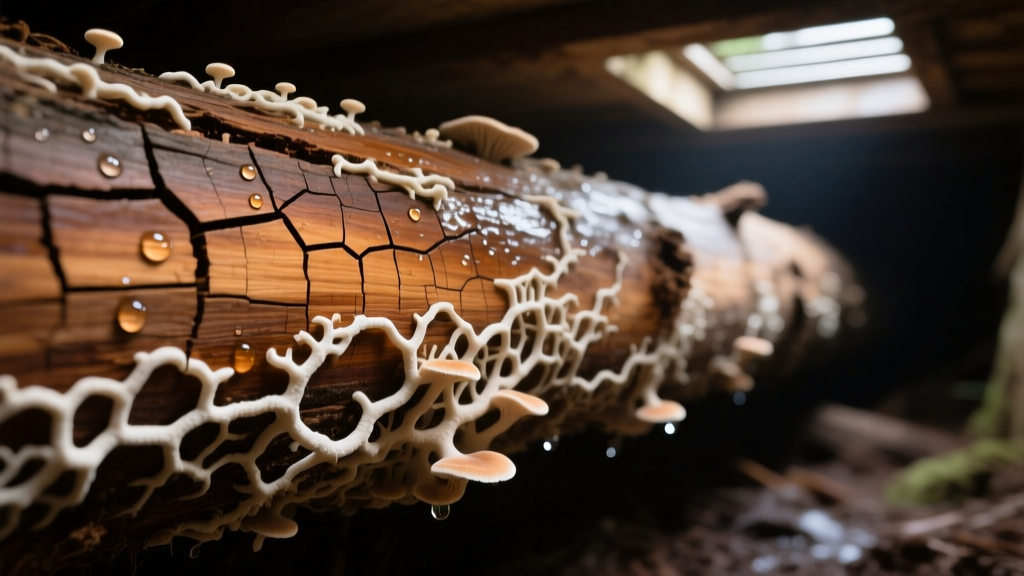
Classification Matrix: The Three Primary Decay Fungi
Wood decay fungi are broadly categorized by the specific cell wall polymers they target and the visual morphology of the damaged timber. The table below contrasts the three primary classifications encountered in structural diagnostics.
| Fungus Type | Target Polymers | Visual Symptoms | Moisture Threshold | Common Species | Structural Impact |
|---|---|---|---|---|---|
| Brown Rot | Cellulose, Hemicellulose | Cubical checking, dark brown color, crumbles to powder | > 20% MC | Gloeophyllum trabeum, Postia placenta | Rapid loss of tensile and bending strength |
| White Rot | Lignin, Cellulose, Hemicellulose | Bleached/white appearance, spongy or stringy texture | > 20% MC | Trametes versicolor, Phanerochaete chrysosporium | Gradual loss of stiffness and compressive strength |
| Soft Rot | Cellulose (S2 layer) | Surface softening, dark discoloration, no distinct cubing | > 30% MC (often saturated) | Chaetomium globosum, Alternaria alternata | Slow surface degradation, critical in ground contact |
Deep Dive: Pathology and Identification
Brown Rot (Cubical Rot)
Brown rot is the most destructive fungus affecting softwood framing (such as Douglas fir, Spruce-Pine-Fir, and Southern Yellow Pine). Rather than relying solely on large enzymes that cannot penetrate the dense wood cell wall, brown rot fungi utilize a non-enzymatic Fenton chemistry reaction. They secrete low-molecular-weight metabolites that react with iron and hydrogen peroxide naturally present in the wood to generate hydroxyl radicals. These radicals rapidly depolymerize cellulose chains.
Diagnostic Indicator: The hallmark of brown rot is 'cubical checking.' As the cellulose is destroyed, the wood shrinks perpendicular to the grain, breaking into distinct, brick-like cubes. According to the USDA Forest Products Laboratory, brown rot can reduce the bending strength of timber by up to 75% before any visible weight loss or surface decay is apparent. If a structural member exhibits severe cubical cracking, it has already lost its engineering design values and must be replaced or sistered.
White Rot (Fibrous Rot)
White rot fungi are more commonly found in hardwoods but will attack softwoods in prolonged high-moisture environments. Unlike brown rot, white rot species produce powerful oxidative enzymes—including lignin peroxidase and manganese peroxidase—capable of breaking down lignin, the rigid polymer that binds wood fibers together.
Diagnostic Indicator: Infected wood takes on a bleached, whitish-yellow appearance and feels spongy, stringy, or punky to the touch. Because white rot degrades all cell wall components simultaneously, the wood retains its original volume but loses significant stiffness. While the strength loss is more gradual than brown rot, heavily infected members will fail under compressive loads.
Soft Rot
Soft rot fungi thrive in environments with extreme moisture and low oxygen, such as wooden foundations, cooling towers, marine pilings, and ground-contact landscape timbers. They form microscopic 'cavity hyphae' that bore directly into the secondary cell wall (S2 layer) of the wood, leaving the middle lamella intact.
Diagnostic Indicator: Soft rot does not cause the dramatic cubical checking of brown rot. Instead, the wood surface becomes soft, spongy, and darkens, often mimicking water damage. It is highly resistant to standard surface-applied preservatives, requiring deep-pressure treatment (like Creosote or Pentachlorophenol) for prevention in high-risk applications.
The 'Dry Rot' Misnomer: Serpula lacrymans
The term 'dry rot' is a dangerous misnomer in the construction industry. Serpula lacrymans (true dry rot) requires the exact same initial moisture content (over 20%) to initiate germination as any other wood fungus. However, once established, it develops thick, water-conducting strands called rhizomorphs. These mycelial cords can transport water from a distant leak across masonry, concrete, or dry framing to sustain the fungal colony. If you identify S. lacrymans—characterized by a pancake-like fruiting body with rust-red spores and thick white mycelial mats—simply fixing the local leak is insufficient. You must trace the rhizomorphs to the primary moisture source and treat all adjacent masonry with a fungicidal biocide.
Diagnostic Decision Tree: Field Identification Protocol
When evaluating a suspect timber in a crawlspace, attic, or wall cavity, follow this sequential diagnostic protocol to confirm active fungal decay:
- Moisture Verification: Use a pin-type moisture meter (e.g., Delmhorst J-2000 or Wagner Orion 910) with deep-penetration probes. Insert the pins into the wood. If the MC reads below 15%, the fungus is dormant or dead. If it reads above 20%, active decay is highly probable.
- The Ice Pick Test: Following AWPA (American Wood Protection Association) field standards, jab a sharp ice pick or awl into the timber at a 45-degree angle and attempt to pry up a splinter. Sound wood will yield long, fibrous splinters that snap cleanly. Decayed wood will break off in short, brittle chunks (brown rot) or pull out as a soft, mushy plug (white/soft rot).
- Fruiting Body Inspection: Look for sporophores (mushrooms, brackets, or crusts) on the surface or in adjacent soil. Spore prints can be taken on glass slides for laboratory identification if the species is ambiguous, though structural remediation remains the same regardless of the exact taxonomy.
Remediation and Chemical Treatment Protocols
Once the moisture source is eliminated (e.g., repairing failed flashing, replacing leaking supply lines, or installing a 6-mil polyethylene vapor barrier in a crawlspace), the remaining sound wood must be protected against residual spores and future moisture events.
Borate Treatments (Disodium Octaborate Tetrahydrate - DOT)
DOT is the industry standard for remedial fungal treatment in enclosed structural cavities. It is odorless, low-toxicity to mammals, and highly lethal to fungi and wood-destroying insects. Products like Bora-Care (which includes a glycol carrier for deep penetration into dry wood) or Tim-bor (water-soluble powder) are applied via low-pressure spray to all exposed framing.
- Application Rate: 1 gallon of mixed solution per 200-250 square feet of raw, unfinished wood surface.
- Cost Estimate: Professional application ranges from $1.50 to $3.00 per square foot; DIY material costs average $90 to $120 per gallon of concentrate.
- Limitation: Borates are water-soluble. They will leach out of the wood if exposed to continuous liquid water or weathering. They are strictly for protected, interior, or covered applications.
Epoxy Consolidation vs. Sistering
If decay is localized to a small area (e.g., the end of a floor joist resting on a damp sill plate), you have two structural repair options:
- Sistering: Excise the decayed section (cutting at least 24 inches past the visible margin of rot) and bolt a new dimensional lumber or LVL (Laminated Veneer Lumber) sister joist alongside the existing member. Cost: $15 to $25 per linear foot.
- Epoxy Consolidation: For historical timbers or architecturally exposed beams where replacement is impossible, excavate the soft rot, dry the cavity with heat lamps, and saturate the area with a liquid epoxy consolidant (e.g., Abatron LiquidWood), followed by a structural epoxy filler (e.g., Abatron WoodEpox). Cost: ~$150 per 1.5-quart kit. This restores compressive strength but does not return the beam to its original tensile capacity.
Preventative Design and Moisture Control
Chemical treatments are secondary defenses; primary prevention relies on building science and moisture management. The Penn State University Extension emphasizes that architectural detailing is the most effective fungicide. Adhere strictly to the International Residential Code (IRC) Section R317.1, which mandates an 18-inch clearance between untreated wood framing and the exposed ground in crawlspaces, and a 12-inch clearance for wood girders.
Furthermore, ensure all exterior wood trim, siding, and structural posts incorporate capillary breaks. Use composite or pressure-treated (AWPA UC4A or higher) material for the bottom 12 inches of any wall assembly. Install drip edges on all horizontal surfaces, and maintain gutter systems to prevent splashback, which routinely raises the moisture content of lower sill plates above the critical 20% threshold required for fungal germination. By controlling the hygrothermal environment, the biological threat of wood fungus is entirely neutralized.
Written by
Marcus ChenMarcus Chen is a licensed structural engineer (PE) and building materials analyst with over 12 years of experience across residential, commercial, and industrial construction. He holds a Master of Science in Civil Engineering from UC Berkeley and spent six years at Thornton Tomasetti before transitioning to independent consulting and technical writing. Marcus specializes in material selection for seismic-prone regions, concrete reinforcement strategies, and lifecycle cost analysis. His work has been cited by the American Concrete Institute (ACI) and the Structural Engineers Association of California (SEAOC). When he is not on a job site or at his desk, you will find him hiking the Sierra Nevada or restoring a 1920s craftsman bungalow in Oakland, CA.
More from Marcus Chen
View all
Construction Cost
How Much Did the Eiffel Tower Cost to Build?
How much did the Eiffel Tower cost to build in 1889? We adjust for inflation and compare its budget to modern skyscraper construction.
Aug 4, 2026

Fire Resistance
What Is a Fire Resistant Material? Testing & Certification Guide
Discover what is a fire resistant material through ASTM and UL testing. Learn how fire ratings, certifications, and assemblies work in construction.
Aug 4, 2026

Construction Cost
How Much Did the Burj Khalifa Cost to Build?
How much did the Burj Khalifa cost to build? We break down the $1.5B project and extract 5 money-saving strategies for your next build.
Jul 30, 2026