What Type of Wood Are Baseball Bats Made Out Of? Lumber Grade Guide
Discover what type of wood baseball bats are made out of, including lumber grading standards, moisture metrics, and Janka hardness for ash, maple, and birch.
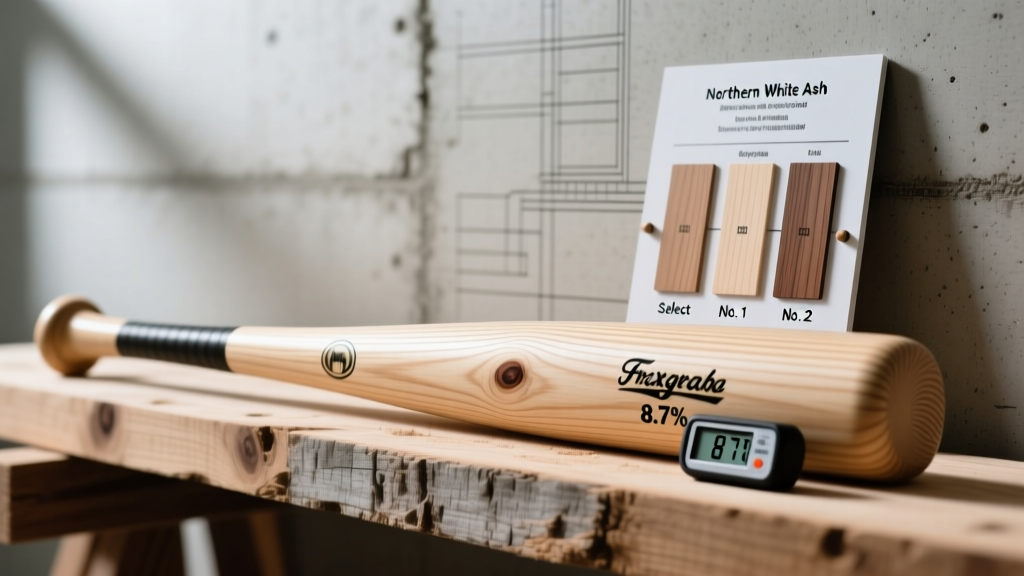
The Core Question: What Type of Wood Are Baseball Bats Made Out Of?
When asking what type of wood are baseball bats made out of, the answer extends far beyond simple species identification. While the vast majority of professional and amateur wooden bats are turned from three primary hardwoods—Sugar Maple, White Ash, and Yellow Birch—the true differentiator in bat performance, durability, and safety lies in the lumber grading and quality control metrics applied to the raw billets. A premium species with improper grain slope or incorrect moisture content will shatter dangerously upon contact with a 95-mph fastball. This guide examines the specific wood species used in bat manufacturing and the rigorous grading standards that separate commercial-grade timber from professional-grade bat billets.
The Big Three: Species Comparison & Mechanical Properties
Not all hardwoods possess the specific combination of density, flexural strength, and impact resistance required for baseball bats. According to data from the USDA Forest Products Laboratory Wood Handbook, the cellular structure of the wood dictates how it transfers energy and ultimately how it fails. Below is a mechanical comparison of the three dominant species.
| Wood Species | Janka Hardness (lbf) | Specific Gravity (Basic) | Grain Structure | Primary Failure Mode |
|---|---|---|---|---|
| Sugar Maple (Acer saccharum) | 1,450 | 0.56 | Diffuse-porous, closed | Brittle shatter, sharp shearing |
| White Ash (Fraxinus americana) | 1,320 | 0.55 | Ring-porous, open | Flaking, splintering, bending |
| Yellow Birch (Betula alleghaniensis) | 1,260 | 0.55 | Diffuse-porous, semi-closed | Denting, gradual soft-fracture |
Sugar Maple: The Modern Powerhouse
Sugar Maple is currently the most popular wood in Major League Baseball (MLB). Its diffuse-porous structure means the wood has a uniform density throughout the growth rings, resulting in a highly rigid surface that does not dent easily. This rigidity translates to maximum energy transfer to the baseball. However, because it lacks the open-pore flex of ash, maple is prone to catastrophic, brittle failure (shattering into sharp, dangerous shards) if the grain slope is compromised.
White Ash: The Traditional Standard
Detailed extensively by The Wood Database, White Ash is a ring-porous wood with distinct earlywood and latewood bands. This structure gives ash its signature 'trampoline effect' and flex. When an ash bat breaks, it typically flakes, splinters, or bends rather than exploding. Historically, ash was the undisputed king of baseball, but the Emerald Ash Borer infestation has severely restricted the supply of high-grade, old-growth ash timber, driving up costs and pushing players toward maple.
Yellow Birch: The Hybrid Compromise
Yellow Birch offers a middle ground. It features the closed-grain surface hardness of maple (resisting dents) but possesses a flex profile closer to ash. Birch requires a more complex drying and curing process to reach optimal hardness, and it is highly sensitive to moisture fluctuations during the turning process.
Lumber Grading Standards for Professional Bat Billets
The journey from a standing tree to a lathe-ready billet involves extreme culling. Less than 10% of a premium hardwood sawlog yields timber that meets professional bat-grade specifications. The grading process focuses on three critical structural metrics.
CRITICAL QUALITY CONTROL: The MLB Ink Dot Test
Following a spike in dangerous bat shattering in the late 2000s, MLB mandated the 'Ink Dot Test' for all maple and birch bats. A drop of ink is placed on the end grain of the raw billet. The ink bleeds along the wood's medullary rays (the grain direction). Using a protractor overlay, graders measure the angle of the ink bleed relative to the edge of the billet. If the grain slope deviates more than 3 degrees (a 1:20 ratio) from perfectly straight, the billet is immediately rejected for professional play. This ensures the bat possesses maximum shear strength along its longitudinal axis.
1. Grain Slope and Straightness
Bat-grade lumber must exhibit exceptional grain straightness. Any run-out (where the grain exits the side of the billet rather than running end-to-end) creates a weak point. Graders visually inspect the split faces of the billet. The wood must be 'split-out' rather than sawn; splitting the log along its natural grain lines ensures that the resulting billets maintain a continuous, unbroken grain structure from knob to barrel.
2. Moisture Content (MC) Precision
Moisture content dictates both the weight and the structural integrity of the finished bat. Bat billets are kiln-dried to a strict MC range of 6% to 10%.
- Below 6%: The wood becomes overly brittle, significantly increasing the risk of barrel shattering upon impact.
- Above 10%: The bat will be excessively heavy, sluggish to swing, and prone to warping or developing micro-fissures as it continues to dry in varying climates.
3. Density Sorting and Weight Distribution
Even within the same species, specific gravity varies based on the tree's growing conditions. Billets are sorted by weight to match player preferences. A player requesting a 33-inch, 30-ounce bat (a -3 drop weight) requires a lower-density billet, while a player wanting a heavier, denser barrel for maximum momentum transfer will be assigned a higher-density billet from the base of the tree.
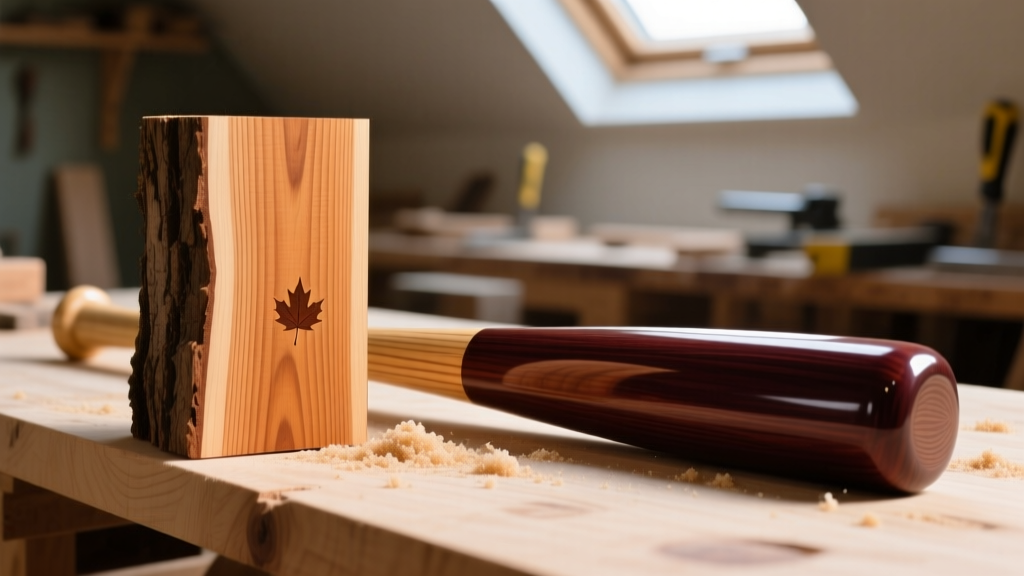
Manufacturing Defects & Failure Modes in Bat Wood
Understanding why bats fail is crucial for woodworkers and buyers evaluating lumber quality. The most common edge cases and failure modes include:
- Slope of Grain (SOG) Failure: If a lathe operator turns a bat slightly off-axis from the billet's natural grain, the resulting bat will have a compromised SOG. This is the leading cause of mid-barrel shearing.
- Case Hardening: If maple is kiln-dried too aggressively, the outside of the billet dries and shrinks faster than the core, creating internal tension. When the lathe cuts into the core, the wood can warp instantly or develop invisible internal checks (cracks).
- Mineral Streaks and Pith: Dark mineral streaks in maple or ash indicate localized density variations. While often visually striking, the pith (the very center of the tree) is structurally weak and must be entirely excluded from the bat's hitting zone.
Sourcing & Selecting Bat-Grade Lumber for Custom Turning
For custom bat makers or woodworkers looking to source raw material, standard lumber yard stock is insufficient. You must procure specialized 'bat billets' or 'turning squares' graded specifically for sporting goods.
- Dimensions: Standard professional billets are rough-turned or square-dimensioned to 3" x 3" x 37". This allows enough material for the lathe centers and the final tapering.
- End Grain Sealing: Ensure the supplier has sealed the end grain with anchor wax or paraffin. Unsealed end grain allows rapid moisture exchange, leading to end-checking (splitting) before the wood even reaches your shop.
- Acclimation: Upon receiving billets, store them in your turning environment (ideally 40-50% relative humidity) for a minimum of 14 days. This allows the outer layers of the wood to acclimate to your shop's specific climate, preventing post-turning warping.
Frequently Asked Questions
Are bamboo baseball bats considered solid wood?
No. Bamboo is technically a grass, not a wood. Bamboo bats are manufactured by laminating long strips of bamboo under high pressure with epoxy resins. While they possess immense tensile strength and are highly durable for batting cage practice, they are classified as composite bats and are strictly prohibited in MLB and most professional leagues.
Why isn't Hickory used for modern baseball bats?
Hickory (specifically Shagbark Hickory) has a Janka hardness exceeding 1,800 lbf, making it incredibly durable. However, its specific gravity is simply too high. A 34-inch hickory bat would weigh well over 40 ounces, making it impossible to generate the bat speed required to hit modern high-velocity pitches. It was used in the early 1900s when pitch speeds were lower, but is obsolete today.
What is 'bone rubbing' an ash bat?
Bone rubbing is a traditional finishing technique applied exclusively to open-grain woods like White Ash. A hardened piece of bone or porcelain is rubbed vigorously along the barrel of the bat. This crushes the large, open earlywood pores, compacting the surface fibers to increase surface hardness and prevent the wood from denting or flaking prematurely upon impact.
Written by
Marcus ChenMarcus Chen is a licensed structural engineer (PE) and building materials analyst with over 12 years of experience across residential, commercial, and industrial construction. He holds a Master of Science in Civil Engineering from UC Berkeley and spent six years at Thornton Tomasetti before transitioning to independent consulting and technical writing. Marcus specializes in material selection for seismic-prone regions, concrete reinforcement strategies, and lifecycle cost analysis. His work has been cited by the American Concrete Institute (ACI) and the Structural Engineers Association of California (SEAOC). When he is not on a job site or at his desk, you will find him hiking the Sierra Nevada or restoring a 1920s craftsman bungalow in Oakland, CA.
More from Marcus Chen
View all
Construction Cost
How Much Did the Eiffel Tower Cost to Build?
How much did the Eiffel Tower cost to build in 1889? We adjust for inflation and compare its budget to modern skyscraper construction.
Aug 4, 2026

Fire Resistance
What Is a Fire Resistant Material? Testing & Certification Guide
Discover what is a fire resistant material through ASTM and UL testing. Learn how fire ratings, certifications, and assemblies work in construction.
Aug 4, 2026

Construction Cost
How Much Did the Burj Khalifa Cost to Build?
How much did the Burj Khalifa cost to build? We break down the $1.5B project and extract 5 money-saving strategies for your next build.
Jul 30, 2026